What did late antique Egyptians sing about at Christmas? Shepherds, the star, and the Virgin Mary, of course.
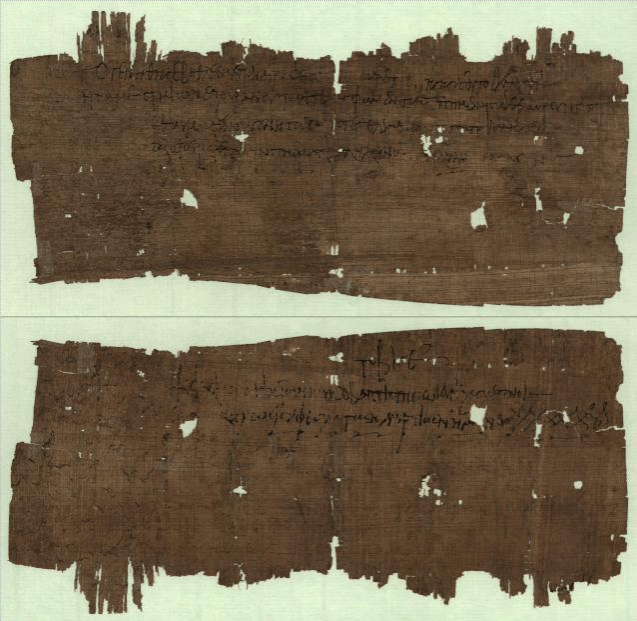
Shepherds worship the newborn Jesus on what appears to be the earliest manuscript of a Christmas carol, preserved in Greek on a papyrus from the area of Heracleopolis (near modern Beni Suef) in Middle Egypt, P.Vindob. G 2326. It was dated by Hans Förster to the fifth or first half of the sixth century. The papyrus was written in a practiced cursive hand used to writing documents, though not well trained in orthography. It seems to have been a ‘choir slip’, a single leaf containing hymns on both sides to aid the cantor in his singing. The back carries a hymn on John the Baptist for his feast on 5 Tybi (30 December according to the Julian calendar). This must have been a local celebration in his honour, as it is not otherwise attested in the Egyptian liturgical calendar.
The Christmas carol extols the mystery of incarnation and alludes to the events around it: it evokes key places in Jesus’ childhood, it describes the veneration of the shepherds and hints to that of the magi. In fact, through a paraphrase of Matt 2:2 (“we saw his star”), the singers take the place of the magi in joining the shepherds in worshipping the newborn king. The final glorification of the Trinity may have been the line for which the congregation joined the cantor in the chant.
Here is my translation of the text:
Who was born in Bethlehem, raised in Nazareth, and lived in Galilee, we saw (your) sign from heaven of the star shining forth, the shepherds keeping watch over their flocks were astonished, and falling on their knees they said: ‘Glory to the Father, alleluia, glory to the Son and the Holy Spirit, alleluia, alleluia, alleluia.’
P.Vindob. G 2326
But why do we have to wait until the fifth century to get the first Christmas carol on papyrus? After all, Christian hymns were recorded in Egypt already in the third century. One reason is that the earliest hymns do not make reference to the liturgical year. They are usually general praises of Jesus Christ and elaborate on salvation and baptism. Even more importantly, Christians in Egypt did not celebrate Christmas until the end of the fourth century. They had only Epiphany (that little noticed festival on 6 January about the Magi and the baptism of Jesus), and they accepted Christmas as a separate feast day of Jesus’ birth only in about the 380s.
Once introduced, however, Christmas became a favourite topic of hymn writers, just like in the West. P.Vindob. G 2326 is the first in a long series of Christmas carols preserved on papyrus. Many of them paraphrase the Nativity narrative of the Gospel of Luke and elaborate on shepherds and angels. A few turn to the Gospel of Matthew and cite the star and the Magi. The Virgin Mary takes the centre stage in many hymns. Her miraculous virgin birth and her being the Mother of God was a matter of theological importance, and liturgy in Egypt was eager to reaffirm it. There is, however, much less focus on baby Jesus. His birth is of course the central question, but it is only on a few occasions that his person enters the spot light and he is described as an infant wrapped in swaddling clothes, especially to emphasize the contrast between his divine glory and his self-humiliation as a human child in a manger. But altogether the late antique Christians in Egypt were little interested in images of a cute little baby Jesus. Their focus was on the theological complexities and the salvific value of the mystery of incarnation.
On the other hand, not everything is a Christmas carol that seems to be. P.Berol. 11842, which I have previously introduced on this blog (which you can read here) as the earliest manuscript of a Christmas carol, has since been revised by Lajos Berkes. By reading a few more words of the effaced writing and coping with the poor orthography, Lajos has shown that it is in fact a hymn on an unnamed martyr, another highly popular genre in early Egyptian hymnography. In fact, a more popular one: hymns on martyrs are both more numerous and appear earlier than hymns for Christmas, which tells something about the preferences of the late antique Egyptian church. But that will be the topic of another post.
Technical Details
Provenance: Heracleopolis, Egypt
Date: ca. 450-550 CE
Language: Greek
Collection: Papyrussammlung, Österreichische Nationalbibliothek, Vienna (G 2326 R)
Designation: P.Vindob. G 2326 [trismegistos.org : TM 64614 / LDAD 5844]
Bibliography: Hans Förster, “Das angeblich älteste liturgische Schriftstück. Neuedition von P. Vindob. G. 2326,” Zeitschrift für Antike und Christentum 1 (1997): 169–77; Lajos Berkes, “‘From Heaven Shone the Grace of the Martyrs.’ A Christian Hymn Reconsidered,” Archiv für Papyrusforschung 68 (2022): 358–65.
 Papyrus Stories
One thought on “Another Egyptian Christmas Carol”