By Jennifer Cromwell
As a child, my most palpable nightmare was of being chased by ghosts and skeletons through a labyrinthine house. In desperation, I became able to travel through walls, putting space between me and my hunters. Yet still they came for me. There was no escape. I’ve had this dream regularly throughout my life, although not so much anymore. Maybe the ghosts have given up on me.
Demons and the malevolent dead – what we may think of as ghosts – were believed in ancient Egypt to be the source of nightmares. Assaulting sleeping men and women at night, they filled their victims with fear and panic, and an intense dread that could paralyse. But, unlike my own inability to ward off my nightly assailants, ancient Egyptians had means to protect dreamers. An ostracon from the New Kingdom, today in the Ashmolean museum in Oxford, preserves a spell to do just this.
Oh male adversary, [female adversary …(?)] be far from [me(?) …], dead man, dead woman, without coming. He will not go forth with face forward, with limbs as [sound] limbs, for his heart is destined for the Evening Meal of the One in the Act of Striking. NN born of NN has [extracted] your hearts, oh dead ones. [He] has taken your hearts, oh dead men and dead women. To the Striker he has offered them [for] his sustenance (of) his limbs. As for you, you will not live! Your limbs are [his(?)] offering cakes. You will not escape from the [four Noble Ladies(?)] from the fortress of Horus who is in Shenit.
RECITE over 4 Uraei made of pure clay with flames in their mouths. One is placed in [each] corner [of every room(?)] in which there is a man or a woman [. . .] sleeping with a man [or woman(?)].1
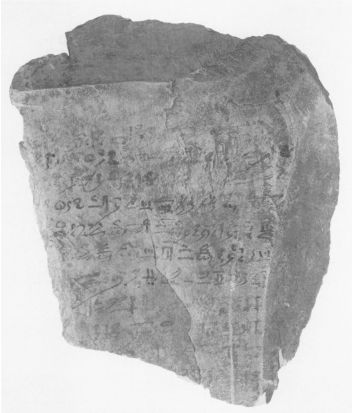
The assailant, whether demon or ghost, is rendered unable to torment the living – its body will be contorted, with its head facing backwards, unable to see and so unsuccessful in its attack. And after its failure it ultimately will be dismembered, its heart removed by the dreamer (NN son of NN) and fed to the One in the Act of Striking – the Striker, the rearing cobra. It will be powerless for eternity, its heart imprisoned, inert, within the fortress of Horus in Shenit, watched over – mostly likely – by the four Noble Ladies, four protective snakes. The spell itself was to be recited over images of cobras – the four flaming uraei, perhaps the Striker herself in multiple forms, or the Noble Ladies – that are then placed in each corner of the sleeper’s room.
Cobra venom burns like fire as it courses through the blood of its victim, or as it is sprayed into their eyes. More than fire, the venom burned like the sun itself, like the eyes of the sun god Ra. It was so powerful that cobras protected the ruler of Egypt, resting upon his brow as part of the royal crown. With four such fiery serpents guarding a room’s perimeter, the sleeper within was safe to dream good dreams. As long as they remembered to recite the spell.

- From Ritner 1990, 26 and Szpakowska 2010, 32. ↩︎
Technical Details
Provenance: perhaps Deir el-Medina.
Date: New Kingdom, perhaps Ramesside.
Language: Middle Egyptian.
Collection: Ashmolean Museum, Oxford; H.O. Ashmolean 363.
Designation: O.Gardiner 363.
Bibliography: Robert K. Ritner (1990), “O. Gardiner 363: A Spell Against Night Terrors”, Journal of the American Research Center in Egypt 27: 25–41; Kasia Szpakowska (2010), “Nightmares in Ancient Egypt”, in Le Cauchemar dans les sociétés antiques: Actes des journées d’étude de l’UMR 7044 (15–16 Novembre 2007, Strasbourg), edited by Jean-Marie Husser and Alice Mouton (Paris: De Boccard), pp. 21–39 [here pp. 32–33].
 Papyrus Stories