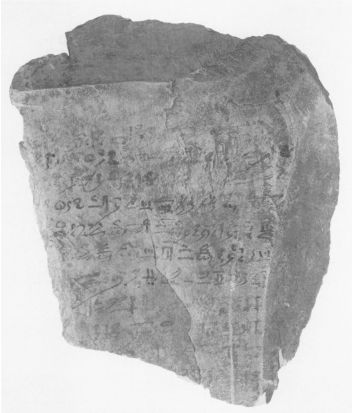
As a child, my most palpable nightmare was of being chased by ghosts and skeletons through a labyrinthine house. In desperation, I became able to travel through walls, putting space between me and my hunters. Yet still they came for me. There was no escape. I’ve had this dream regularly throughout my life, although not so much anymore. Maybe the ghosts have given up on me. Demons and the malevolent dead – what we may think of as ghosts – were believed in ancient Egypt to be the source of nightmares. Assaulting sleeping men and women at night, they filled their victims with fear and panic, and an intense dread that could paralyse. But, unlike my own inability to ward off my nightly assailants, ancient Egyptians had means to protect dreamers. An ostracon from the New Kingdom, today in the Ashmolean museum in Oxford, preserves a spell to do just this.
Oh male adversary, [female adversary …(?)] be far from [me(?) …], dead man, dead woman, without coming. He will not go forth with face forward, with limbs as [sound] limbs, for his heart is destined for the Evening Meal of the One in the Act of Striking. NN born of NN has [extracted] your hearts, oh dead ones. [He] has taken your hearts, oh dead men and dead women. To the Striker he has offered them [for] his sustenance (of) his limbs. As for you, you will not live! Your limbs are [his(?)] offering cakes. You will not escape from the [four Noble Ladies(?)] from the fortress of Horus who is in Shenit. RECITE over 4 Uraei made of pure clay with flames in their mouths. One is placed in [each] corner [of every room(?)] in which there is a man or a woman [. . .] sleeping with a man [or woman(?)].1
O.Gardiner 363 (from Ritner 1990, 28)
The assailant, whether demon or ghost, is rendered unable to torment the living – its body will be contorted, with its head facing backwards, unable to see and so unsuccessful in its attack. And after its failure it ultimately will be dismembered, its heart removed by the dreamer (NN son of NN) and fed to the One in the Act of Striking – the Striker, the rearing cobra. It will be powerless for eternity, its heart imprisoned, inert, within the fortress of Horus in Shenit, watched over – mostly likely – by the four Noble Ladies, four protective snakes. The spell itself was to be recited over images of cobras – the four flaming uraei, perhaps the Striker herself in multiple forms, or the Noble Ladies – that are then placed in each corner of the sleeper’s room. Cobra venom burns like fire as it courses through the blood of its victim, or as it is sprayed into their eyes. More than fire, the venom burned like the sun itself, like the eyes of the sun god Ra. It was so powerful that cobras protected the ruler of Egypt, resting upon his brow as part of the royal crown. With four such fiery serpents guarding a room’s perimeter, the sleeper within was safe to dream good dreams. As long as they remembered to recite the spell.
Clay Serpent. British Museum EA55594. On such clay figures as ‘demonic paraphernalia’, see Kasia Szpakowska (2013), “Striking Cobra Spitting Fire”, Archiv für Religionsgeschichte 14/1: 27–46.
Technical Details Provenance: perhaps Deir el-Medina. Date: New Kingdom, perhaps Ramesside. Language: Middle Egyptian. Collection: Ashmolean Museum, Oxford; H.O. Ashmolean 363. Designation: O.Gardiner 363. Bibliography: Robert K. Ritner (1990), “O. Gardiner 363: A Spell Against Night Terrors”, Journal of the American Research Center in Egypt 27: 25–41; Kasia Szpakowska (2010), “Nightmares in Ancient Egypt”, in Le Cauchemar dans les sociétés antiques: Actes des journées d’étude de l’UMR 7044 (15–16 Novembre 2007, Strasbourg), edited by Jean-Marie Husser and Alice Mouton (Paris: De Boccard), pp. 21–39 [here pp. 32–33].
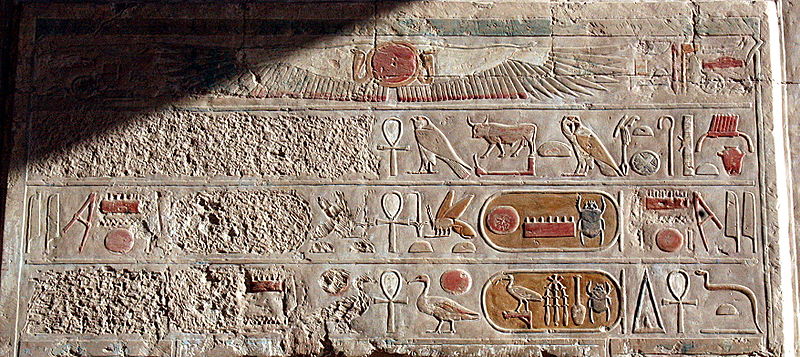
The pharaohs of the Egyptian New Kingdom made a habit of rewriting history. Through a process defined as ‘usurpation’, rulers routinely altered, often by adding their own titulary, or destroyed their predecessors’ monuments, reliefs and statues. Where we see evidence of destruction, the aim is clear: to erase aspects of the past, or at least present them in a negative light. The reigns of ‘illegitimate’ rulers were often wiped from the historical record in order to help the incumbent pharaoh secure their own position. This process has become known as damnatio memoriae, meaning ‘the condemnation of memory’.
Titulary originally belonging to Hatshepsut (left) erased by her nephew and co-ruler, Thuthmosis III (right), from Hatshepsut’s mortuary temple, Deir el-Bahri (image by Hedwig Storch, 2009, Wikimedia)
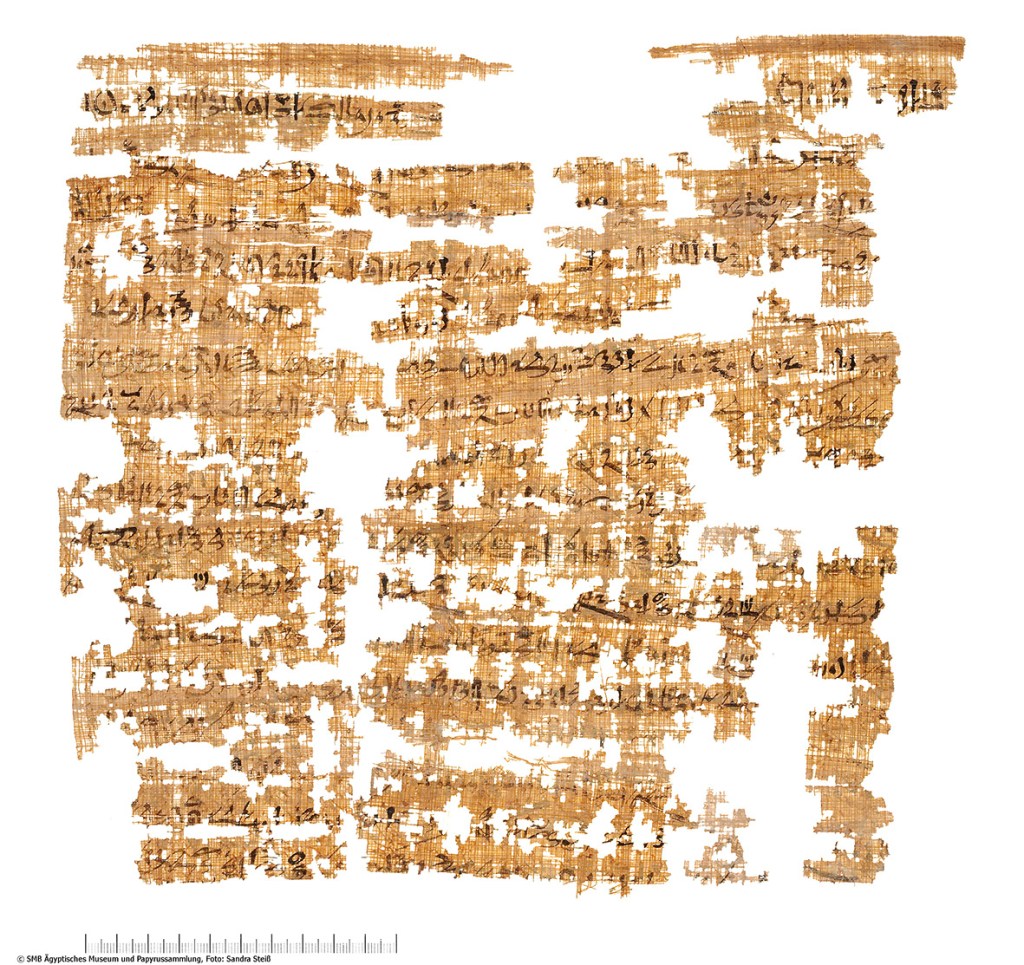
We have plenty of evidence for damnatio memoriae being conducted at the highest echelon of Egyptian society by the pharaoh, in the form of defaced statues, temples and inscriptions. The above image, from Hatshepsut’s mortuary temple at Deir el-Bahari, is but one example of the name and titulary of an earlier ruler being hacked away, and the kind of highly localised damage seen here is one of the telltale signs of a usurped monument. In other examples, we see old cartouches flattened out and replaced with the name of another king, and statues sometimes altered to resemble a different king. Through this process, New Kingdom pharaohs could keep tight control over the historical narrative, which helped them both legitimise their own reigns and ensure that the title of pharaoh itself remained strong and stable. However, these are obviously very large-scale, visible displays, and as Polly Low argues, the aim of these very noticeable acts of erasure may not so much have been to completely obliterate the memory of an individual, but to vilify them, and make the viewer consider why that individual needed to be subject to such an act. However, there is one object, currently in the Staatliche Museen zu Berlin, which could offer another interpretation. Measuring around thirty square centimetres, it is a letter, written in hieratic, the standard Egyptian script at the time. The letter was addressed to the ‘Prince’ or ‘Mayor’ of Thebes, named Paser, at some point during the reign of Ramesses II (1279 – 1213 B.C.E). Unfortunately, the papyrus is in quite a sorry state, yet what can still be read from these few fragmentary remains is highly valuable. Lines 6 and 7 particularly stand out, reading:
Further, as to what you write to me asking that the day of […]’s death should be sent to you, when one (i.e. Pharaoh?) arrived in Memphis, [the … came to me] to say that he died in year nine of the Rebel. (ÄM P.3040; trans. by Gardiner 1938)
Letter to the Mayor of Thebes, Paser (Staatliche Museen zu Berlin, P.3040)
This part of the letter responds to what must have been an earlier request from Paser for the date of an individual’s death. In a case like this, where the mention of a specific year was needed, people would normally refer to the regnal year of the pharaoh on the throne at that time. However, in this letter, a ruler’s name is not given, and instead the writer refers to a ‘rebel’ king. In another case, also from during the reign of Ramesses II but inscribed at Mehu’s tomb in Saqqara, a court record refers in a similar way to ‘that damned one of Akhetaten’. This is an example of ‘nonmention’, where, as the term implies, an individual was simply omitted from any future records. In the case of P.3040 the allusion is very vague, but it had enough similarities to the inscription at Saqqara for Alan Gardiner (1905) to conclude that both referred to the so-called ‘heretic king’, Akhenaten. Ironically, Akhenaten’s reign is well known today. Assuming the throne as Amenhotep IV, he changed his name four years later to reflect the drastic changes to Egypt’s religion he planned to enact. In the place of the existing polytheistic system, the pharaoh promoted the sole worship of the Aten, portrayed as a life-giving sun disc, and as part of this program he usurped many temples and monuments, erasing the names and images of other gods, mainly Amun and Mut. We have little evidence that might shed light on Akhenaten’s motivations, but, whatever the reason, we know his changes were unpopular. After his death in 1336 B.C.E, just as he himself had defaced imagery of the old deities, his monuments were destroyed, including his new capital city, Akhetaten, which lay at the modern-day site of Amarna. The years of his reigns, and those of his immediate successors (including, most famously, Tutankhamun) were later attributed to the pharaoh Horemheb, in king lists such as that in the temple of Seti I at Abydos. In doing so, the heretic was expunged from history.
The Abydos king list, inscribed during the reign of Seti I, which omits Akhenaten and his family, jumping straight from Amenhotep III to Horemheb; Temple of Seti I, Abydos (image by Hic et nunc, 2012, Wikimedia)
This is a rare example of damnatio memoriae filtering down throughout wider Egyptian society. But this papyrus is intriguing for more reasons. The fact that the mere mention of Akhenaten became something of a taboo shows that the aim of the damnatio memoriae against him was likely to erase his very existence from the historical record, and to ascribe the chaotic Amarna period to the work of a nameless, illegitimate rebel, rather than that of a king. Clearly this period was so deeply unpopular, and such a stain on the institution of pharaoh, that it was necessary for later rulers to take this step. Yet, despite his successors’ best efforts, as this allusion to him proves, it was clear that Akhenaten was never fully forgotten. It is also not clear whether it was the king or the people themselves who mandated this nonmention. One thing that is plain is that there is still a lot more that needs to be understood about the process of damnatio memoriae in ancient Egypt.
Technical Details Provenance: West Thebes, Egypt Date: New Kingdom, 19th Dynasty, Reign of Ramesses II (1279 – 1213 B.C.E) Language: Late Egyptian (Hieratic script) Collection: Staatliche Museen zu Berlin, Egyptian Museum and Papyrus Collection (P.3040) Designation: ÄM P.3040 Bibliography: Alan H.Gardiner, ‘A Later Allusion to Akhenaten,’ The Journal of Egyptian Archaeology, 24 (1938) p. 124; Donald B. Redford, Akhenaten: The Heretic King (Princeton: Princeton University Press, 1984) pp. 227-31. Additional Bibliography: Peter Brand, ‘Usurpation of Monuments’, in UCLA Encyclopaedia of Egyptology, ed. Willeke Wendrich (Los Angeles, 2010) [online]; Polly Low, ‘Remembering, forgetting, and rewriting the past: Athenian inscriptions and collective memory,’ Histos, Supplements 11 (2020), pp. 235-68 (p. 245); ; Alice McClymont, ‘Historiography and methodology in the study of Amarna Period erasures’ in The Cultural Manifestations of Religious Experience: Studies in Honour of Boyo G. Ockinga ed. Camilla di Biase-Dyson and Leonie Donvovan (Munster: Ugarit-Verlag, 2017) pp. 31-42; Alan H. Gardiner, The Inscription of Mes: A Contribution to the Study of Egyptian Judicial Procedure (Leipzig: J.C. Hinrichs, 1905) p. 11.
What did late antique Egyptians sing about at Christmas? Shepherds, the star, and the Virgin Mary, of course.
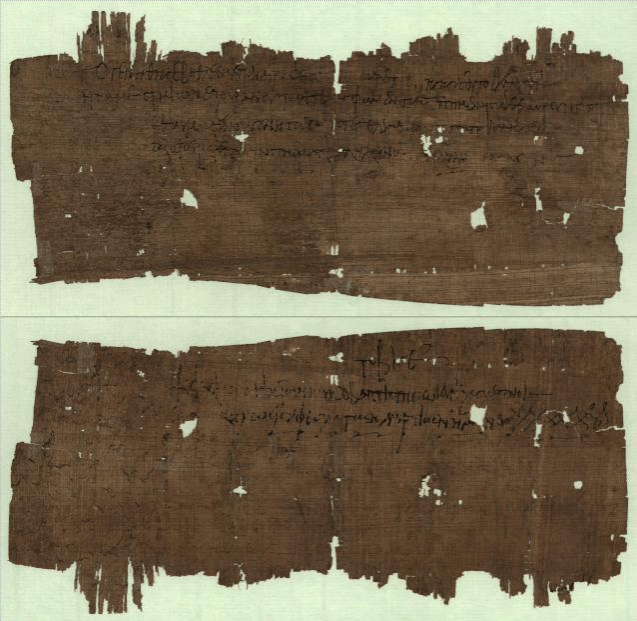
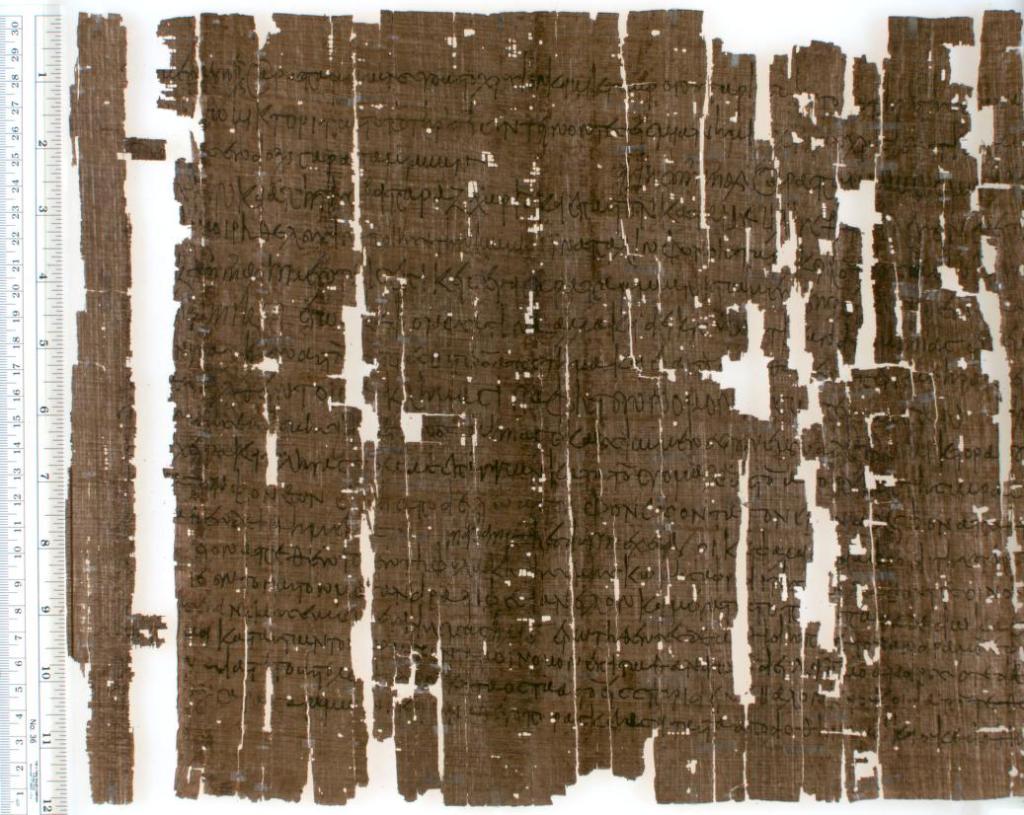
Shepherds worship the newborn Jesus on what appears to be the earliest manuscript of a Christmas carol, preserved in Greek on a papyrus from the area of Heracleopolis (near modern Beni Suef) in Middle Egypt, P.Vindob. G 2326. It was dated by Hans Förster to the fifth or first half of the sixth century. The papyrus was written in a practiced cursive hand used to writing documents, though not well trained in orthography. It seems to have been a ‘choir slip’, a single leaf containing hymns on both sides to aid the cantor in his singing. The back carries a hymn on John the Baptist for his feast on 5 Tybi (30 December according to the Julian calendar). This must have been a local celebration in his honour, as it is not otherwise attested in the Egyptian liturgical calendar. The Christmas carol extols the mystery of incarnation and alludes to the events around it: it evokes key places in Jesus’ childhood, it describes the veneration of the shepherds and hints to that of the magi. In fact, through a paraphrase of Matt 2:2 (“we saw his star”), the singers take the place of the magi in joining the shepherds in worshipping the newborn king. The final glorification of the Trinity may have been the line for which the congregation joined the cantor in the chant.
Here is my translation of the text:
Who was born in Bethlehem, raised in Nazareth, and lived in Galilee, we saw (your) sign from heaven of the star shining forth, the shepherds keeping watch over their flocks were astonished, and falling on their knees they said: ‘Glory to the Father, alleluia, glory to the Son and the Holy Spirit, alleluia, alleluia, alleluia.’
P.Vindob. G 2326
But why do we have to wait until the fifth century to get the first Christmas carol on papyrus? After all, Christian hymns were recorded in Egypt already in the third century. One reason is that the earliest hymns do not make reference to the liturgical year. They are usually general praises of Jesus Christ and elaborate on salvation and baptism. Even more importantly, Christians in Egypt did not celebrate Christmas until the end of the fourth century. They had only Epiphany (that little noticed festival on 6 January about the Magi and the baptism of Jesus), and they accepted Christmas as a separate feast day of Jesus’ birth only in about the 380s. Once introduced, however, Christmas became a favourite topic of hymn writers, just like in the West. P.Vindob. G 2326 is the first in a long series of Christmas carols preserved on papyrus. Many of them paraphrase the Nativity narrative of the Gospel of Luke and elaborate on shepherds and angels. A few turn to the Gospel of Matthew and cite the star and the Magi. The Virgin Mary takes the centre stage in many hymns. Her miraculous virgin birth and her being the Mother of God was a matter of theological importance, and liturgy in Egypt was eager to reaffirm it. There is, however, much less focus on baby Jesus. His birth is of course the central question, but it is only on a few occasions that his person enters the spot light and he is described as an infant wrapped in swaddling clothes, especially to emphasize the contrast between his divine glory and his self-humiliation as a human child in a manger. But altogether the late antique Christians in Egypt were little interested in images of a cute little baby Jesus. Their focus was on the theological complexities and the salvific value of the mystery of incarnation.
On the other hand, not everything is a Christmas carol that seems to be. P.Berol. 11842, which I have previously introduced on this blog (which you can read here) as the earliest manuscript of a Christmas carol, has since been revised by Lajos Berkes. By reading a few more words of the effaced writing and coping with the poor orthography, Lajos has shown that it is in fact a hymn on an unnamed martyr, another highly popular genre in early Egyptian hymnography. In fact, a more popular one: hymns on martyrs are both more numerous and appear earlier than hymns for Christmas, which tells something about the preferences of the late antique Egyptian church. But that will be the topic of another post.
Technical Details Provenance: Heracleopolis, Egypt Date: ca. 450-550 CE Language: Greek Collection: Papyrussammlung, Österreichische Nationalbibliothek, Vienna (G 2326 R) Designation: P.Vindob. G 2326 [trismegistos.org : TM 64614 / LDAD 5844] Bibliography: Hans Förster, “Das angeblich älteste liturgische Schriftstück. Neuedition von P. Vindob. G. 2326,” Zeitschrift für Antike und Christentum 1 (1997): 169–77; Lajos Berkes, “‘From Heaven Shone the Grace of the Martyrs.’ A Christian Hymn Reconsidered,” Archiv für Papyrusforschung 68 (2022): 358–65.
“I did not murder anyone, and I also prove it.” So states the soldier Flavius Menas in a report of legal proceedings dated 558/9 CE from Aphrodito (modern Kom Ishgau). He stands accused of murdering two men: Victor and Herakleios.
The report records the testimony against Menas by people representing each of the deceased. A man, whose name is lost, declares:
Menas forced my brother Victor, a priest, outside and murdered him. He threw a piece of machine wood at his left arm and beat his stomach from the fifth hour until the evening of the same day.
Herakleios’ wife, Maria, then testifies about the murder of her husband, recounting how he was brutally killed by a group of men at the command of both Menas and an official called Sarapammon.
The headmen of my village Aphrodito, together with others who are in its service, arrested my husband Herakleios and put him in the watch-house of my village Aphrodite. After having taken wine to the same watch-house, they drunk with him, and when the evening came they beat my same husband Herakleios and killed him with their swords and then they gave his remains to the fire. … Being asked why they murdered my husband, they said: ‘The most illustrious Sarapammon and Menas wrote us to kill him’ … When Herakleios, my wretched husband, had been killed and his remains had been given to the fire so that they may be burned, they poured again water on the same remains and they threw his bones in a basket and buried them I do not know where. I ask, therefore, that they are given to me so that I can bury them.
Menas, in his defence, has brief responses. Concerning Victor, a man who died from a repeated beating, Menas claims that he’d felt nauseous and died from a throat abscess, while he himself was away in Antaiopolis (Qaw el-Kebir). And when Herakleios was killed, he simply claims to have been elsewhere, although an alibi seems to be lacking.
The same priest, feeling nauseous, stayed in the church – and I in Antaio – and an abscess came out of the priest’s throat and he died from it. About Herakleios, I was not there and I do not know (about him).
And so who are we to believe? The events and parties recorded in the document are often difficult to piece together, in part because of damage to the papyrus (especially in the second half) and also because of the difficulty in identifying the array of men named as bit-players in this episode. We read about sums of money changing hands, as well as of a conspiracy in Aphrodito over control of the village (for such goings on in Aphrodito, Giovanni Ruffini’s 2018 book is an excellent place to start). One thing that is clear is that Herakleios had been sat drinking with his murderers before they killed him. They knew him, and he them. So why did they do it? Giovanni Ruffini, in Social Networks in Byzantine Egypt, has proposed a way to understand this case. He suggests that Herakleios was also an official, to be identified with a village guild head (Greek kephalaiotai) of the same name, and that other guild heads named in the document were therefore killing one of their own. In P.Mich. XIII 661, connected to the same legal proceedings, Herakleios is called an informer. Is it possible that his words, his betrayal of his fellow guild heads, caught the attention of Sarapammon – who Maria also names in her testimony, alongside Menas – who arranged his murder? As Ruffini stresses, we cannot be certain about who exactly was involved and their motivations, but the scenario is not impossible considering the complex social interactions and machinations at work in village society.
Technical Details Provenance: Aphrodito (Kom Ishgau), Egypt Date: 558/559 CE Language: Greek Collection: University of Michigan Papyrus Collection, Ann Arbor (P.Mich.inv. 6900 + 6901); Barcelona, Palau-Ribes Collection (P.Palau Ribes inv. 70) Designation: P.Mich. XIII 660 + SB XVI 12542 Online resources: Trismegistos (TM 36006); papyri.info (DDbDP); University of Michigan (APIS) Bibliography: Leslie MacCoull (1990), “The Aphrodito Murder Mystery,” Journal of Juristic Papyrology 20, pp. 103–7; Traianos Gagos (1992), “The Aphrodito Murder Case (“P.Mich.” XIII 660 and 661) and the Ghost-epithet κακοσιωμένος,” Zeitschrift für Papyrologie und Epigraphik 93, p. 222; James G. Keenan (1995), “The Aphrodito Murder Myster: A Return to the Scene of the Crimes,” Bulletin of the American Society of Papyrologists 32, pp. 57–63; Giovanni R. Ruffini (2008), Social Networks in Byzantine Egypt (Cambridge: CUP), pp. 180–3 [with further references that discuss specific details in the texts]; Giovanni R. Ruffini (2018), Life in an Egyptian Village in Late Antiquity: Aphrodito Before and After the Islamic Conquest (Cambridge: CUP).
Picture the scene: from across the way, a young man spots a young woman who takes his breath away. She is exquisite, with dazzling eyes and sweet lips. Every part of her body is the epitome of feminine beauty. She is beyond compare. But his love is only from afar.
A papyrus today in the Chester Beatty Library in Dublin bears several works of Egyptian literature from the New Kingdom. Alongside the Contendings of Horus and Seth, a text in praise of Rameses V, and several short business documents sit three groups of love songs. It is in one of these poems that we meet the smitten youth. He is not alone, though, in his longing. The girl has spotted him, too. And yet neither learn of the other’s feelings. As she bemoans: “He knows nothing of my desire to embrace him!” Across seven stanzas, the poem’s audience learns of the yearnings of each, of their heartsickness at their unrequited love. Only the audience, though, knows the truth about these star-crossed young lovers and their shared infatuation. The thoughts of the young man and woman are presented in alternating stanzas; each takes it in turn to express their feelings, first the boy and then the girl. While the poem starts with the description of the girl’s beauty, with the boy extolling the virtues of her all parts of her body, we don’t have the same description of him. Instead, the rest of the poem is one of the pain of unrequited love. Of love as a sickness that invades the body and cannot be cured by doctor or magician. Of a heart that flutters and makes you crazy. The only cure is the other person, but this is the one cure that can never be attained.
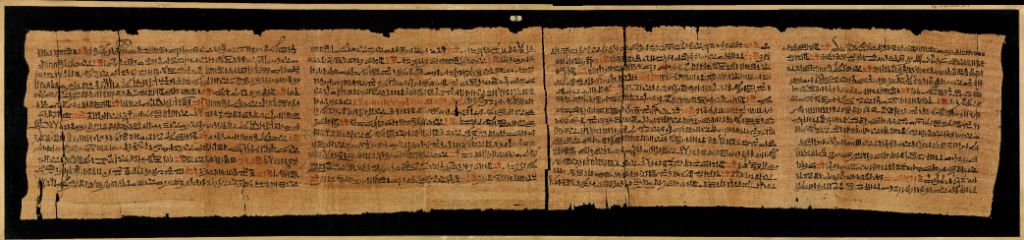
Papyrus Beatty I; section containing the start of the love song. (c) Chester Beatty Library.
Fourth stanza (by the girl)
My heart flutters hastily, When I think of my love of you; It lets me not act sensibly, It leaps from its place. It lets me not put a dress, No wrap my scarf around me; I put no paint upon my eyes, I’m even not anointed. “Don’t wait, go there,” says it to me, As often as I think of him; My heart, don’t act so stupidly, Why do you play the fool? Sit still, the brother comes to me: “A woman fallen through love!” Be steady when you think of him, My heart, do not flutter!
Seventh stanza (by the boy)
Seven days since I saw my sister, And sickness invaded me; I am heavy in all my limbs, My body has forsaken me. When the physicians come to me, My heart rejects their remedies; The magicians are quite helpless, My sickness is not discerned. To tell me ‘She is here’ would revive me! Her name would make me rise; Her messenger’s coming and going, That would revive my heart! My sister is better than all prescriptions, She does more for me than all medicines; Her coming to me is my amulet, The sight of her makes me well! When she opens her eyes my body is young, Her speaking makes me strong; Embracing her expels my malady— Seven days since she went from me!
Translation from Lichtheim (1976)
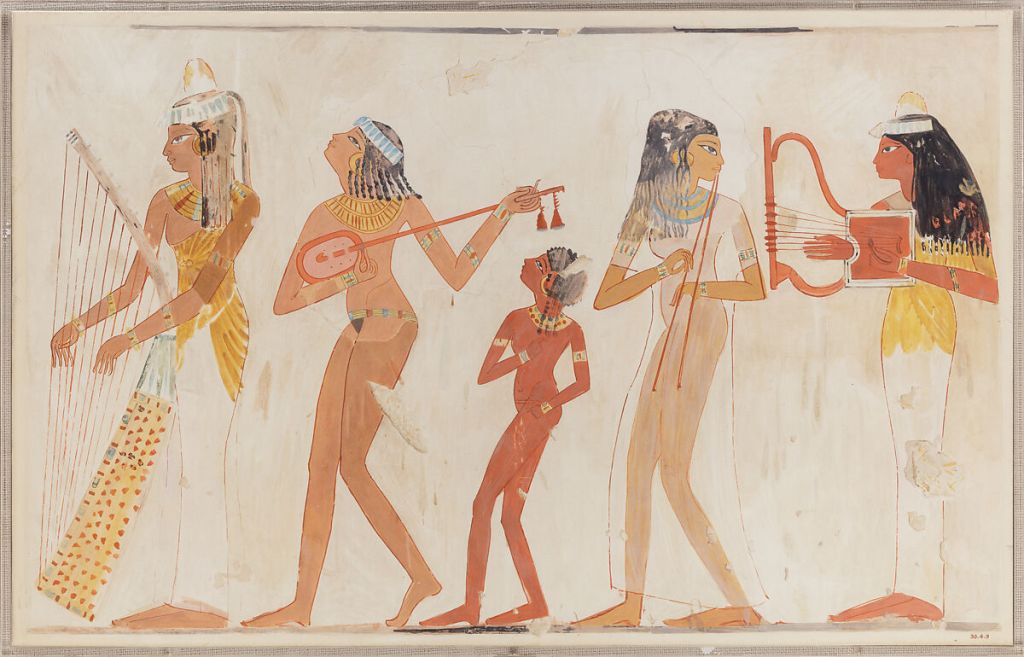
As with Egyptian literature in general, the author – or authors – of the poem is unknown. The 20th dynasty scribe of the Chester Beatty papyrus was seemingly interested in such love songs, collecting several of them together, but the diverse texts on this papyrus means that it can’t be understood as an anthology of love songs. The title of this poem is ‘The Great Entertainment’, where ‘entertainment’ is literally ‘distraction of the heart’; the text is meant to be performed. And so who would perform the poem and where? Again, specifics are unclear, but it is not far-fetched to imagine it at either a private affair – at banquets or court festivities – or a religious festival, perhaps connected with Hathor, the goddess associated with love, music, dancing, and fertility. Tomb scenes from the New Kingdom show images of women playing musical instruments and dancing, such as that of Nebamun and Djeserkareseneb. In the latter, four women play the harp, lute, lyre, and double reed flute, while a young girl dances between them. The accompanying inscription reveals that this is part of a larger banquet. Such an ensemble could well have accompanied the poem’s reciters, or perhaps the women sang the poem as they played – as one poem among many showing the different facets of love. With their lack of identity, the two young lovers of the poem could be anybody – any performer could embody these roles.
Female Musicians in the tomb of Djeserkareseneb (TT38). Watercolour facsimile by Charles K. Wilkinson. MMA 30.4.9. (c) Metropolitan Museum of Art.
Technical Details Provenance: Western Thebes, southern Egypt. Date: New Kingdom, ca. 1160 BCE. Language: Egyptian (Late Egyptian; written in hieratic) Collection: Chester Beatty Library, Dublin (Papyrus 1; verso). Designation: Papyrus Chester Beatty I Bibliography: Alan H. Gardiner, The Library of A. Chester Beatty. Description of a Hieratic Papyrus with A Mythological Story, Love-Songs, and Other Miscellaneous Texts. The Chester Beatty Papyri, No. I (Oxford University Press, 1931), pp. 27–38 and pls 16–17, 22–26, and 29–30 [available here]; Miriam Lichtheim, Ancient Egyptian Literature II: The New Kingdom (University of California Press, 1976), pp. 182–6 [translation]; Michael V. Fox, The Song of Songs and the Ancient Egyptian Love Songs (Wisconsin, 1985), pp. 51–64 [translation and commentary]; Vincent A. Tobin in William Kelly Simpson (ed.), The Literature of Ancient Egypt: An Anthology of Stories, Instructions, and Poetry (Yale University Press, 2003), pp. 322–7 [translation]; Bernard Mathieu, La poesie amoureuse de l’Egypte ancienne (Ifao, 1996).
Other bibliography: Renata Landgráfová and Hana Navrátilová, Sex and the Golden Goddess: I. Ancient Egyptian Love Songs in Context (Czech Institute of Egyptology, 2009). Renata Landgráfová and Hana Navrátilová, Sex and the Golden Goddess: II. The World of the Ancient Egyptian Love Songs (Czech Institute of Egyptology, 2015).
There are some problems in human life that are timeless. One of them is sleep deprivation caused by a teething baby. I have had my fair share of it recently, and on one sleepless night when just nothing seemed to work, desperate I remembered a fourth-century Coptic recipe to aid a baby’s teething. This is how it goes:
“For a small child, to make its teeth grow without it feeling pain: put foam of wax on its swellings.”
Translation from Love and Zellmann-Rohrer (2021, 87; §7)
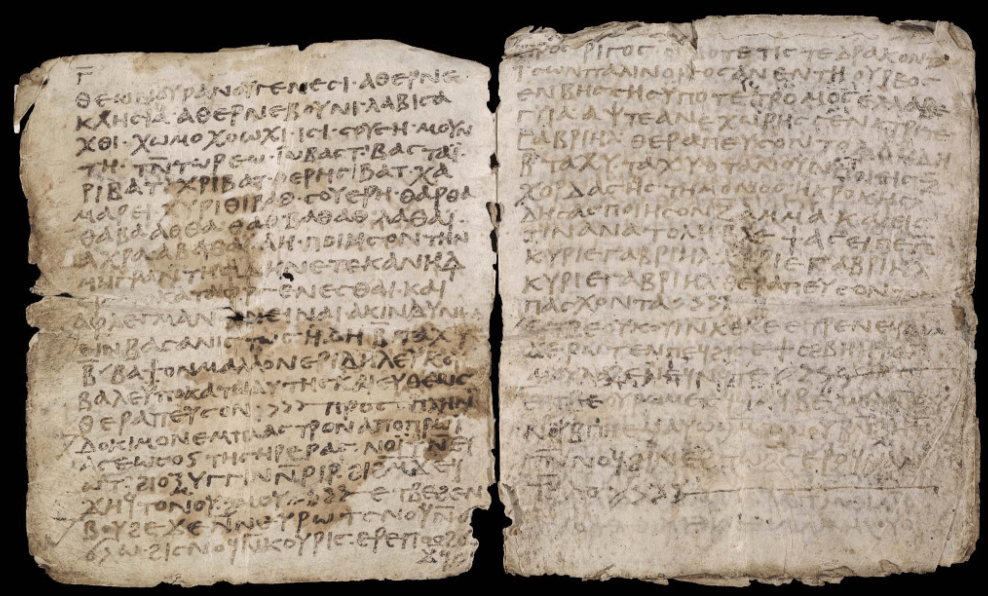
The recipe is contained in a small parchment leaflet inscribed with Greek and Coptic recipes for various, chiefly health-related problems. Inside, purely pharmacological recipes are mixed with incantations and charms, which exemplifies how the distinction between ‘medical’ and ‘magical’ healing was vague, and for practical purposes non-existent, in this period. The small codex belonged to a healing professional in the Fayum, who likely tailored it for his own needs, copying the text from various sources, Greek and Coptic alike. Some of these sources went back to ancient Egyptian incantations and pharmacological lore, others to Greek magical and medical traditions. He passed on his collection to two later owners, who added further recipes in Coptic. The problems they encountered in their practice included some common ailments such as fever, stomach- and headache, earache, sciatica, and constipation, but there are some less familiar problems as well, such as extensive eye-lash growth (§5) or demonic possession (§18). Their collection also included some non-medical recipes: two charms for favour (§12) and supernatural assistance (§15) as well as recipes against pests in the house (§19 and 29).
Pages from the Book of Ritual Spells, University of Michigan Special Collections (Ms. 136)
As for the baby toothing aid, I did not try it. I ended up giving another dose of painkiller instead. But that recipe is certainly more inviting than the following one from the same collection for “a small child that is crying”:
“smear its head with bull’s marrow, or bull’s brain.”
Translation from Love and Zellmann-Rohrer (2021, 105; §28)
Medicine made of marrow and brain of animals was known in antiquity, especially in its capacity as painkillers. But whether such a medicine succeeded in soothing a crying baby, I am not sure.
Technical Details Provenance: Fayum Date: 4th century? Language: Coptic (Fayumic) and Greek Collection: Ann Arbor, University of Michigan Library Designation: Special Collections Ms 136 Bibliography (edition and translation): Michael W. Zellmann-Rohrer and Edward O. D. Love, Traditions in Transmission: The Medical and Magical Texts of a Fourth-century Greek and Coptic Codex (Michigan Ms. 136) in context (Berlin: De Gruyter, 2021). For further bibliography, see the Coptic Magical Papyri Database.
On 11 May 218 BCE, a Greek man living in the Fayum was walking through the streets of the village Psya. Suddenly, from above a shower of human effluence poured down upon him, drenching him to the bone. The culprit? An Egyptian woman. But was it an accident or a malicious act by a local against a foreign interloper? Our evidence for the altercation comes from the petition that Herakleides, the Greek man in question, wrote to King Ptolemy (Ptolemy II Philadelphus). We see the situation from his perspective, as the victim in a clear act of aggression by the woman, Psenobastis (note that Psenobastis is presumably a mishearing of the name by Herakleides, as it is a male name). The petition records his account, for which he is seeking justice at trial:
On Phamenoth 21 of year 5 in the fiscal calendar, I went to Pysa in the said nome on a personal matter. As I was passing by [her house] an Egyptian woman, whose name is said to be Psenobastis, leaned out [of a window] and emptied a chamber pot of urine over my clothes, so that I was completely drenched. When I angrily reproached her, she hurled abuse at me. When I responded in kind, Psenobastis in her own right hand pulled the fold of my cloak in which I was wrapped, tore it, and ripped it off me, so that my chest was laid quite bare. She also spat in my face, in the presence of several people whom I called to witness. The acts that I charge her with committing are: resorting to violence against me and being the one to start [the fracas] by laying her hands on me unlawfully. When some of the bystanders reproached her for what she had done, she simply left me and went back into the house from which she had poured the urine down on me. I therefore beg you, O king, if it please you, not to ignore my being thus, for no reason, manhandled by an Egyptian woman, whereas I am a Greek and a visitor …
P.Enteux. 79; translation adapted from Lewis (1986, 60–61)
For Herakleides, who was merely going about his daily business, the event was sudden, shocking, and deeply unpleasant. It is likely that the whole thing started as a simple accident. Psenobastis was simply doing what she always did, throwing the contents of a chamber pot out the window. While Egypt had toilets for many centuries by this time, they weren’t a feature of typical houses. Instead, chamber pots would be used, which needed to be emptied, and while faeces would likely have been disposed of in a specific place (to minimise risk of spreading illness), it would have been common practice to simply empty urine out the window. Herakleides describes Psenobastis as leaning out the window to empty the chamber pot, giving the impression of an intentional act against him – but unless he was looking up at her at the time (in which case he surely could have dodged the ensuing shower), he wouldn’t know whether her act was intentional or simply careless, not looking at what might be below.
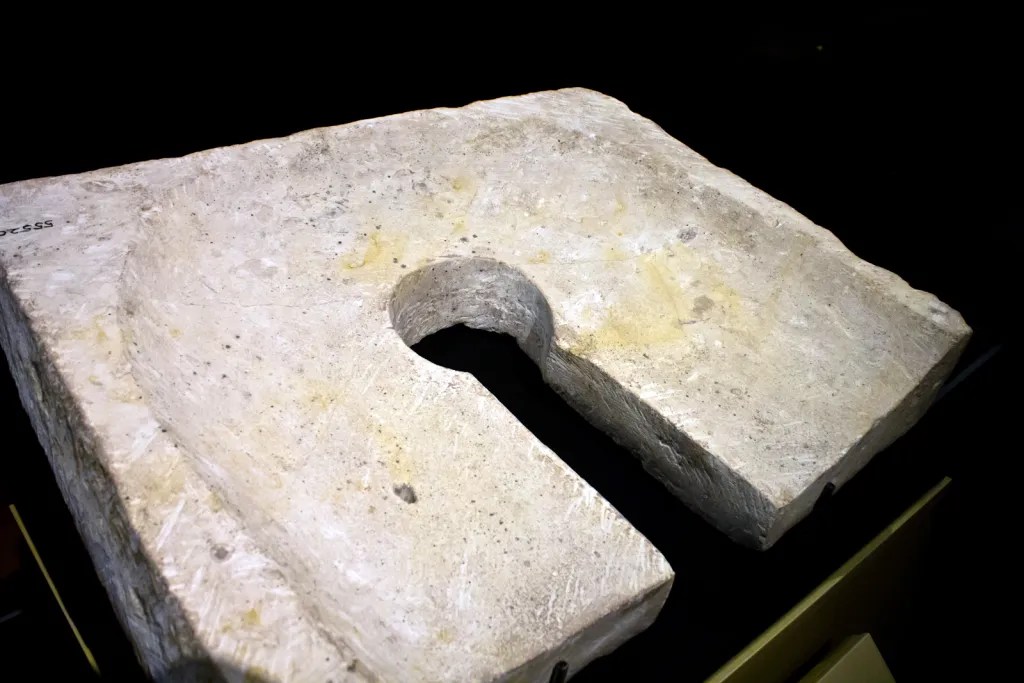
An Egyptian toilet seat from Amarna (New Kingdom), which would have been placed over a hole in the ground. Image from the post “Minding your Business: A Look at Egyptian Sanitary Practices” by Nile Scribes, which you can check out for more information about ancient Egyptian toilets.
Even if an accident, Herakleides was understandably outraged (who wouldn’t be, standing in a street covered in pee?) and reproached Psenobastis for her actions. Psenobastis, however, was not in the mood for his attitude and reacted aggressively, pulling and tearing his clothes, leaving his chest exposed, and increasing his humiliation in this foreign village. And here lies a key point. As Herekleides stresses, he was a Greek and a visitor (Greek xenos, a stranger or foreigner) and his appeal emphasises the ethnic dimensions involved. It was an Egyptian woman who did this to him, one who would have recognised he was not local, by his features and clothing, and her violence is interpreted as a result of her own xenophobia. Psenobastis’ actual thoughts on the matter cannot be determined. We have no record of her account of the event. The role of ethnic tensions in exacerbating her actions cannot be dismissed, but perhaps her response was that of a harried wife and mother, taking care of her family and domestic chores, with neither time nor inclination to deal with the blustering protestations of an unknown man outside her house.
Technical Details Provenance: Crocodilopolis, Fayum (Medinet al-Fayum). Date: 11 May 268 BCE. Language: Greek. Collection: Cairo, Egyptian Museum (JdE 58963). Designation: P.Enteux. 79; older designation: P.Lille Gr II 24 (sigla according to the Checklist of Editions); see also the entries in papyri.info and Trismegistos for further details. Bibliography: John G. Winter (1933), Life and Letters in the Papyri (Ann Arbor: University of Michigan Press), pp. 115–116; Naphtali Lewis (1986), Greeks in Ptolemaic Egypt (Oxford: Clarendon Press), pp. 60–61; Maryline Parca (2002), “Violence by and against Women in Documentary Papyri from Ptolemaic and Roman Egypt,” Henri Melaerts and Leon Mooren (eds.), Le rôle et le statut de la femme en Égypte hellénistique, romaine et byzantine. Actes du colloque international, Bruxelles – Leuven 27-29 novembre 1997 (Leuven: Peeters), pp. 283–296; Ivo Volt (2011), “Identity and Ethnic Friction in Greek Papyrus Letters from Egypt,” in Thomas R. Kämmerer (ed.), Identities and Societies in the Ancient East-Mediterranean Regions. Comparative Approaches (Münster: Ugarit Verlag), pp. 333–340; Chrysi Kotsifou (2012), “Emotions and Papyri: Insights into the Theatre of Human Experience in Antiquity,” in Angelos Chaniotis (ed.), Unveiling Emotions: Sources and Methods for the Study of Emotions in the Greek World (Stuttgart: Franz Steiner Verlag), pp. 39–90.
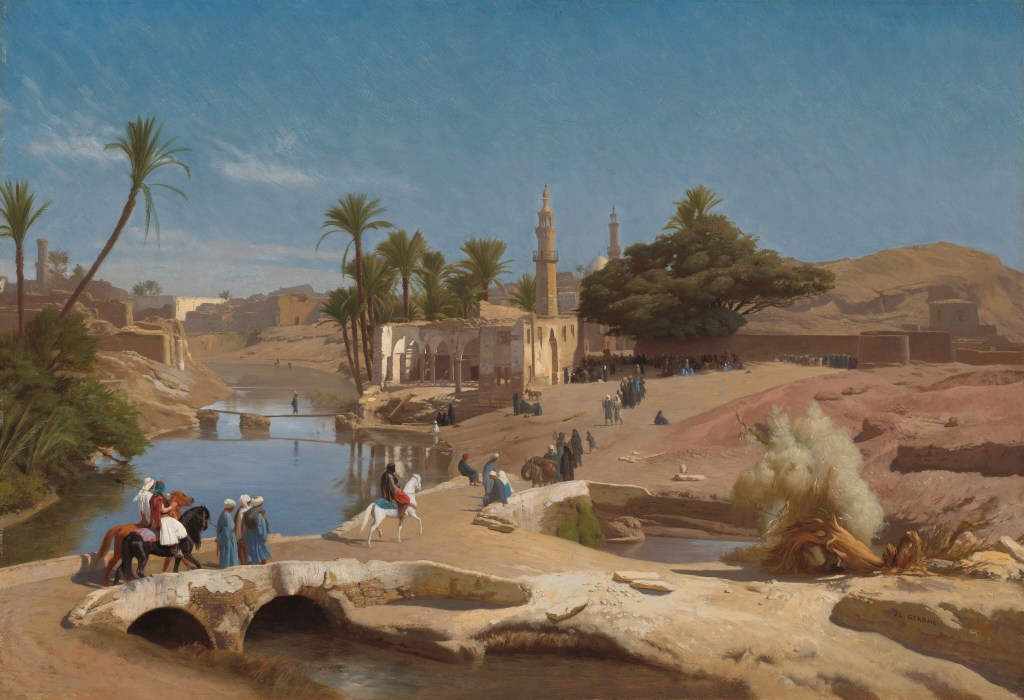
View of Medinet El-Fayoum (ca. 1868/1870) by the French artist Jean-Léon Gérôme. Today in the National Gallery of Art, Washington D.C. (2013.62.1)
Three papyri from the village Deir el-Medina, dating to the late New Kingdom, reveal a shocking event: the punishment of two policemen – medjay – with death by drowning in the Nile. Each letter is written from “the general of Pharaoh”, by his scribe Qenkhnum, to three people: the Scribe of the Necropolis, Tjaroy; the agent/controller (Egyptian rwDw) Payshuweben; and the head of the harem of Amun-Re, the lady Nodjmet. In the letter to Tjaroy, the general writes:
I’ve taken note of all matters you wrote to me about. As for the mention you made of this matter of these two policemen saying, ‘They spoke these words’, join up with Nodjmet and Payshuweben, as well, and they shall send word and have these two policemen brought to this (i.e., my) house and get to the bottom of their charges in short order. If it is determined that they are true, you shall put them in two baskets and they shall be thrown into the water by night – but don’t let anybody in the land find out!”
P.Berlin P.10487, letter to Tjaroy. Late Ramesside Letter 21, translation slightly modified from Wente (1990, 183)
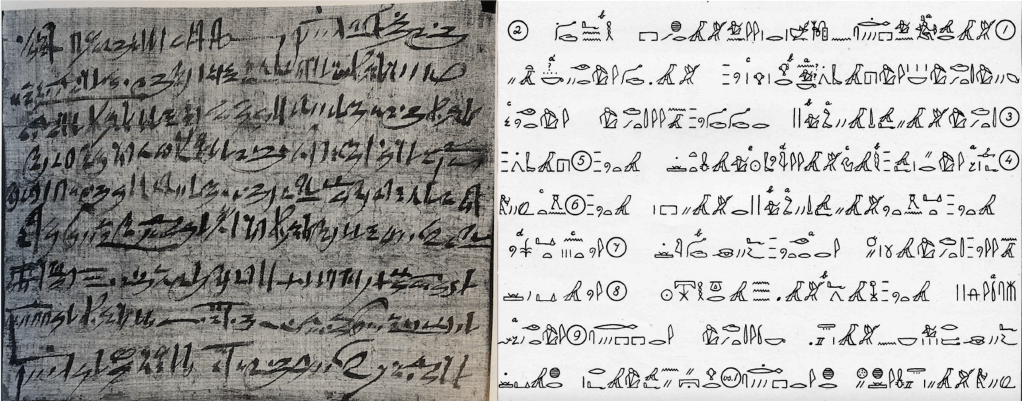
P.Berlin.P10478 (recto – first ten lines of the letter to Tjaroy). Photo of the papyrus from Janssen, Late Ramesside Letters and Communications, pl. 50; transcription from Černý, Late Ramesside Letters, pp. 36–37 [no. 21]
While each letter is slightly different, one with more personal enquiries another with reference to other business matters, this instruction regarding the two unnamed policemen is the same in each one. But what had the two men done to warrant such a course of action? As is often the case in letters, the key details, which were well known to the writer and recipient, are not stated directly. Instead, the policemen’s words are referred to obliquely: “They spoke these words”. But what words? The medjay fulfilled a number of roles at Deir el-Medina (‘policeman’ is a convenient rather than accurate translation). They were guards of the necropolis, were responsible for maintaining law and order, could serve on tribunals and deliberate with village officials, and also served as a point of contact between the community and central authorities, delivering messages to and from the village. These men were therefore privy to confidential information, potentially relating to the highest authorities in the land. Were they guilty of leaking secrets, whether through indiscretion or acting as informants, and were punished? If this were the case, why weren’t they formally tried and sentenced? The clandestine nature of the investigation reported in these letters – taking place at the general’s house and being drowned at night without witnesses – suggests something else may be taking place. Had the men instead made charges against Tjaroy, Payshuweben, and Nodjmet, who were now taking action to silence them? Either way, as the ‘words’ in question were confidential (or damning), they could not be repeated in these letters and so anybody who read the letters – including the modern reader – is none the wiser, unless they had access to other sources of information. And why death by drowning in the Nile? If murder, why not make the deaths look like an accident on the mountain – a fateful slip, or a fight that resulted in fatal wounds? There may be evidence for drowning as an official punishment at this time, if this is how ‘taken to the river bank’ is to be understood in texts from Deir el-Medina. But apart from any pragmatic advantages that drowning may have – the bodies would be carried away by the current and eaten by animals, leaving no evidence – there is another aspect of such deaths. The destruction of the body also meant the loss of an afterlife, and so the punishment was not only of this world but also of the next. A final point about these three letters is that they are the only papyri from Deir el-Medina that were found with their original seal attached. They had been intentionally kept together, having been rolled up and tied by a linen strip with a clay seal. Perhaps after the punishment had been enacted, the letters were reunited and put in a safe place, ready to be brought out in case the bodies were found and the parties involved needed to defend themselves against accusations of murder.
Technical Details Provenance: Deir el-Medina. Date: Late New Kingdom; dated by Wente to year 10 of the whm nswt (‘Renaissance’) of Rameses XI (so year 28 of his reign, ca. 1080 BCE). Language: Late Egyptian, written in hieratic. Collection: Ägyptisches Museum und Papyrussamlung, Berlin (P.Berlin P.10487, 10488, 10489). Bought together in 1912. Designation: Late Ramesside Letter 21 (10487), 34 (10488), and 35 (10489). Bibliography: Jaroslav Černý (1939), Late Ramesside Letters (Brussels: Édition de la Foundation égyptologique Reine Élisabeth); Adolf Erman (1913), Ein Fall abgekiirzter Justiz in Agypten. Abhandlungen der Kiniglich-PreuBischen Akademie der Wissenschaften zu Berlin, philosophisch-historische Klasse (Berlin: Verlag der K6niglichen Akademie der Wissenschaften); Jac Janssen (1991), Late Ramesside Letters and Communications (London: British Museum Press); Edward Wente (1969), Late Ramesside Letters (Chicago: The University of Chicago Press), available as a pdf here; Edward Wente (1990), Letters from Ancient Egypt (Atlanta: Scholars Press).
Some Further reading: Benedict G. Davies (2018), Life within the Five Walls. A Handbook to Deir El-Medina (Wallasey: Abercromby Press); see the entry on “Medjayu” (pp 184–187). Kerry Muhlestein (2005), “Death by Water: The Role of Water in Ancient Egypt’s Treatment of Enemies and Juridical Process,” in L’Acqua Nell’antico Egitto: Vita, Rigenerazione, Incantesimo, Medicamento, edited by Alessia Amenta, Michela Luiselli, and Maria Novell (Rome: L’Erma di Bretschneider), 173–179. Torgny Säve-Söderbergh (1992–92), “A Stela of a Rameside Policeman,” Orientalia Suecana 41–42: 273–275, which you can read online here.
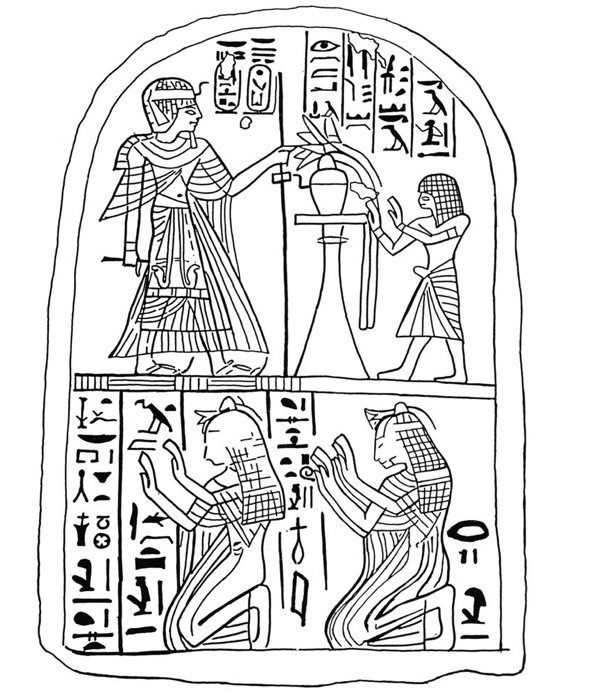
Stela of Korka – the only known monument of a medjay from western Thebes. Today in Uppsala University museum, Sweden; see Säve-Söderbergh, ‘A Stela of a Rameside Policeman’
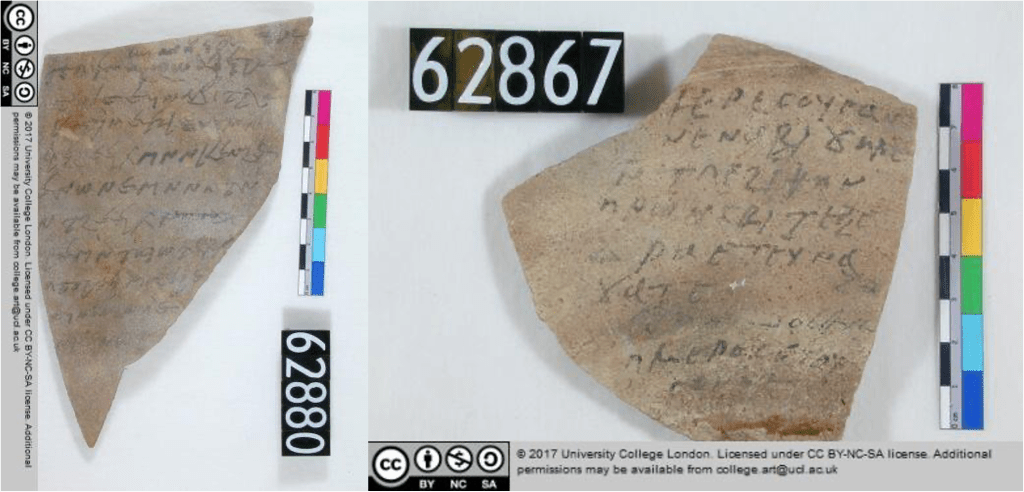
Families in late antique Egypt regularly fought over property rights. At least, that’s the impression given by the textual record from some villages, among which a common category of legal documents is those that record settlements of disputes. It is not always clear, though, if the disputes were hostile or simply that mediation was necessary to determine who would receive what specific rooms, especially in inherited houses that needed to be divided between multiple family members. Local officials who mediated the cases and documents often simply say that ‘they distributed lots’. What does this mean and how did these officials reach their decisions? Thanks to short texts on ostraca, we can see how these lots were cast. Officials divided the property in question into different parcels and these individual divisions were written on ostraca. An ostracon in the Petrie Museum of Egyptian Archaeology, UC62880 (published as O.CrumVC 13), bears one such division:
“He who will receive the southern veranda will take the tenth(?) that is outside the house. The entrance room, the stone porch, the area below the entrance room, the storage room, the well, the staircase, and the storage room will be communal.”
O.CrumVC 13 (translation: J. Cromwell)
A short line precedes the main text, which is partially broken and difficult to read, but it should state the identity of the property in question. This ostracon and the others connected with the same property would have been distributed to the parties involved, as a lottery – each share was equal and so the parties received an equal part from the house, thereby ensuring that there was no possible bias in the decision-making process. Here, the person who received this ostraon acquired the veranda on the southern side of the house (a room which was open to the air on at least one side, either entirely or with columns supporting the roof), a part of the land outside the house, and also equal access to a number of communal rooms. We know that this was a common practice to settle disputes because several ostraca provide evidence of the same practice. In the Petrie Museum’s collection alone, three other Coptic ostraca record similar, albeit longer and more complex, divisions. Unfortunately, they are all broken in places and the extent of the individual parcels does not survive. These ostraca are: UC62875 (O.CrumVC 12), UC62847 (O.CrumVC 15), and UC62841 (O.CrumVC 16).
Left: O.CrumVC 13 (UC62880); Right: O.CrumVC 14 (UC62867). Images from the Petrie Museum’s online catalogue (links below)
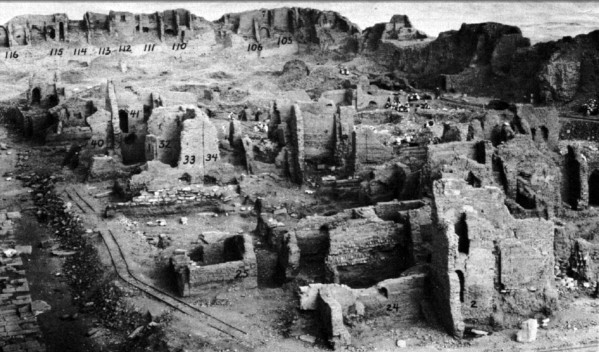
Another ostracon is slightly different. Rather than note the parcel to be distributed, UC62867 (O.CrumVC 14) names the individual involved: “Susanna shall receive the upper storage room before the door and the veranda, which is to be opened up(?).” In this case, the mediators themselves may have specified who received what, or this ostracon marks the final decision and no long papyrus legal document was written that recorded her share – having a papyrus document written up would have been a much more expensive venture! It is possible that some of these ostraca come from the village Djeme (built in and around Medinet Habu, the mortuary temple of Rameses III), which is especially well documented during the 7th and 8th centuries. Until the 1920s, remains of houses from this period survived, but they were removed to reveal the original ground level of the pharaonic temple. Photographs and plans of the houses provide an impression of the ground floor layout and cellars of over 130 houses. Houses had an entrance room, containing a recess for large water containers, which led to another room and staircase – the type of common rooms mentioned in the first ostracon above. Today, remains of these late houses are only visible on the edges of the temple complex, where they were built on top of the ancient mudbrick perimeter wall.
Houses from Djeme (Medinet Habu), showing numbering given by Uvo Hölscher. Photograph from the Oriental Institute, Chicago, Expedition (from Hölscher, Medinet Habu V, 1954)
[Note: I originally wrote this post for the Petrie Museum’s ‘Papryi for the People’ project in 2017. Those posts were not published but material has been included in the Petrie’s online Catalogue for the respective entries, for which see the hyperlinks below, which unfortunately do not credit the contributors involved.]
Technical Details (for both ostraca) Provenance: Probably western Thebes. Date: 8th century? Note that the Petrie catalogue notes ‘Byzantine Period’, but it is surely late 7th/8th century based on the handwriting and because Coptic was mainly used for writing legal documents (and associated texts) during this time (the early Islamic period). Language: Coptic. Collection: Petrie Museum of Egyptian Archaeology, University College London. UC62880 and UC62867. Designation: O.CrumVC 13 and 14 (according to the Checklist of Editions). Bibliography: Walter Till, Erbrecthliche Untersuchungen auf Grund der koptischen Urkunden (Vienna, 1954), 226 [both texts]; Walter Till, Die koptischen Rechtsurkunden aus Theben (Vienna, 1964), 237 [both texts].
The year 2022 marks the 200-year anniversary of the modern decipherment of hieroglyphs by Jean-François Champollion. While hieroglyphs are synonymous with ancient Egypt, they continued to be used throughout the centuries of Ptolemaic and Roman rule, although in increasingly restricted areas of use and with fewer and fewer people bearing the knowledge to produce them. The last known hieroglyphic inscription dates to August 394 CE, and was written by one Nesmeterakhem, the Second Priest of Isis, on a wall of the temple of Isis at Philae. Dating several centuries earlier, during the reign of emperor Trajan, a papyrus from Oxyrhynchus provides the briefest of glimpses into the lives of hieroglyph-carvers in this town. This papyrus, written to a royal scribe (Claudius Menandrus), records the names of all such men, together with where they were located in the town. Four of the men are from the ‘quarter of the Tenth’, one of whom, Osmolchis, is identified as a hieroglyphic carver of the god Osiris:
– Teos son of Onnophris and Taseus – Onnophris, brother of Teos – Asklas son of Onnophris (son of Osmolchis) and Tesauris – Osmolchis, brother of Asklas
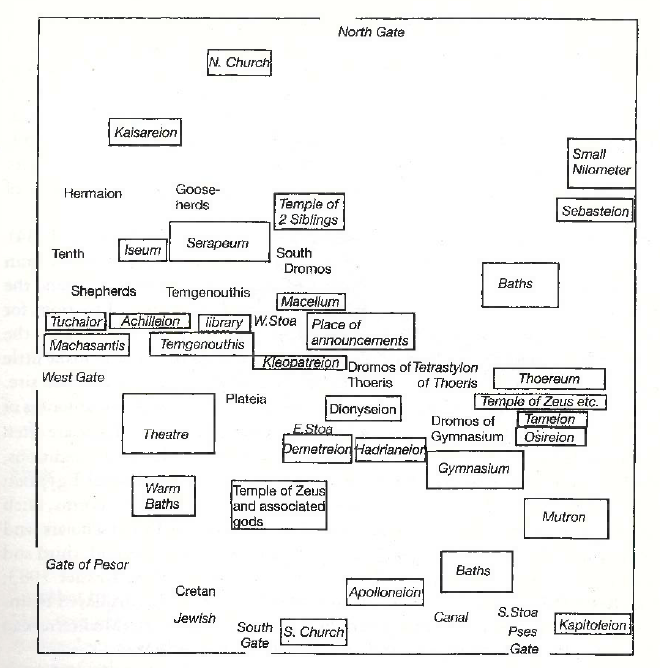
We don’t know anything about the parents of these two sets of brothers, born of two men called Onnophris – a common Egyptian name meaning ‘the one who is perfect’ (an epithet of Osiris). The fact that we are dealing with brothers perhaps indicates that this is a family occupation. The only other detail that we get is the association with the temple of Osiris in the town. And this connection is important, as throughout this period knowledge of hieroglyphs is confined mainly to the traditional temples and their priesthood. As for the fifth man, Ptolemais son of Petosorapis (son himself of Petosorapis), he lives in a different quarter of the town, Thoeris. One especially interesting part of this list is the declaration that there are no more carvers in Oxyrhynchus – not even “apprentices or strangers carrying on the art down to the present day”! In a town of maybe 30,000 people, only a handful of men preserved this ancient knowledge.
Diagrammatic guide to the topography of Oxyrhynchus, from Richard Alston (2002), The City in Roman and Byzantine Egypt (London-New York), p. 267 (fig. 5.11). Mentioned in P.Oxy. VII 1029, he Tenth is located to the left of this diagram, Thoeris is in the middle, and the Osireion (temple of Osiris) on the right.
“To Claudius Menandrus, royal scribe (basilieogrammateus), from Teos, younger son of Onnophris son of Teos, his mother being Taseus, and Asklas son of Onnophris son of Osmolchis, his mother being Tesauris, both of the city of Oxyrhynchus, hieroglyphic carvers, who have been delegated by their fellow-carvers: the list of ourselves and the said fellow-carvers of hieroglyphics for the present year of Trajanus Caesar the lord, as follows: In the quarter of the Tenth, Teos son of Onnophris, the aforesaid, Onnophris his brother, Asklas son of Onnophris, the aforesaid, Osmolchis his brother, who is also a hieroglyphic carver of Osiris the greatest god. In the quarter of the square of Thoeris, Ptolemais son of Petosorapis son of Petosorapis. Total 5 men. And we swear by the Emperor Caesar Nerva Trajanus Augustus Germanicus Dacicus that we have honestly and truthfully presented the foregoing list, and that there are no more than these, and that we have no apprentices or strangers carrying on the art down to the present day, otherwise may we be liable to the consequences of the oath. The 11th year of the Emperor Caesar Nerva Trajanus Augustus Germanicus Dacicus, Phaophi 29.”
Trans. Arthur Hunt, P.Oxy. VII 1029 (1910).
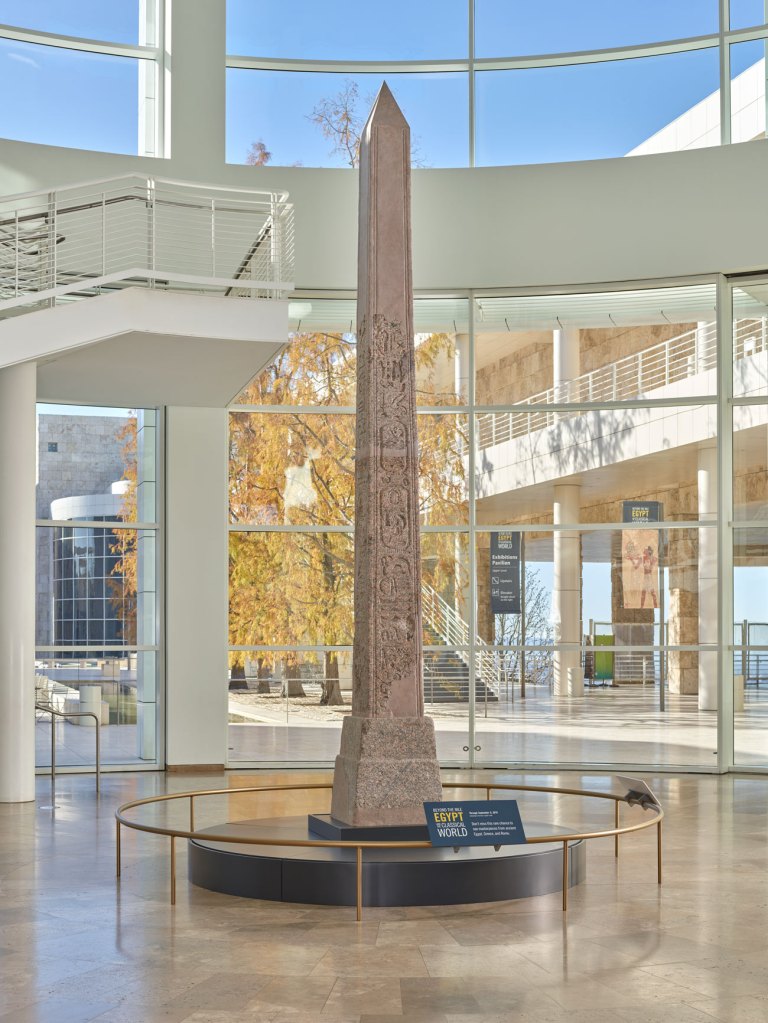
But knowledge and use of hieroglyphs was not entirely restricted to a few people in Egypt. Several Roman Emperors removed Egyptian obelisks from Egypt and had them installed in the empire’s capital, Rome. And their fascination with obelisks didn’t end with appropriating ancient monuments. A small number of new obelisks were also built during the late 1st century CE. Today in Piazza Navona stands the obelisk of Domitian (81–96 CE), while two smaller twin obelisks were erected in the name of the same emperor in the city Benevento (see the new study of the obelisks recently undertaken by Luigi Prada, noted in the bibliography below). The identity of the authors and carvers of these obelisks is unknown, yet, even if an increasingly specialised profession in a land of foreign rulers, there remained an important role for hieroglyph carvers to play, at both a local and an imperial level.
Technical Details Provenance: Oxyrhynchus. Date: 27 October 107. Language: Greek. Collection: Egyptian Museum, Cairo (JdE 47429). Designation: P.Oxy. VII 1029; Sel. Pap. II 316 (papyrological sigla according to the Checklist of Editions). The Greek text is available on the Duke Databank of Documentary Papyri. Bibliography: Allan C. Johnson (1936), An Economic Survey of Ancient Rome. II: Roman Egypt to the Reign of Diocletian (Baltimore), p. 397 [#250]; Thomas Kruse (2002), Der königliche Schreiber und die Gauverwaltung. Untersuchungen zur Verwaltungsgeschichte Ägyptens in der Zeit von Augustus bis Philippus Arabs (30 v. Chr.–245 n.Chr.) (Munich-Leipzig), Vol. II, pp. 716–718.
Select bibliography: hieroglyphs in Roman Egypt: El Daly, Okasha (2008), Egyptology: The Missing Millennium. Ancient Egypt in Medieval Arabic Writings (London). Love, Edward O. D. (2021), Script Switching in Roman Egypt. Case Studies in Script Conventions, Domains, Shift, and Obsolescence from Hieroglyphic, Hieratic, Demotic, and Old Coptic Manuscripts (Berlin). Prada, Luigi (2022), “‘To Isis the Great, Lady of Benevento’: Privately Dedicated Egyptian Obelisks in Imperial Rome and the Twin Obelisks of Benevento Reedited,” in Egypt and the Classical World: Cross-Cultural Encounters in Antiquity, ed. Jeffrey Spier and Sara E. Cole (Los Angeles). Westerfeld, Jennifer T. (2019), Egyptian Hieroglyphs in the Late Antique Imagination (Philadelphia).
One of the two Benevento Obelisks, today in the Getty. For the recent restoration of the obelisk, see this article by Sara E. Cole, Erik Risser, and William Shelley, “Conserving an Ancient Obelisk” (2018), from which the above photograph is take.


 Papyrus Stories

