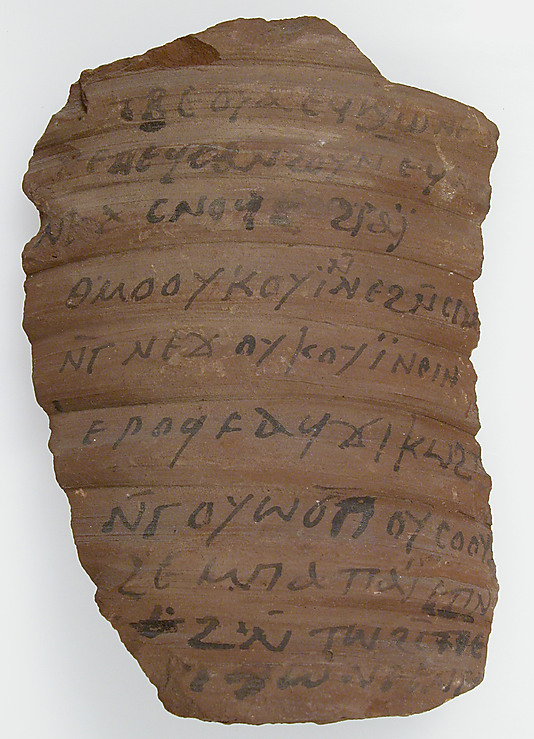
“I greet my Father Athanasios. I spoke to you about the medical book. I often wanted to come south, but looking after here has not allowed me to come south. I wanted to come south, (but) the roads prevented me. Now, please send it to me, either (by) Pmoute or give it to Aaron and he will send it to me via his brother. If I can examine it (for) two days, I will return it.”
So wrote a man, also called Athanasios, to a monastic elder. The ostracon, O.Crum 253, today in the Ashmolean Museum in Oxford, probably dates to the 7thcentury CE and likely comes from western Thebes (maybe the village Djeme/Medinet Habu). While the letter is only brief, there is quite a lot to unpack. Before the most obvious point – the request for the medical book – there is the passing reference to the road preventing Athanasios himself from travelling. Does this mean that he’s simply not up to the journey, or that he doesn’t have travel permits to travel out of his village, or is this an allusion to potential danger on the roads? Instead, Athanasios suggests a couple of men who can collect and deliver the book, highlighting the importance of social networks in day-to-day life, for support in various ways.
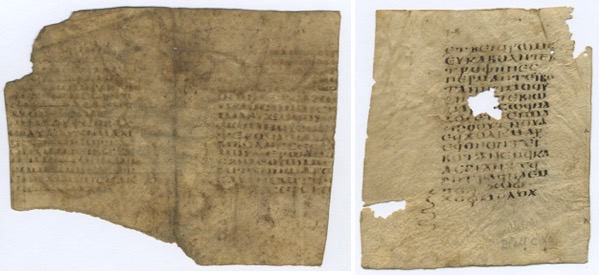
As for the main issue, the need for a medical book, The writer, Athanasios, doesn’t say who is sick or what the symptoms are, so the book in question must be something like the pocket-sized medical codex today in Copenhagen. This miniature book, only ca. 9 x 8 cm, contains remedies and instructions for a range of symptoms and conditions. For example, on p. 112 (below right), the text reads:
“For those people who throw up their food. (Mix) seeds of this plant and water and wine and honey. Let him drink and he will be healed.”
Water, wine, and honey are common ingredients in such treatments, especially honey! But, seeds from what plant? Sometimes, these medical books require some further knowledge from their users.
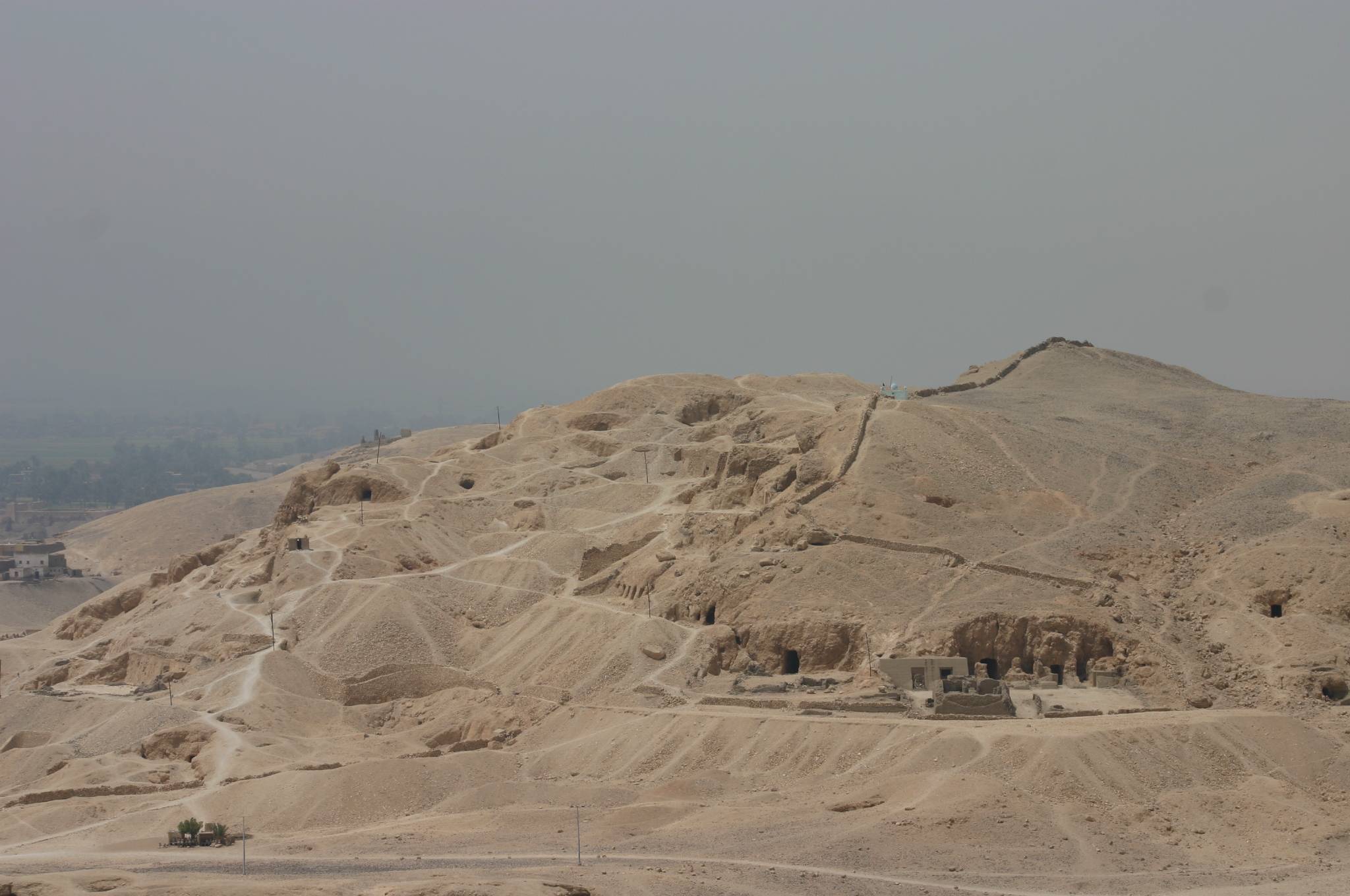
In addition to this kind of medical book, individual treatments could also be written and sent. An ostracon, P.Mon.Epiph. 574, found at the monastery of Epiphanius in western Thebes (built in and around Theban Tomb 130 on Sheikh Abd el-Qurna), contains a treatment for vomiting blood:
“For somebody with an internal illness who is vomiting blood:
heat up a little radish oil;
add to it a little burnt sulphur;
break a hen’s egg into the oil;
anoint the one who is sick in his bowels three times a day and he will be relieved.”
As the treatment mentions bowels in the last section, the problem seems to be intestinal rather than respiratory problems (vomiting rather than coughing up blood – the Coptic verb itself is more vague). Where the sick person is to be anointed is not stated, although perhaps over his abdominal region, as the point of contact closest to the affected region.
Foreground: “Monastery of Epiphanius” on Sheikh Abd el-Qurna. The actual ancient name of the hermitage is unknown, but we refer to it today by its best-known figure. Today, remains of two large towers survive in the courtyard.
In both of the ostraca, monks are closely connected with the healing process: Father Athanasios, a monastic elder, is asked to send the book, while the treatment for vomiting blood was found at a small hermitage. While monastic figures are most often characterised as holy people and miracle-workers, studied primarily for their spiritual endeavours, they also fulfilled many important social functions. In his book, From Monastery to Hospital: Christian Monasticism and the Transformation of Health Care in Late Antiquity, Andrew Crislip illuminates the innovative approaches to health care that took place within the earliest monasteries. Monks and monasteries were not isolated, religious institutions but were a fundamental and integrated aspect of secular life in Egypt as well.
Hopefully, the medical book that Athanasios requested provided the treatments he needed to help those in his care.
Technical Details (Text 1): Provenance: Western Thebes(?), southern Egypt. Date: 7th century(?) CE. Language: Coptic, Sahidic dialect. Collection: Ashmolean Museum, Oxford; inv. Bodl.Copt.Inscr. 104. Designation: O.Crum 253 (according to the Checklist of Editions).
Technical Details (Text 2): Provenance: Middle Egypt, perhaps the monastery of Apa Jeremias at Saqqarah. Date: 6th century CE. Language: Coptic, Sahidic dialect. Collection: Papyrus Carlsberg Collection, University of Copenhagen (P.Carlsberg 500). Designation: P.Carlsberg 500. Bibliography: Wolja Erichsen (1963), “Aus einem koptischen Arzneibuch,” Acta Orientalia27: 23–45; Tonio Sebastian Richter (2014), “Neue koptische medizinische Rezepte,” Zeitschrift für Ägyptologie und Altertumskunde141/2: 154–194.
Technical Details (Text 3): Provenance: Theban Tomb 130 (“Monastery of Epiphanius”), western Thebes, Egypt. Date: 7th century CE. Language: Coptic, Sahidic dialect. Collection: Metropolitan Museum of Art, NYC; inv. 12.180.79. Designation: P.Mon.Epiph. 574 (according to the Checklist of Editions).
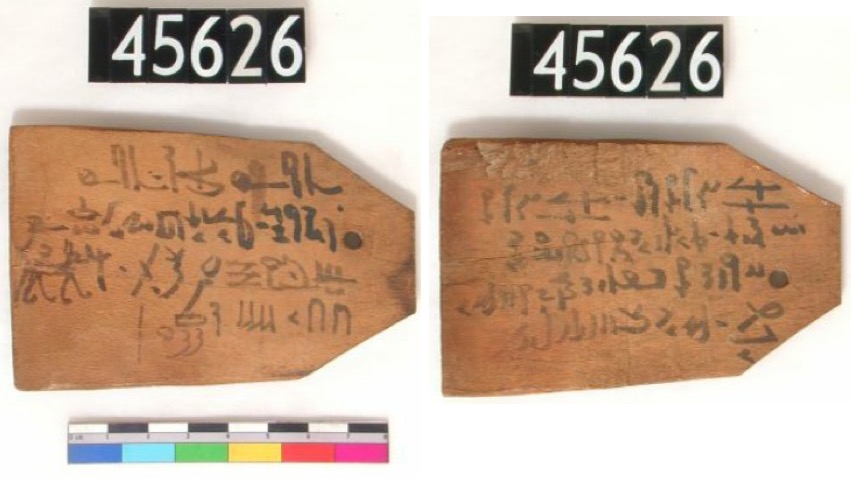
On 26thApril of the 24thyear of reign of an unspecified Roman emperor (probably Commodus, which equals the year 184 AD), a modest Egyptian priest named Bes, son of his namesake and a lady called Tadinebhau, died in Pernebwadj, a provincial town in Middle Egypt—then a remote region within the vastness of the Roman empire. We know almost the precise address in Pernebwadj at which Bes had resided during his lifetime, within the town’s ‘tenth quarter’. Such detailed information stems from neither an inscription on Bes’ tomb walls nor a papyrus, but from a much more unassuming object: his mummy label (UC 45626).
UC 45626 (c) Petrie Museum of Egyptian Archaeology
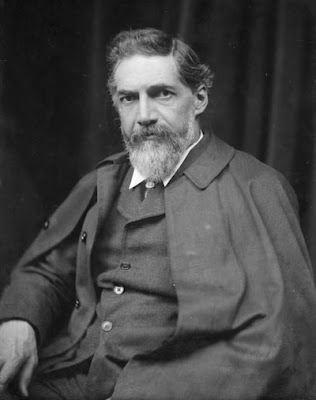
William Matthew Flinders Petrie
Mummy labels are a type of artefact characteristic of Roman Egypt, from which they survive in their thousands—though they are also attested, in much more limited numbers, from Ptolemaic and even earlier, dynastic times. They consist of small tablets, often around ten centimetres in length and half the size in width, which are typically made of wood, albeit other materials (e.g., stone or bone) are attested as well. The Petrie Museum of Egyptian Archaeology’s collection comprises hundreds of such items, the origin of many of which is—remarkably, and unlike those in many other museum holdings—documented through William Flinders Petrie’s own excavation records (for Petrie, see here).
As suggested by their name, the primary function of these objects was utilitarian: they ‘labelled’, i.e. identified, the mummy to which they were attached, through inscriptions giving the deceased’s name, typically in association with that of their parents (a necessary form of identification in a society like that of ancient Egypt, which knew no surnames). Optionally, additional information could be included on these labels, to give the name not only of the dead’s parents, but also of their forefathers, as well as their age at the time of death, the date of their death or burial, their profession, their origin and/or place of residence, and any other information that the family (or the embalmers) opted to include. Labels could be inscribed in either demotic or Greek, the two languages spoken in Egypt at the time, and many a label actually bore the same text in both—one language per side—thus being a remarkable testimony to the multilingualism of Roman Egypt. More rarely, inscriptions in hieratic or even hieroglyphs occurred (such is the case for Bes’ label, whose text is written in demotic and hieratic).
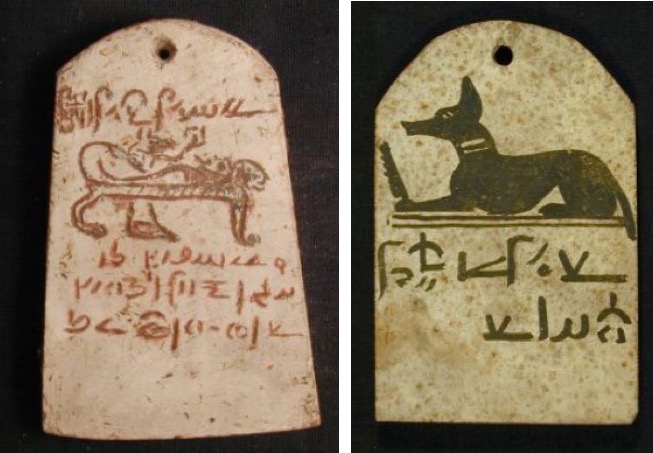
Sometimes, texts could even be accompanied by drawings. The Petrie collection includes a few very fine examples of such illustrated mummy labels. One is that of Tabyn, daughter of Pasherinpu son of Hun (UC 39590): here, lying on a lion-shaped bier and in the care of the embalmer-god Anubis, her mummy is portrayed oddly sporting a beard—an obvious feature of male mummies! Another is the label of Nesmin the Elder, son of Padiaset (UC 34471), which is decorated with the figure of a recumbent jackal, emblematic of the god Anubis. Both labels, made of limestone and of early Roman date, originate from Petrie’s excavations in Dendera.
Left: UC 39590. Right: UC 34471 (c) Petrie Museum of Egyptian Archaeology
So, why were these objects so common in Roman Egypt? By that time, mummies were often cheaply prepared and deposited in mass-tombs, without a coffin to protect them or much in the way of funerary equipment. Thus, the function that had previously been fulfilled (and was still, but only for more elite burials) by inscriptions on tomb walls, coffins, stelae, or papyri, was now often compacted in these small and cheap artefacts.
UC 39582 (c) Petrie Museum of Egyptian Archaeology
And, although their primary function was to identify the body to which they were attached, they could also take over a ritual and religious function—both through drawings of a mortuary character (such as those presented above) and through the inclusion in their texts of funerary formulae and prayers for the wellbeing of the deceased in the netherworld. This is the case, for instance, in the following example, which begins with a variant of the ‘offering formula’ (a kind of religious invocation attested since the earliest times of Egyptian history, in the third millennium BC) for the benefit of the deceased ‘Pana, son of Padihorsematawy son of Pana son of Hornefer, who has gone to his forefathers, in (his) 27th year of life, 6th month, and 21st day’ (note how the text enlightens us over Pana’s pedigree through four generations!). Pana’s mummy label ends with the expression of a pious wish on the part of his loved ones: ‘May his soul live for eternity and ever’ (UC 39582).
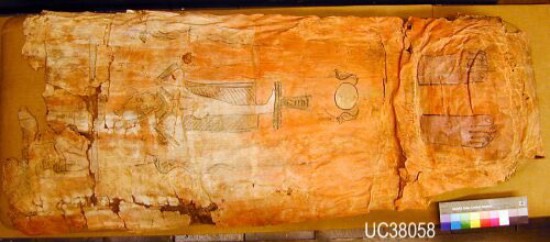
Similar short funerary texts could also be written directly on the mummy’s bandages, whenever a mummy label was not available or otherwise deemed unnecessary. One remarkable such example is a lavishly painted mummy shroud of Roman date (UC 38058). The linen cloth that contains the body is decorated with several religious motifs, among which is the god Osiris, standing at the centre of it. Originally, this shroud would have been combined with one of the so-called ‘Fayum portraits’, life-like encaustic portraits on wooden tablets placed on the mummy’s visage, in order to preserve forever their original appearance. Looking at the shroud closely, one notices a brief demotic text written just above its feet: ‘Pyltewa, the man from the Fayum—in order to transport <him> to Hawara’. In this case, the text fulfils two very practical functions. On the one hand, it identifies the deceased, a certain Pyltewa—possibly an Egyptian rendering of the Greek name Philotas. On the other hand, it is almost a ‘parcel delivery’ note, for it contains an instruction to deliver the body, once its mummification had been completed, to its family and tomb in Hawara, the city and cemetery at the entrance of the semi-oasis of the Fayum where Petrie unearthed it some two millennia later.
UC 38058 (c) Petrie Museum of Egyptian Archaeology
The value that mummy labels and similar notes on mummy bandages or shrouds have for the modern historian can hardly be overstated. Taken individually, they may appear unremarkable and of little consequence. But once hundreds or thousands of them are brought together into statistical studies, with focus either on a specific town/cemetery or on larger areas (including Egypt as a whole), their importance becomes apparent. Not only do these objects inform us on the funerary practices of the time, they are unique sources for the social history of Roman Egypt, allowing us to reconstruct the genealogy of families, the demography of smaller and larger communities, their mortality rates—at times, we can even trace a ‘topography of the dead’, as in the case of the label of Bes discussed above, where the information on his mummy label also reveals the neighbourhood of the town in which he had spent his life. This is all to show that, unexpected as this may be, it is often through the evidence of small and unassuming objects that history is written.
*Note: all of the above images are available on the Petrie Museum’s online catalogue (accessible here). When searching for items by inventory number, the UC prefix is needed plus the number, with no spaces (e.g., UC45626 not UC 45626).
Technical Details (Label 1): Provenance: Pernebwadj (Middle Egypt) Date: 26th April, perhaps 184 CE (during the reign of Commodus) Language: Egyptian (hieratic and demotic) Collection: Petrie Museum of Egyptian Archaeology, London (UC 45626) Designation: Short Texts II 444 (according to the Checklist of Editions) Bibliography: Sven P. Vleeming (2011), Demotic and Greek Mummy Labels and other short texts gathered from many publications (Leuven) #444.
Technical Details (Label 2): Provenance: Dendera Date: 30 BCE to 50 CE Language: Egyptian (demotic) Collection: Petrie Museum of Egyptian Archaeology, London (UC 45626) Designation: Short Texts II 350 (according to the Checklist of Editions) Bibliography: William Matthew Flinders Petrie (1900), Dendereh 1898 (London), p. 56, pl. 26B (#56) Günter Vittmann (1985), ‘Mumienschilder in Petries Dendereh’, Zeitschrift für Ägyptische Sprache und Altertumskunde 112, p. 162 (#56); Sven P. Vleeming (2011), Demotic and Greek Mummy Labels and other short texts gathered from many publications (Leuven) #350.
Technical Detail (Label 3): Provenance: Dendera Date: 30 BCE to 50 CE Language: Egyptian (demotic) Collection: Petrie Museum of Egyptian Archaeology, London (UC 34471) Designation: Short Texts II 369 (according to Checklist of Editions) Bibliography: William Matthew Flinders Petrie (1900), Dendereh 1898 (London), p. 56, pl. 26A (#10) Günter Vittmann (1985), ‘Mumienschilder in Petries Dendereh’, Zeitschrift für Ägyptische Sprache und Altertumskunde 112, p. 155 (#10); Betsy Teasley-Trope, Stephen Quirke, and Peter Lacovara (2005), Excavating Egypt: Great Discoveries from the Petrie Museum of Egyptian Archaeology, University College London(Atlanta), #143; Sven P. Vleeming (2011), Demotic and Greek Mummy Labels and other short texts gathered from many publications (Leuven) #369.
Technical Details (Label 4): Provenance: Dendera Date: 41 to 54 CE Language: Egyptian (demotic) Collection: Petrie Museum of Egyptian Archaeology, London (UC 39582) Designation: Short Texts II 378 (according to the Checklist of Editions) Bibliography: William Matthew Flinders Petrie (1900), Dendereh 1898 (London), p. 56, pl. 26A (#48) Günter Vittmann (1985), ‘Mumienschilder in Petries Dendereh’, Zeitschrift für Ägyptische Sprache und Altertumskunde 112, p. 160 (#48); Sven P. Vleeming (2011), Demotic and Greek Mummy Labels and other short texts gathered from many publications (Leuven) #378.
Technical Details (Bandages): Provenance: Hawara Date: Roman (30 BC to 284 CE) Language: Egyptian (demotic) Collection: Petrie Museum of Egyptian Archaeology, London (UC 38058) Designation: Short Texts II 1041 (according to the Checklist of Editions) Bibliography: William Matthew Flinders Petrie (1911), Roman Portraits and Memphis IV (London), p. 22, pl. 24 (#6); Lorelei H. Corcoran (1995), Portrait Mummies from Roman Egypt (I–IV Centuries AD) with a Catalog of Portrait Mummies in Egyptian Museums(Chicago) p. 41 #a; Sven P. Vleeming (2011), Demotic and Greek Mummy Labels and other short texts gathered from many publications (Leuven) #1041.
*This blog post was originally posted on the website of the European Research Council project, “Embedding Conquest”, and was reposted on the Leiden Islam Blog. With many thanks to the author and the original hosts for allowing the story to be reposted here.
Have you ever wondered what the Arab conquests of Egypt meant for the average Egyptian villager? The following story takes place a few years after 700, in the countryside of Middle Egypt. It’s based on a Coptic document that belonged to the management of the country by the Arab-Muslim government.
Shenoute was making his way through the village, hammer and nail in one hand, and he wretched letter in the other. As he headed for the church, a woman passed him by and looked at him questioningly. He’d been getting those looks from the villagers all day. They knew that this morning he was in the office of Basileios, the district administrator. A letter from the governor had arrived, and Shenoute and the other headmen of the villages in the district, had been summoned there to hear it. “They will know soon enough”, Shenoute thought, “and they are not going to like it”. The atmosphere around the village had been tense, since letters from the governor had been coming every month or so lately, and they never brought good news.
That morning, when he had arrived at the office of Basileios, the district administrator himself had not been in the room yet. As he greeted the office scribes, Shenoute immediately recognized the letter from the governor: a long strip of high quality papyrus, written in Arabic, the language of the amirs and amils who’d been running the country since the time of Shenoute’s grandparents. A scribe had just finished translating the letter to Greek and Coptic, for the benefit of Basileios and the village headmen, who, like Shenoute, didn’t know Arabic.
In a corner of the room, Shenoute had spotted Iohannes, headman of a neighboring village. His usual bored expression had made place for a preoccupied frown. Shenoute wanted to go over to greet him, but at that point Basileios had come in, followed by a man Shenoute had never seen before. He must be the messenger who had brought the letter, Shenoute thought.
Everyone fell silent as the scribe started to read the letter aloud. As Shenoute had expected, the governor was not happy, and he wrote, yet again, about the so-called “strangers” in Basileios’ district. They were immigrants from other districts, who had moved away and were not paying their taxes. The letter ordered Basileios to gather them and prepare them to be sent to the governor. The messenger who carried the letter, was to wait there until Basileios handed him the strangers, so that he could take them to the governor in the capital up North, where they would be punished.
The scribe reached the passage with the usual abuse and threats for Basileios if he wouldn’t do as told again: “You’re neglectful, you don’t value your life, I will crush your soul,” and so on. Shenoute glanced at Basileios, but his stony expression did not betray any emotion. Shenoute understood his own task from the letter: he, like the other village head men, would have to supply Basileios with a list of names of these so-called strangers, and the names of their wives and children, and the places where they had come from.
After the reading of the letter, a scribe handed him an abridged Coptic translation of it, to be pinned up on the church door and read aloud to the people in his village, so that they would know that those so-called strangers among them were to be sent away, by personal order of the highest authority in the country. And then, Shenoute reminded himself, he would be among the men responsible for rounding those poor people up and bringing them to Basileios’ office.
Lost in thoughts about the events of that morning and the contents of the letter, Shenoute didn’t notice that he’d almost reached the church. A small crowd was already waiting for him, and he tried to look confident and authoritative as he made his way to the church door. They watched as he nailed the letter to the door. He turned around and opened his mouth to speak.
***
Scholars tend to treat the Arab-Muslim government of Egypt, centered in the capital Fustat, and the villages in the countryside which it governed as two separate worlds. But, those worlds were integrated, and documents played an important part in that integration. The letter on which the story is based brings the words of the governor in the middle of the Egyptian village. In my next blog, read more about this specific document, its contents and how it testifies to the growing presence of the Arab-Muslim government in the Egyptian villages.
In the ancient world, education – learning to read and write – wasn’t a right and was accessible by only a small number of people. Only 5–10% of the population was literate. But what does this mean, what constitutes being literate? Does being able to write basic sentences fit the bill, or do you need to be able to write complicated compositions? By whose standards are we to judge literacy? Daily writing from the ancient world shows a wide range of abilities, showing that it is difficult (and probably not productive) to generalise about it.
When it comes to studying how people learned to write, we have a lot of education material – texts produced by both students and teachers from throughout Egyptian history, in the ancient languages of Egypt through to Coptic and the languages of its rulers, in particular Greek. Problems with teachers, funding, and other issues were recorded in letters, especially from students learning Greek in the cities (for the 2nd century CE, see this story). Outside of the major towns and cities, in the predominantly Egyptian-speaking villages of the Nile Valley in late antiquity, how did you learn to read and write? Who were the educators? Where did you go?
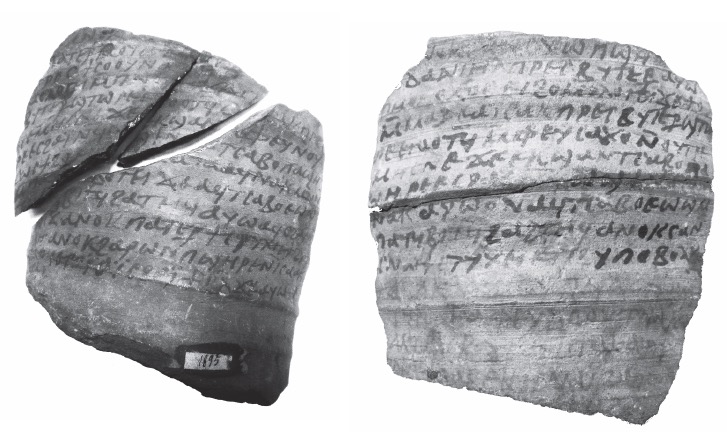
Paris, Cabinet des Médailles, #1894 and 1895 (Boud’hors 2016)
Two ostraca (pottery sherds) provide a very rare glimpse into these questions. Writing in Coptic, two priests – Sansno and Patermoute – declare that their colleague Isaac, another priest, hired another man, Pheu, to teach his son how to write and read. Once Pheu had fulfilled his contract, he will be paid one tremis, a small gold coin (one-third of the standard gold coin of the period). There is no mention of advance payment, everything was based on Isaac’s son demonstrating that he could write by his hand and read. Notice that the order is to write and read, not read and write, as might be expected today. People in the ancient world rarely learned to read just for the sake of it.
Sansno’s declaration:
I, the priest and monk Sansno son of Daniel declare that I bear witness that the priest Isaac promised Pheu one tremis, saying ‘If you teach my son to write and read, I will give it to you’. And he taught (him) to read before he received it. I, Sansno, consent to this matter.
Patermoute’s declaration:
I, [the priest] Patermoute, know and declare by God that the priest Isaac promised Pheu one tremis, saying ‘If you teach my son to write and read, I will give it to you.’ Then, I declare that he taught (him) to read, before he received it, and he wrote by his hand.1 I, Patermoute consent to this matter. He spoke it, and I, Aaron son of Isaac, wrote the ostracon and bear witness.
The two priests confirm Pheu’s successful completion of the task and his subsequent payment. No other details are recorded – not even the boy’s name! No timeframe is noted, and so how long such a process would have taken is unknown. Neither priest mentions where they live, and so we also don’t know in which village this takes place, let alone the specific space. It has tentatively been suggested that the texts were written in western Thebes, but both the handwriting and the material are found elsewhere, so this is far from certain (there is also often a tendency to ascribe unprovenanced ostraca to Thebes, simply because so many ostraca have been found in that region).
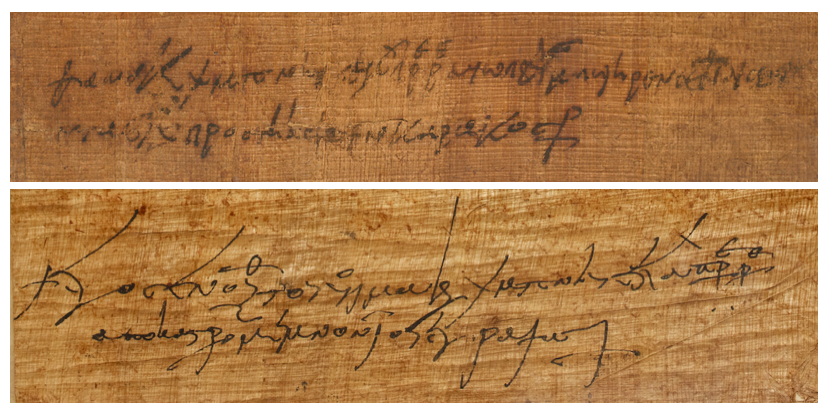
It is striking that three of the four men mentioned are priests, except for Pheu who is hired to teach Isaac’s son. In the village Djeme (Medinet Habu) in western Thebes, many of the people who wrote or witnessed legal documents were priests. The signatures of the father-son priests, Chmentsney and Shenoute, are below. In this case, did Chmentsney teach Shenoute how to write? And, if so, did he train him completely? Their documents show lots of differences, in handwriting and formulae, so it’s hard to say. Maybe he taught Shenoute the basics, but in this case professional legal training was taught somewhere else, so that new scribes were kept up to date with all the latest practices.
Signatures of Chmentsney (above) in P.KRU 13, dated 733, and Shenoute (below) in P.KRU 2, dated 749. (c) British Library (Or. 5985 and 4869)
As for the son of Isaac in our two ostraca, it is unlikely he ever advanced to the level of a professional scribe, as so few people ever reached that stage. But, Pheu at least taught him enough to satisfy the demands of his father.
*For Coptic literary evidence about the school experience, see this story.
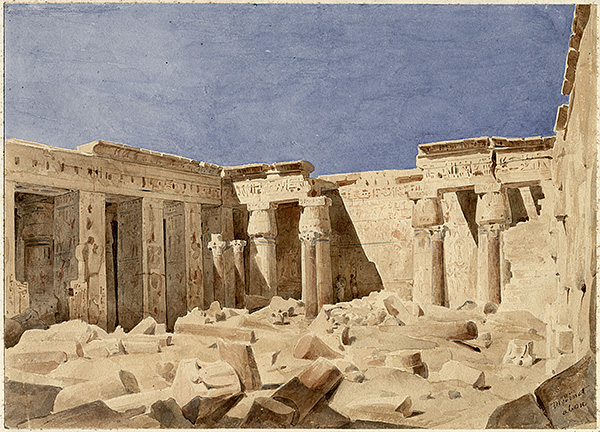
Remains of the Holy Church of Djeme (Medinet Habu, the mortuary temple of Rameses III). Is this the church in which Chmentsney and Shenoute worked as priests? Watercolour of Hector Horeau (Horeau MSS 23.1) (c) Griffith Institute, Oxford
Technical Details Provenance: Unknown; perhaps western Thebes. Date: 7th/8th century. Language: Coptic, Sahidic dialect. Collection: Paris,Cabinet des Médailles, #1894 and 1895 Designation: The text does not have a papyrological siglum; Trismegistos TM 85154. Bibliography: Anne Boud’hors (2016) “Apprendre à lire et à écrire: Deux documents coptes revisités,” in Proceedings of the 27th International Congress of Papyrology, Warsaw, 29 July–3 August 2013, edited by T. Derda, A. Łatjar, and J. Urbanik, pp. 1027–1039. Warsaw: Raphael Taubenschlag Foundation; Spiegelberg (1903) “Review of W. E. Crum, Coptic Ostraca from the collections of the Egypt Exploration Fund, the Cairo Museum and others,” Orientalistische Litteraturzeitung6, pp 59–69 (pages 67–68 for these texts).
On the 29 August 766 CE, a woman named Tachel daughter of Sophia from Luxor (ancient Apê) donated her son Athanasius to a local monastery, the monastery of Apa Phoibammon at Deir el-Bahri.
“In this current 5th indiction year, an infant boy was born to me, the woman and free person Tachel, in his seventh month. I promised him as a servant to the holy monastery of Apa Phoibammon of the mount of Djeme, that if God saves him from death, I will give him to the holy place.”
P.KRU 86
In an echo of the Old Testament I Samuel 1:10–11, and the dedication of the prophet Samuel to the temple by his mother Hannah, Tachel swears to dedicate her child to the monastery should he survive infancy.* The text can be interpreted as above, that the child was born prematurely in his seventh month, or that Tachel promised to dedicate him when he was seven months old (the Coptic syntax works either way). In the Greek and Roman world, it was believed that premature children born at seven months were more likely to survive than those born at eight months, as recorded in the writings of the ancient medical writers Hippocrates (5th/4th century BCE) and Soranus (1st/2nd century CE).
Hippocrates
On the Eight Month Foetus10: “The eight months’ children never survive.”
On Regimen1.25: “And likewise they are born viable both those fully formed more quickly in seven months and those fully formed more slowly in nine months.”
On Fleshes19: “The child born at seven months comes into being according to logic and lives … but one born at eight months never lives.”
Soranus
Gynaecology2.11: “[Birth] is best, then, in the ninth month and later if it should happen; but, in the seventh month as well.”
These months also occur in the documentary record. For example, in a letter from 64 CE, P.Fouad I 75 (from the Fayum), a woman Thaubas writers to her father informing him that his other daughter, Herennia, has died soon after childbirth, having given birth to a stillborn child a month prematurely, at eight months. In our later Theban document, it may therefore be significant that Tachel mentions the age of her child: at seven months, it was possible that he would survive, but it would be a dangerous time.
Tachel’s promise was heard and Athanasios not only survived, but thrived. In the face of his health and vigour, Tachel decided to break her promise to God and the monastery and keep the child. But the boy was punished for her decision, succumbing to a severe illness.
“Afterwards, God caused the little boy, whom I named in the holy baptism Athanasios, to grow and get bigger, and my lost reason threw me into great sin. Concerning this little boy, I plotted that I would not give him to the holy place. After God saw the lawless act that I had committed, he cast the little boy into a great illness, in which he remained for a long time, such that I and everybody who saw him reckoned that he had died. When I considered the reckless act that I had committed, I turned back and begged the saint in his monastery: ‘If you ask God to grant this infant boy healing, I will place him in the monastery forever, in accordance with my initial agreement.’ Then, the mercy of the merciful God had pity on the little boy and he granted him healing. I lifted him in my arms and took him to the holy monastery, because he had fallen into a demoniacal-illness. Everybody saw him and was amazed by him.”
P.KRU 86
After receiving healing, Tachel upheld her promise and donated the boy, having the legal document P.KRU 86 drawn up as a security for the monastery and confirming it as the new owner of the child. The legal clauses are exactly the same as those occurring in other contracts, e.g., sales of property.
“As the surety, then, the holy place asked me for this donation deed in respect of my beloved son Athanasios, which I concede to, as I live, my mind being my own, my reason firm, and there being no bodily illness upon me, but through my desire and my own decision, without any cunning, fear, violence, deceit, and ruse I declare that I assign my son Athanasios to the abovementioned monastery, from now to forever and for all time following me, forever. Furthermore, the person who will dare sue this infant boy, thusly, he will be subject to the judgement of my offering and the judgement seat of God, and I will receive judgement with him. As a surety, then, for the holy place, I have drawn up this donation deed. It is secure and valid everywhere in which it may be produced.”
P.KRU 86
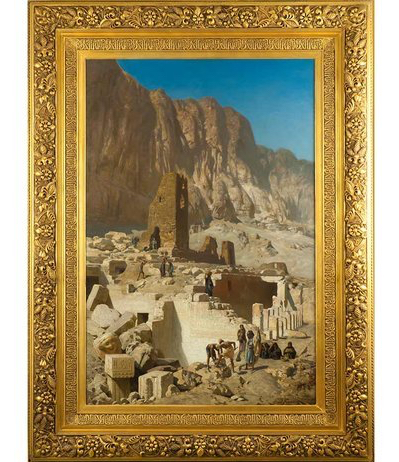
Monastery of Apa Phoibammon, remains at Deir el-Bahri. Oil painting by Ernst Koerner (1846–1927) entitled Ruinen des Tempels der Königin Hatschepsut (Neues Museum, Berlin)
The Corpus of Child Donation Documents This document is one of a group of 25 texts that record donations of boys to the monastery of Apa Phoibammon, dating primarily from 750–781 CE (P.KRU 78–103). Our document above is one of a small number in which women alone donate their child. Tachel doesn’t mention the child’s father, nor does she mention her own, providing only her own mother’s name, and she acts together with her sister: “I, Tachel the daughter of Sophia from Apê of the Hermonthite nome, with my sister Elisabeth acting with me in this.” Can we read anything into this? Was Tachel a single mother with no male family in her support network, for whom donating a child – especially a sick child – to the monastery was the best decision? However, in other documents, fathers donate their son without any mention of a mother (did the mother die in childbirth or soon afterwards?), while in the majority of documents both parents donate their child together. In most cases, the child was ill – sometimes near death – and the parents pray for their recovery. Child mortality rates were very high in the ancient world, with a 30% chance that a child would die before its first birthday. Parents praying for the well-being of their child is no surprise, nor is their willingness to do anything for their protection, including giving them away to a monastery. But was this the only motive? The documents say no more, but the mid-8thcentury was a time of increasing difficulty for villagers throughout the Nile, and our documents are the latest evidence of daily-life in western Thebes with the settlements in this area seemingly abandoned by the end of the eighth century. Can we read economic motives in the donations?
And what of the children themselves? What were they to do in the monastery? While P.KRU 86 provides no information in this respect, other documents in the corpus record more information. It is clear that the boys were not to become monks. Their tasks in the monastery were entirely of a servile nature: manual labour dedicated to the upkeep of the monastery. As P.KRU 80 (776 CE) states:
“… and he will serve the holy monastery for the sweeping, the sprinkling, the water for the tanks, the care of the lamp of the altar, and every duty of the holy place and everything that the steward will order him (to do). If it happens that the steward wants to release him and he works, the product of his hands will belong to the steward annually, forever, and he spends it on oil for the lamp of the altar.”
P.KRU 80
Even if the child eventually leaves the monastery, all the profits of his work will belong to the monastery. According to another donation, P.KRU 95 (ca. 750 CE), any children that the boys would have of their own in the future would also belong to the monastery. Their status was hereditary.
Were these children then slaves? A couple of documents state this explicitly: “he will serve the monastery for all his remaining days, like an old slave” (P.KRU90; ca. 750–760 CE); he will be “like a slave bought for money” (P.KRU 82; 771 CE). The monastery will care for them, provide food, shelter, and clothing, and in return the monastery receives a source of free labour, allowing the monks to turn their attention to other concerns.
When Tachel donated her child Athanasios, what was she thinking about and feeling? Was she sad at losing her child? Was she relieved at no longer having the burden of a sick child with limited family support? Did she know what future lay in store for Athanasios? Or, was she mainly happy knowing that he would have a safe home in a turbulent time?
*A direct reference to I Samuel I:10–11 occurs in three of the documents (P.KRU 89, 96, 100), showing that the parallel was well-known (if not obvious) to some of those involved in producing these contracts.
Technical Details Provenance: Written Luxor (ancient Apé), found Deir el-Bahri (Monastery of Apa Phoibammon) Date: 29 August 766 CE Language: Coptic (Sahidic dialect) Collection: British Library, London (Papyrus LXXXV) Designation: P.KRU86; P.Lond.Copt. I 384; Greek beginning = SB I 5597 (according to the Checklist of Editions) Bibliography: W. C. Till (1964), Die koptischen Rechtsurkunden aus Theben (Vienna) pp. 162–164; T. G. Wilfong (2002), Women of Jeme: Lives in a Coptic Town in Late Antique Egypt (Ann Arbor), pp. 100–102.
Other bibliography on the Coptic child donation texts: Papaconstantinou, A. (2002) “Notes sur les actes de donation d’enfant au monastère thébain de Saint-Phoibammon,” Journal of Juristic Papyrology 32: 83–105. Available online here (Open Access). Papaconstantinou, A. (2002) “ΘΕΙΑΟΙΚΟΝΟΜΙΑ: Les actes thébains de donation d’enfants ou la gestion monastique de la pénurie,” Travaux et mémoires 14: 511–526. Richter, T. S. (2005) “What’s in a Story? Cultural Narratology and Coptic Child Donation Documents,” Journal of Juristic Papyrology 35: 237–264. Available online here (Open Access). Schenke, G. (2016) “The Healing Shrines of St. Phoibammon: Evidence of Cult Activity in Coptic Legal Documents,” Zeitschrift für Antikes Christentum / Journal of Ancient Christianity 20: 496–523.
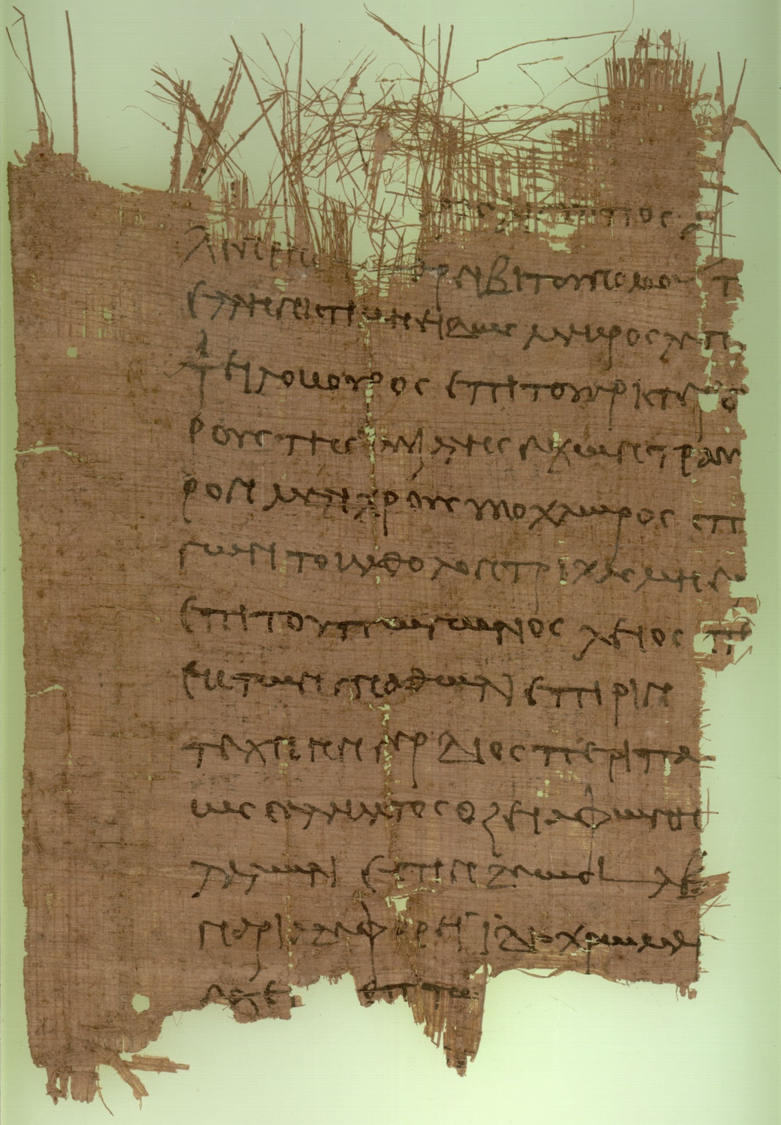
At some point during the third century CE, a slave-owner wrote a notice of a runaway enslaved man. The tall, thin Egyptian man in his early thirties – a weaver by trade – had gone missing and a reward was out for his return. The description of him, given by his owners, is particularly unflattering:
“[A reward is available if anyone finds NN] an Egyptian from the nome of Athribites, who does not know Greek, [and is] tall, thin, bald-headed, with a scar on the left side of his head, of olive complexion, jaundiced, thinly bearded, and having no hair at all on his chin, smooth-skinned, narrow-jawed, with a long nose, a weaver by trade, who walks around like he’s somebody, rambling on in a high-pitched voice. He is about 32 years old. He is wearing a brightly coloured cloak.”
P.Oxy. LI 3617; translation by Parkin and Pomeroy 2007
Other documents found at Oxyrhynchus also provide evidence of fugitive slaves. P.Oxy. XII 1423 from the mid-4thcentury is an authorisation for the arrest of a slave, while in P.Oxy. XIV 1643 (dated 298 CE) a slave-owner authorises his representative to imprison his slave, who had fled to Alexandria (380 km away), and to accuse him, beat him, pursue those harbouring him, and return him to Oxyrhynchus.
Runaway slaves were not uncommon in the slave societies of ancient Greece and Rome, as revealed by classical writers. In Xenophon’s Memorabilia2.10.1–2, Socrates asks his companion Diodorus: “Tell me, Diodorus … if one of your servants runs away, do you take steps to bring him back safe?”, to which Diodorus replied “Yes, of course, and I invite others to help, by offering a reward for the recovery of the man.” Despite being separated in time and space (from 4thcentury BCE Athens to 3rdcentury CE Egypt), slave owners’ concern that their slaves would flee was universal, a reflection of the horrors that the majority of slaves endured. The slave owner in the translation above derides his slave as walking around “like he’s somebody”, when in reality he was nobody in the eyes of his owner.
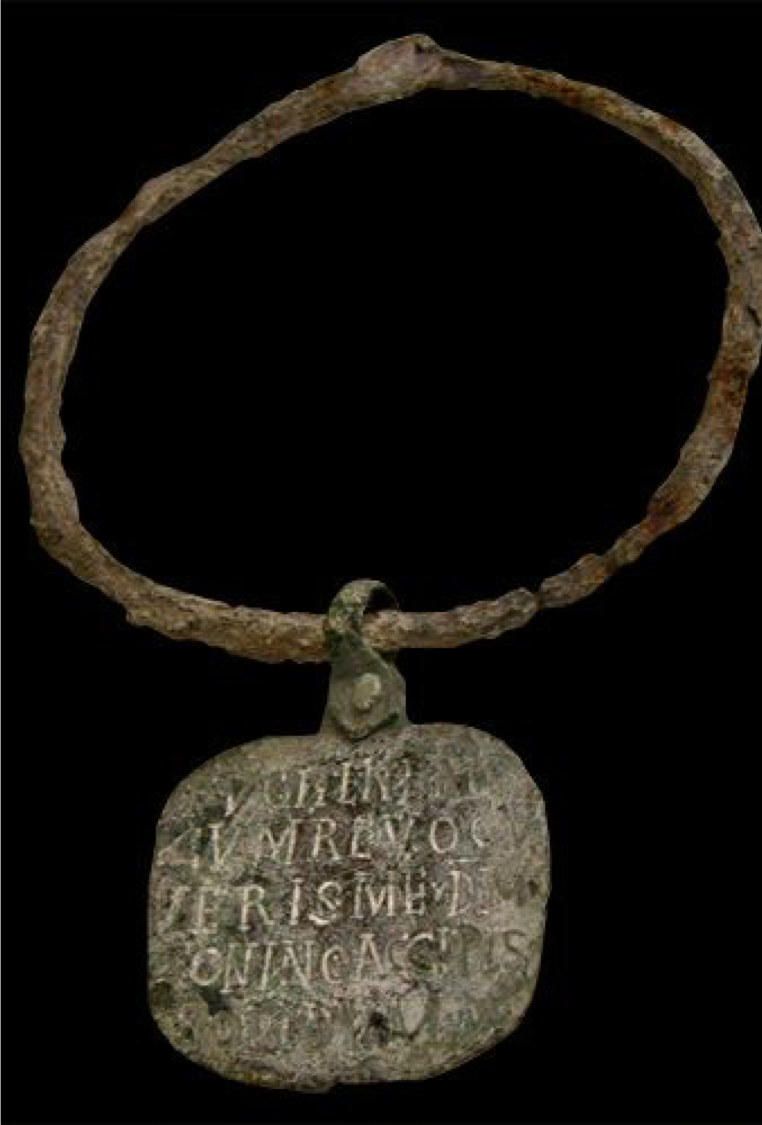
Slaves were property and treated as such. They could be sold, bequeathed, given in dowries and gifts, and even divided up between multiple owners who each owned a part of the slave (or the slave’s services). To protect their property, owners could undertake different measures to restrict slaves’ abilities to escape. Perhaps the most overt examples of these measures that survives in the archaeological record were slave collars. The most famous example of these collars, which is the only one to survive with its bronze label attached, is known as the Zoninus collar, after the name of the slave-owner written on the tag. The Latin inscription reads Fugi, tene me. Cum revoc(a)veris me d(omino) m(eo) Zonino, accipis solidum“I have run away; hold me. When you have brought me back to my master Zoninus, you will receive a gold coin.” These collars seem to be especially common in late antiquity, after the rise of the Christian church, when other brands of marking slaves that involved physical disfiguration may have been frowned upon.
Zoninus slave collar (c) Museo Nazionale Romano-Terme di Diocleziano (Rome)
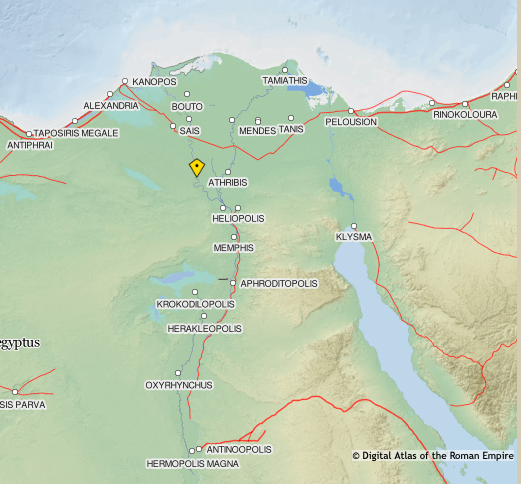
But where would slaves run to? In the example of the tall, thin Egyptian man above, he’s described as from the Athribite nome, but the papyrus was found in Oxyrhynchus, almost 250 km to the south (see map). How are we to understand this? Was he originally from there, but had been brought as a slave to Oxyrhynchus, and perhaps he was trying to return home? Or, had he fled from Athribis and the note of his escape somehow found its way south? When slavery was legal everywhere, where was there a safe haven? And who could provide safe haven when harbouring an escaped slave was also against the law?
As the protagonist Lucius in Apuleius’ Metamorpheses (“The Golden Ass”) asks of a slave-girl: “But where in the world will your flight be directed? And who will provide a sanctuary for you?”
Technical Details Provenance: Oxyrhynchus, Egypt Date: 3rd century CE Language: Greek Collection: Sackler Library, Oxford (papyrus 3617) / Egypt Exploration Society Designation: P.Oxy. LI 3617 (according to the Checklist of Editions) Bibliography: Tim G. Parkin and Arthur J. Pomeroy (2007), Roman Social History: A Sourcebook (London: Routledge) p. 169; Jennifer Trimble (2016), “The Zoninus Collar and the Archaeology of Roman Slavery,” American Journal of Archaeology 120/3, pp. 447–472
Additional bibliography: Keith Bradley and Paul Cartledge, eds. (2011) The Cambridge World History of Slavery Volume 1: The Ancient Mediterranean World (Cambridge: CUP)
Playmobil boxed and unboxed: My new desk companion!
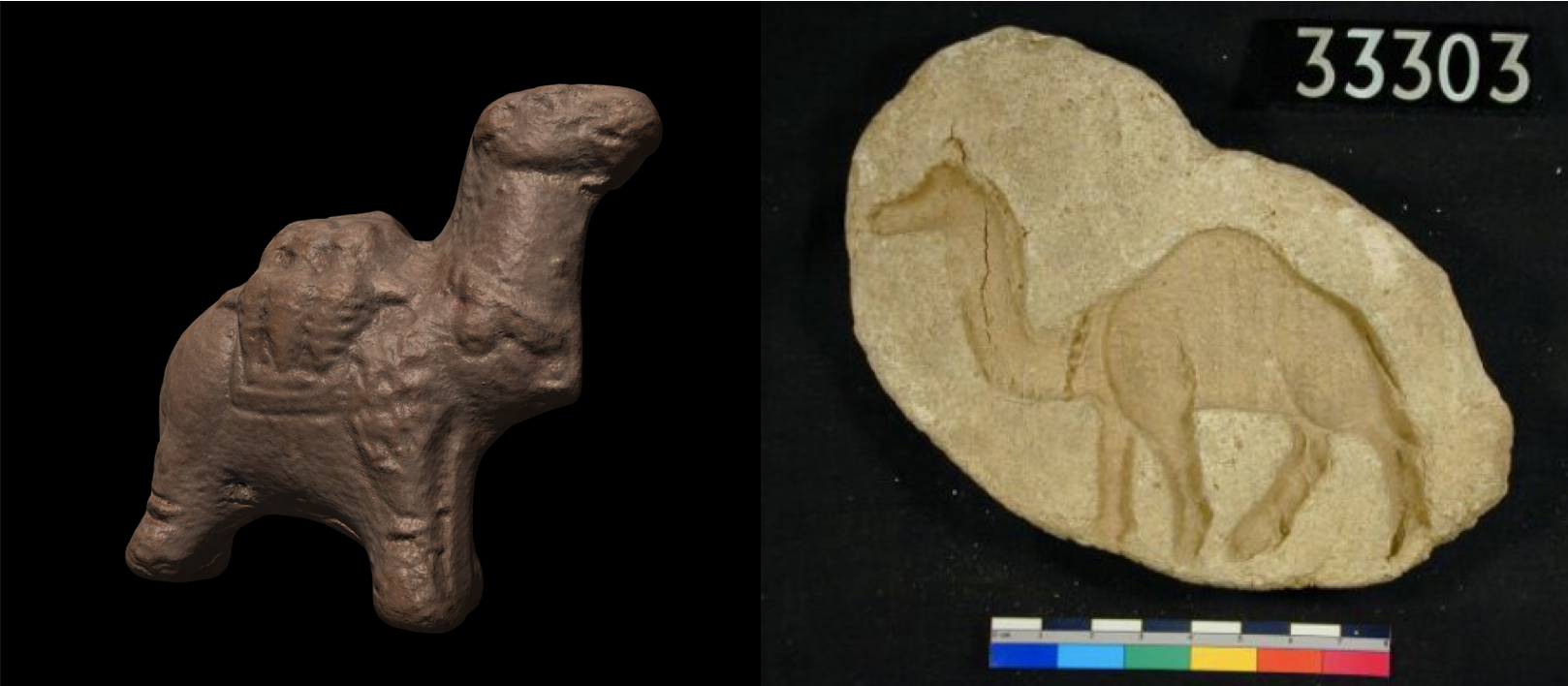
I recently bought my first ever Playmobil set: Egyptian Warrior with Camel. It’s only taken me thirty odd years. But I can’t resist a camel. And this kit evokes one of the key images that comes to mind when we think of ancient Egypt: the quintessential image of camels in front of the pyramids. Camels, however, were not common in the pharaonic period – they are not indigenous to Egypt. It’s possible that they were transported to Africa via the narrowest part of the Red Sea, between the Arabian Peninsula and modern Eritrea / Djibouti in ancient times, and so the odd one may have been seen by the ancient Egyptians. If anybody did see one, though, it’s really unusual that camels are never depicted in tomb scenes, which show a whole variety of exotic animals.
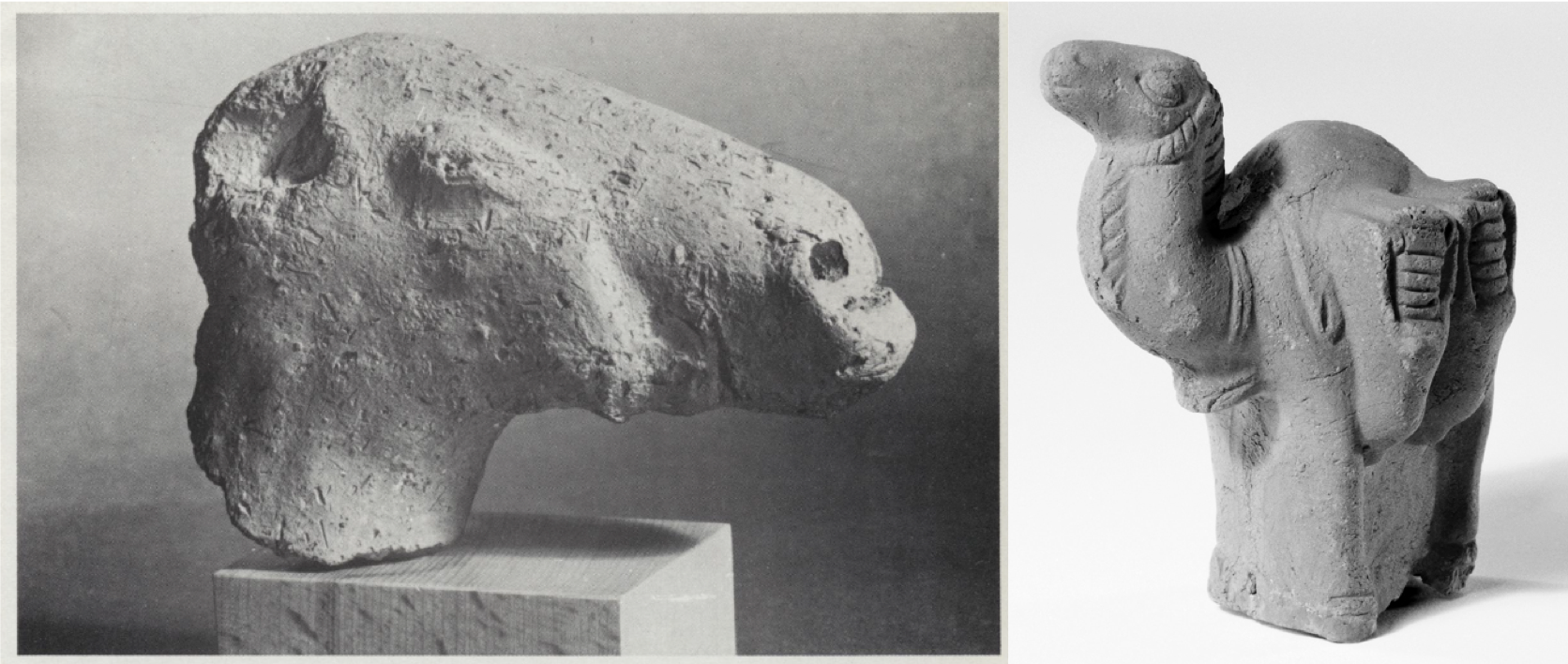
Early 20th century archaeologists, including Frederick Green and James Quibell at Heirakonpolis and Flinders Petrie at Abydos, seemingly identified terracotta camel heads on site. However, model camel heads and sheep heads are almost indistinguishable – without the long legs and neck of the camel, when is a camel not a sheep? Possibly the earliest secure pharaonic attestation of a camel is a dish from Qantir in the Delta dating to the late 18th or 19th dynasty, ca. 1,300–1,100 BCE (published in Pusch 1996). The Assyrian occupation may have brought more camels into Egypt, but it is probably not until the reign of Ptolemy II (285–246 BCE) that the dromedary, the single-humped camel, was introduced in large numbers.
Left: From Midant-Reynes and Braunstein-Silvestre (1977). Right: from Adams (2007) Both now in the Ashmolean Museum, Oxford
In the grand scale of Egyptian history, camels are a relatively new thing. And that postcard of camels in front of the pyramids, never actually happened. And, contrary to Playmobil’s sets, no Egyptian ‘warrior’ would have saddled one up and charged into battle.
After its introduction to Egypt, however, the camel became one of the most important long-distance beasts of burden, perfectly equipped as it is for travel across the desert. Any discussion of transportation in Roman Egypt, especially the Eastern Desert, has a wealth of material to draw upon to discuss the use of camels. But what of smaller scale use closer to the Nile Valley itself? What role did camels play in the daily lives of people in late antiquity? Coptic documents from several sites give us an idea.
Wadi Sarga The monastery of Apa Thomas at Wadi Sarga, located in a desert valley a couple of kilometres from the cultivation’s edge, provides great opportunities to study its daily and economic life in the 7th and 8th centuries CE (for which, the project page at the British Museum is a great place to start). Excavation of the site in 1913/14 resulted in the discovery of a large body of documents, mainly in Coptic. Among this corpus are letters written to the monastery that ask for loans of camels for different reasons. In one letter, the senders – the names of whom are unfortunately lost – ask:
“… send [us] eight [camels], so we can load them with wheat … And provide three camels for wine … Whenever the camels are coming up(?) loaded with fodder, tell us, so we can load [them], to come down(?)”
O.Sarga 93
In another letter, really much more of a brief note asking for a favour, monks from another monastery write to the superior of the monastery at Wadi Sarga for an unspecified number of camels for a different reason:
“Give it to the Father, Apa Justus, from the brethren of Pohe. Please send us all the camels, so that they can clear out these palm-branches. For we will come up/down on the night of the feast.”
O.Sarga 94
(As a sidenote for both texts, in Sahidic Coptic the same word is used for ‘up’ and ‘down’, so we don’t actually know what directions are intended.) In addition to these letters, receipts of wine show that large quantities were delivered to Wadi Sarga by camels, on a daily basis for a month after the grape harvest. Whether the monastery owned all these camels is difficult to determine, but the letters at least confirm that the monastery did own some of its own and they were used for a range of activities, from transport to cleaning up before a festival.
O.Sarga 94 (left) and 93 (right). Photographs by J. Cromwell, (c) Trustees of the British Museum
Western Thebes Moving south to western Thebes, a number of legal contracts were drawn upon between individuals and camel herders to work and tend the animals for them. These contracts all differ in their details, based on the needs and expectations of the parties involved. In one ostracon, a man Sacou is hired to look after two camels together with all the equipment belonging to them. In turn, he will be paid in a mix of wheat, wine, and other commodities. One really important incidental detail is that Sacou’s payment will vary depending on whether the inundation is high or low, that is, whether the resulting harvest will be a good or a bad one:
“I, Isaac, hired Sacou for the camels, to tend the two camels, their equipment, and their accessories. If I find any negligence on his part, he will swear an oath to me about my cattle and the work [for] the monastery. I, myself, am ready to pay him twenty artabai of wheat in the high-yield year, plus twenty-five jugs of wine, an artaba of dates, and two lakane of oil. In the low-yield year, sixteen artabai of wheat, plus twenty jugs [of wine], and two lakane of oil.”
O.Lips.Copt. 28
In a second example, Joseph son of Paul is hired by Apa Victor on behalf of the monastery of Apa Phoibammon (built upon the temple of Hatshepsut at Deir el-Bahri) to look after a camel and its calf, from the first day of the festival of Apa Papnoute on Mechir 15 (9th February or the 10th if a leap year) for one year. Unlike the previous contract, no wages are actually recorded here, but the document specifies the individual pieces of equipment belonging to the camel, including a couple of collars and baskets.
“I, Joseph the son of Paul, write to the priest Apa Victor. You hired me to tend your camel. Now, I am ready to devote myself to it, with all my power, and to tend the calf until the time that I will leave your camel. I will tend it from the first day of Apa Papnoute1to the first day of Apa Papnoute of another year. Moreover, I will look after your [equipment] and return it to you when I leave you, namely: a working(?)-collar, a chain(?)-collar, a rope basket, and a […] basket. Moreover, you shall not find me in contempt over anything.”
O.Crum 221
But what did the camels do? A short letter found at the monastery of Epiphanius (built in and around Theban Tomb 103) records how two camels were used to transport a loom (P.Mon.Epiph. 352). A contract, from the church of St Mark on Gurnet Mourrai, records that the herder’s terms of employment include drawing water one day a week (SB Kopt. IV 1803).
From short to long distance travel, drawing water from wells, and sweeping up debris, camels became an essential part of everyday life in Egypt. Albeit not until the Ptolemaic period, and not in the way that Playmobil thinks.
Technical Details (Text 1): Provenance: Monastery of Apa Thomas, Wadi Sarga, Egypt Date: 7th century CE Language: Coptic (Sahidic) Collection: British Museum (EA 55736) Designation: O.Sarga 93 (according to the Checklist of Editions)
Technical Details (Text 2): Provenance: Monastery of Apa Thomas, Wadi Sarga, Egypt Date: 7th century CE Language: Coptic (Sahidic) Collection: British Museum (EA 55752) Designation: O.Sarga 94 (according to the Checklist of Editions)
Technical Details (Text 3): Provenance: Western Thebes; Egypt Date: 7th century CE Language: Coptic (Sahidic) Collection: Ägyptisches Museum, University of Leipzig, Leipzig (inv. 1611) Designation: O.Lips.Copt. 28; SB Kopt. IV 1802 (according to the Checklist of Editions) Bibliography: Tonio Sebastian Richater (1998) “Zwei Komposita jüngerer Bildungsweise im koptischen Ostrakon Ägyptisches Museum der Universität Leipzig Inv.-Nr. 1611,” Zeitschrif für ägyptische Sprache und Altertumskunde 125, pp. 56-62
Technical Details (Text 4): Provenance: Monastery of Apa Phoibammon (Deir el-Bahri), western Thebes, Egypt Date: Early 7th century CE Language: Coptic (Sahidic) Collection: British Museum (EA 33062) Designation: O.Crum 221 (according to the Checklist of Editions) Bibliography: Walter C. Till (1956), “Die koptischen Arbeitsverträge,” Eos48.1, pp. 272—329 (#28); Walter C. Till (1964), Die koptischen Rechtsurkunden aus Theben (Vienna), p. 58.
Other bibliography on camels: Adams, Colin (2007), Land Transport in Roman Egypt. A Study of Economics and Administration in a Roman Province (Oxford: OUP) Agut-Labordère, Damien, and Bérangère Redon, eds. (2020) Les Vaisseaux du désert et des steppes: Les camélidés dans l’Antiquité (Camels dromedarius et Camels bactrianus) (Lyon: MOM Editions); available online here. Midant-Reynes, Béatrix and Florence Braunstein-Silvestre (1977), “Le chameau en Égypte,”Orientalia, NOVA SERIES 46/3, pp. 337–362 Pusch, Edgar B. (1996), “Ein Dromedar aus der Ramses-Stadt,” Ägypten und Levante6, pp. 107–118 Ripinsky, Michael (1985), “The Camel in Dynastic Egypt,”The Journal of Egyptian Archaeology 71, pp. 134–141 (note: this article repeats early archaeologists’ presumed discovery of ceramic camel heads)
Left: camel terracotta (UC48026), Right: camel mould (UC33303). Both in the Petrie Museum of Egyptian Archaeology. See online publication here.
What did late antique Egyptians sing about at Christmas? Angels, shepherds, and the Virgin Mary, of course. Angels have the main role in what appears to be the earliest manuscript of a Christmas carol, preserved in Greek on a papyrus from the city of Hermopolis (modern el-Ashmunein) in Middle Egypt, Berlin P. 11842. The somewhat effaced hymn is written on the back of a tax receipt from the mid-fifth century, thus it probably hails from the same period. It is a single text that was scribbled on any available scrap papyrus, and all the empty spaces were used to write lists; perhaps someone took a note of a hymn he heard in church. The text evokes the light that appeared to the shepherds and cites the song of the angels. Here is my rough translation:
“Light shone from above… to us the word of faith, and he heralded us the song of the angels, Glory to God in the highest, to God our Saviour, hallelujah.”
But why do we have to wait until the fifth century to get the first Christmas carol on papyrus? After all, Christian hymns were recorded in Egypt already in the third century. One reason is that the earliest hymns do not make reference to the liturgical year. They are usually general praises of Jesus Christ and elaborate on salvation and baptism. Even more importantly, Christians in Egypt did not celebrate Christmas until the end of the fourth century. They had only Epiphany (that little noticed festival on 6 January about the Magi and the baptism of Jesus), and they accepted Christmas as a separate feast day of Jesus’ birth only at some point in the 5th century. Once introduced, however, Christmas became a favourite topic of hymn writers, just like in the West. Berlin P. 11842 is the first in a long series of Christmas carols preserved on papyrus. Many of them paraphrase the Nativity narrative of the Gospel of Luke and elaborate on shepherds and angels. A few turn to the Gospel of Matthew and cite the star and the Magi. The Virgin Mary takes the centre stage in many hymns. Her miraculous virgin birth and her being the Mother of God was a matter of theological importance, and liturgy in Egypt was eager to reaffirm it. There is, however, much less focus on baby Jesus. His birth is of course the central question, but it is only on a few occasions that his person enters the spotlight and he is described as an infant wrapped in swaddling clothes, especially to emphasize the contrast between his divine glory and his self-humiliation as a human child in a manger. But altogether the late antique Christians in Egypt were little interested in images of a cute little baby Jesus. Their focus was on the theological complexities and the salvific value of the mystery of incarnation.
Coptic mural from the Monastery of Appolo at Bawit with the Virgin Mary and Jesus
Technical Details Provenance: Egypt, Hermopolis Date: ca. 450 CE Language: Greek Collection: Ägyptisches Museum und Papyrussammlung, Berlin (P. 11842 verso) Designation: Berlin P. 11842 vo 1 (trismegistos.org: TM 64971 / LDAD 6212) Edition: Kurt Treu (1971), “Neue Berliner Liturgische Papyri,” Archiv für Papyrusfroschung 21, 66.
What did a young man in the fourth century CE wish from life? Not much different from what young men today might desire: professional success, favour with others, and, of course, women. His means of attaining his goals were, however, not that familiar to the modern reader. He resorted to a long roll filled with Greek magical charms, a papyrus now kept in the Oslo University Library, which promised him immediate success with all these things. Or as the title of the second spell suggests: “Charm to restrain anger, to secure favour and an excellent charm for gaining victory in the courts. It works even against kings, no charm is greater.” Who would not want that? And it was easy to perform. All our ambitious young man needed to do was to write with a bronze pen on a silver foil (lamella) the figures and signs below, and wear the result under his garment.
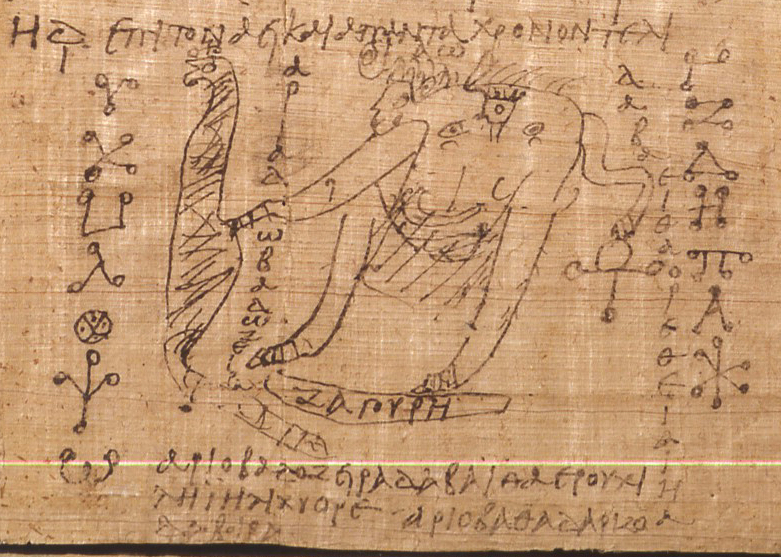
Our young man was perhaps a lawyer or was involved in local politics, as many ambitious young men in the period were, hence his interest in winning court cases, reflected in another charm for “gaining the favour of people in your presence and of crowds.” Victory could be achieved by restraining the tongue of the advocate of the adversary as well, as the first charm of the roll promises. A prudent man moreover counts on the other party using a similar charm against him, and learns “a charm to break all spells,” which included drawing this cute figure on a lead foil:
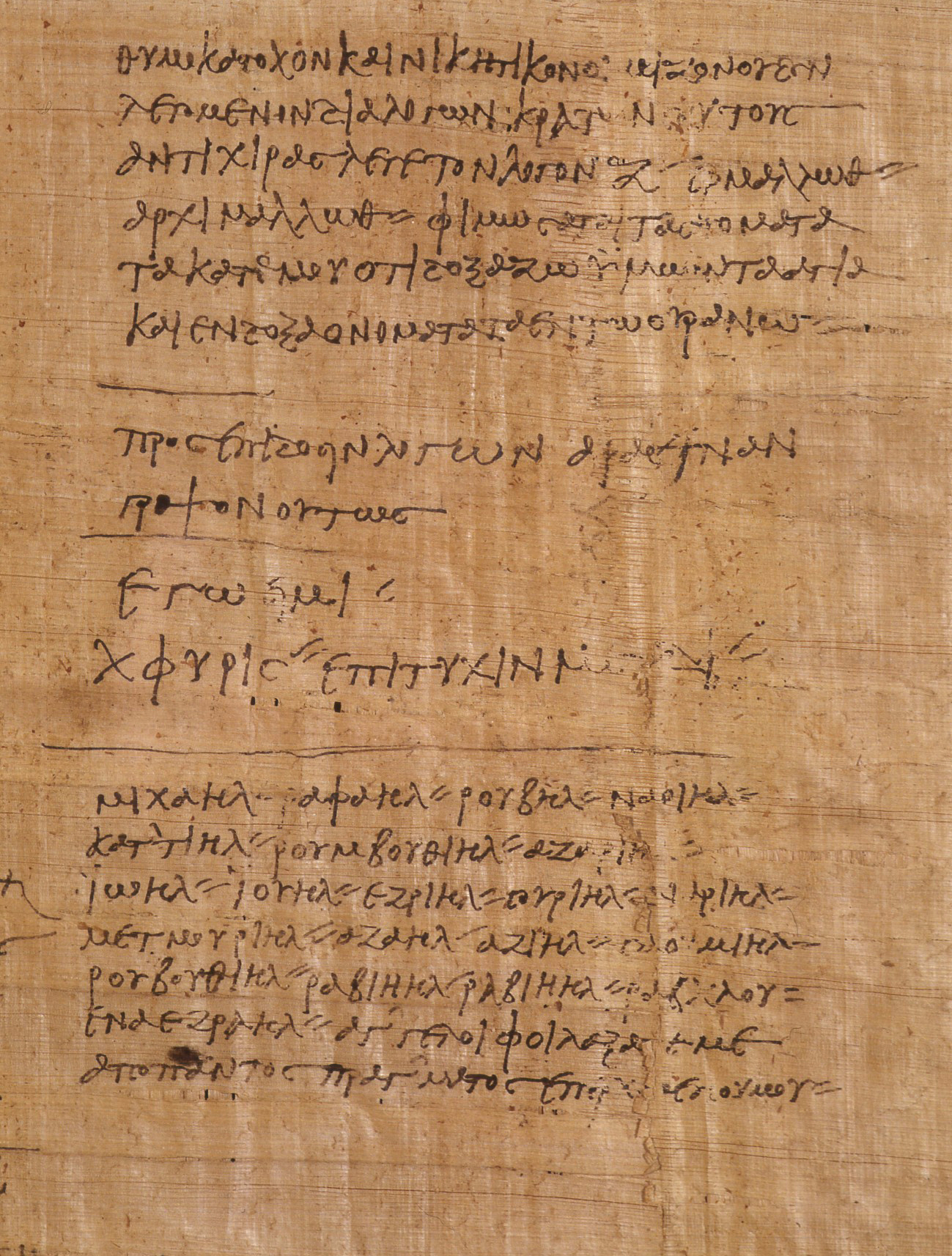
Gaining favour and restraining the evil intentions and gossip of adversaries is a general desire, and it is all the better if you can achieve it by simply holding your thumbs and saying a short prayer seven times: “Ermalloth archimalloth, stop the mouths that speak against me, because I glorify your sacred and honoured names which are in heaven.” (If it does not work, you might be holding your thumbs in the wrong way. You can also try saying a much longer prayer to Helios, the Sun-god, provided a few columns below.)
However, the main concern of our fourth-century young man, as of young men in all ages, was getting women. For attaining his goal he collected seven “irresistible love spells of attraction,” the most efficient dating tricks available, since they also worked against the will of the woman. The user of these charms never needed to take no for no again if he could also command a cock-headed demon to set the soul of the desired woman on fire until she rushes out of her home and, as the spell says, “glues her female pudenda to my male one” (just to make sure the demon does not misunderstand his job).
Once our young man attained the woman he wanted, he could resort to another charm to ensure her faithfulness, the “pudenda key spell,” to be recited over a balm which is then applied to the penis before lovemaking. As a result, “she will love you alone and by no one else will she be laid,” ensures the spell. And another useful thing for ambitious young men, a contraceptive charm, “the only one in the world.”
In short, this impressive roll of over two meters contained a lot of things that a young man in the fourth century (or indeed in any time) would need for professional and personal success. If the charms worked we do not know, but many needed desperate users, since they involved blood from a bat, gall of a river electric eel, the umbilical cord of a firstborn ram, and manipulating dangerous demons. Try only at own risk!
Technical Details Provenance: Egypt, Fayum Date: ca. 350 CE Language: Greek Collection: University Library, Oslo Designation: P.Oslo I 1 = Pap.Graec.Mag. XXXVI (following the Checklist of Editions) Translation: Hans Dietrich Betz (ed.), The Greek Magical Papyri in Translation. Chicago: The University of Chicago Press, 1986. Bibliography: William M. Brashear, “The Greek Magical Papyri: An Introduction and Survey; Annotated Bibliography (1928–1994)”, in Aufstieg und Niedergang der römischen WeltII. 18.5. Berlin, 1995, 3552–3553; Todd Hickey, Anastasia Maravela, Michael Zellmann-Rohrer, “Historical and Textual Notes on Magical Texts in the Papyrus Collection of the University of Oslo Library”, Symbolae Osloenses: Norwegian Journal of Greek and Latin Studies 89 (2015), 156–185.
The Neo-Assyrian physician Nabû-tabni-uṣurseems once upon a time for reasons we may never know to have fallen out of favour with the court. Unlike his colleagues, he no longer received compensation for his work. Payments promised by the court never materialised. Concern for his financial well-being and his position in the court snowballed into fear. Gripped by anxiety, he penned – or, rather, impressed – this letter to the king.
“To the king, my lord, your servant Nabû-tabni-uṣur. Good health to the king, my lord!
…
If the king, my lord, knows a fault made by me, let the king not keep my alive!
…
All my associates are happy, (and) I am dying of a broken heart. I have been treated as if I did not keep the watch of the king, my lord; my heart has become exceedingly troubled, heartbreak has seized me, I have become exceedingly afraid: may the king revive my heart before my colleagues!” (ABL 525)
Found at Nineveh in the royal library and now housed in the British Museum (K. 590), the cuneiform tablet that carries these words provides a window onto a language for anxiety that overlaps with modern ways of framing worry, fear, and sorrow, a language that centres the heart, or Akkadian libbu,as an organ of thought and emotion. More specifically, a broken heart.
Our physician’s description organises his experience of heartbreak along the same lines as those found in contemporary therapeutic medical texts, a rich corpus of texts that describe illnesses and prescribe treatments, like this one from nearby Aššur:
“[If] he continually has heartbreak… in his bed he is continually afraid, he suffers paralysis up his form; toward god and king, his heart is filled (with anger), his limbs are poured out repeatedly, on repeated occasions he is afraid; day and night he does not sleep, he continually sees frightening dreams, he continually suffers paralysis; he has no desire for bread or beer; he forgets the words that he speaks.” (BAM 234)
Fear, paralysis, nightmares, sleeplessness, loss of appetite, and forgetfulness are recorded as presenting with the condition labelled as heartbreak.
For anyone who has experienced anxiety, some of these symptoms might sound familiar. In modern biomedical models, anxiety is also described both in mental and physical terms. Adjectives that describe emotional states, like worried, afraid, and nervous, appear alongside descriptions like physical weakness, gastrointestinal problems, and a pounding heart to describe experiences associated with anxiety.
Symptoms of any illness are labelled according to socially available categories, and it seems that for a Neo-Assyrian physician, the vocabulary for this particular experience of mental distress has echoes in today’s world. And it seems that in the first millennium BCE, it was acceptable to admit, even to a king, that one was suffering emotional anguish.
Some of the earliest known expressions of mental distress come from ancient Mesopotamia, where ancient scribes impressed into clay words that capture individual, collective, and historical experiences not just of anxiety, but of a whole spectrum of mental health issues, from depressed states to disorganised thoughts.
So, if you ever you find yourself feeling anxious, remember Nabû-tabni-uṣur and his letter to a Neo-Assyrian king, and remember that you are not alone. These are ancient and human problems. They connect us to the past, and they connect us to each other.
Technical Details: ABL 525 Provenance: Nineveh (near modern Mosul, northern Iraq) Date: Neo-Assyrian (911–612 BCE) Language: Akkadian Collection: British Museum, London (K.590) Designation: ABL 525; Cuneiform Digital Library Initiative P.334358 Bibliography: Simo Parpola (1993)Letters from Assyrian and Babylonian Scholars. State Archives of Assyria 10 (Helsinki: Helsinki University Press): Text 334
Technical Details: BAM 234 Provenance: Aššur (modern Iraq) Date: Middle-Assyrian (ca. 1400–1000 BCE) Language: Akkadian Collection: Vorderasiatisches Museum, Berlin Designation: BAM 234; Cuneiform Digital Library Initiative P.285320 Bibliography: Franz Köcher (1963) Die babylonisch-assyrische Medizin in Texten und Untersuchungen. Volume 3 (Berlin: De Gruyter): Text 234









 Papyrus Stories