Student Life in the 2nd Century CE

Some time around the turn of the 2nd century CE, a student – probably in Alexandria – wrote back to his father Theon to complain about various parts of student life. Unfortunately, the name of the student isn’t mentioned, so he remains anonymous. But his litany of complaints nevertheless will almost certainly strike a chord with many students today:

  • Bad, or at least uninspiring, teachers: the ones the writer had hoped to study with are no longer in the city, only “junk” is left behind.
  • Too many fees! Despite paying more and more fees, he has had to resort to self-study and learning by attending public declamations.
  • Neglect of personal appearance: “it is my despondency about those things that forces me to disregard my physical appearance, as it is not necessary for those who are not engaged in work to care about these things”.
  • Living in cramped quarters. The writer is currently living with another boy, Didymus (probably his brother), and is awaiting the arrival of another boy (probably their youngest brother), but is looking for a new, bigger place to live.
  • Food parcels from home – the letter ends with the writer acknowledging receipt of various goods, including lentils, vinegar, and meat.

Student life doesn’t seem to have changed that much over the past two millennia! One point is notably different, though. Despite all his problems and moaning, the writer is from a wealthy family who can afford to send a slave with him to the city: Heracles. Heracles had been sent to do unskilled labour to provide extra funds for our unhappy student, but is presented as a miscreant who has escaped and run back to tell-tales to Theon. One can’t help but wonder if this letter is a pre-emptive strike, to protect the student from his slaves’ tales of abuse at his hand.

While the student only mentions individual teachers and public declamations, it is possible that he studied at the site in Alexandria known today as Kom el-Dikka, which could be described as an ancient university complex, with auditoria and the only  Roman theatre to survive from Egypt, surrounded by domestic quarters and imperial baths.

The theatre at Kom el-Dikka (Alexandria) (c) Polish Centre of Mediterranean Archaeology, University of Warsaw

The full text of the letter is provided here, with the translation taken from Parkin and Pomeroy (2007):

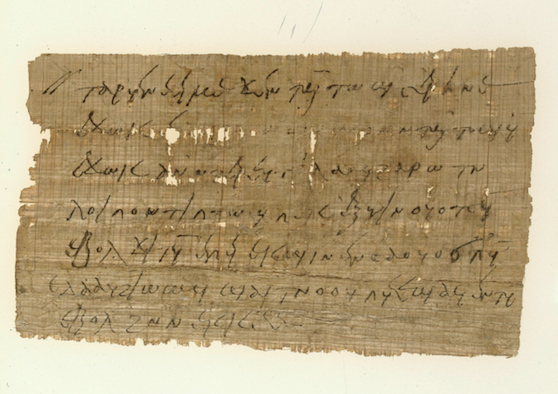
“To Theon, my lord and father, greetings. You have rescued us from the greatest despondency … I hoped by hurrying in sailing down that I would find fine opportunities – but what have I achieved for my enthusiasm? Even now, I am looking for a teacher and I have discovered that Chairon the teacher and Didymus son of Aristocles, with whom I have hoped that I might make progress, are no longer in the city, but only junk through whom most have taken the direct road to ruin. Previously, I wrote to you, just as I wrote to Philoxenus and company, to deal with the matter, and I was introduced by them to someone who looked suitable. But you immediately rejected him, although he had begged for Theon’s pardon, on the ground that you know him personally and he is totally lacking in ability. When I passed on your judgement to Philoxenus, he thought the same, saying that he pitied the city only for this lack of rhetors, but Didymus had sailed down [to Alexandria], apparently a friend of his who ran a school and would look after the others – and in particular he persuaded the pupils of Apollonius son of Herodas to transfer to him. They have up to now been seeking such a teacher of a higher education after the teacher they had enrolled with had died. But I, having prayed not to even look at Didymus from a distance if I found teachers worth mentioning, am depressed by this very fact: that he who used to teach in the country is settling himself up in competition with the others here.

So, knowing this – that, apart from paying more fees in vain, I have gained nothing from my teacher but have achieved something by myself – please write back as soon as possible saying what you think. I have Didymus, as Philoxenos will also say, always available to me and offering whatever help he can. Furthermore, by auditing the public performances, including those of Poseidonius, if the gods are willing I will quickly make good progress.

But it is my despondency about those things that forces me to disregard my physical appearance, as it is not necessary for those who are not engaged in work to care about these things, especially when they don’t have anyone to bring in some money. For once upon a time after a few days the helpful Heracles – woe of woes – would bring in some obols, but now along with his being put into restraints by Isidorus, he has run away and gone off, so it appears, to you. Be well aware that he isn’t averse to plotting against you if he has the opportunity. For he is not ashamed, especially to spread tales of events in the theatre and the city with alacrity and to babble out lies that no prosecutor would declare – and he has done this although he hasn’t suffered anything such as he deserved, but had been let roam and was acting like a free person in all matters.

But, all the same, you can hire him out to a builder if you don’t send him back, as I hear that a young man can make 2 drachmas a day. Or assign him some other task, where he can earn more money, so that the wages collected by him can be sent to us from time to time. For you know that Diogas is studying literature as well. In the time it takes you to send the young fellow, we will look for a bigger place in a private house: in order to be Dionysius’ neighbours, we have been living in a very small place.

We received the basket that had all that you wrote about safe in it: all the jars with the half-cadus, in which we found not 18, but 22 choes. And I sent a half cadus with a letter to all you wrote about. I got the six measures of whole lentils and a Coan jar full of vinegar, and 126 pieces of salted meat, plus those in the jar, and 30 pieces of cooked meat.

Farewell.”
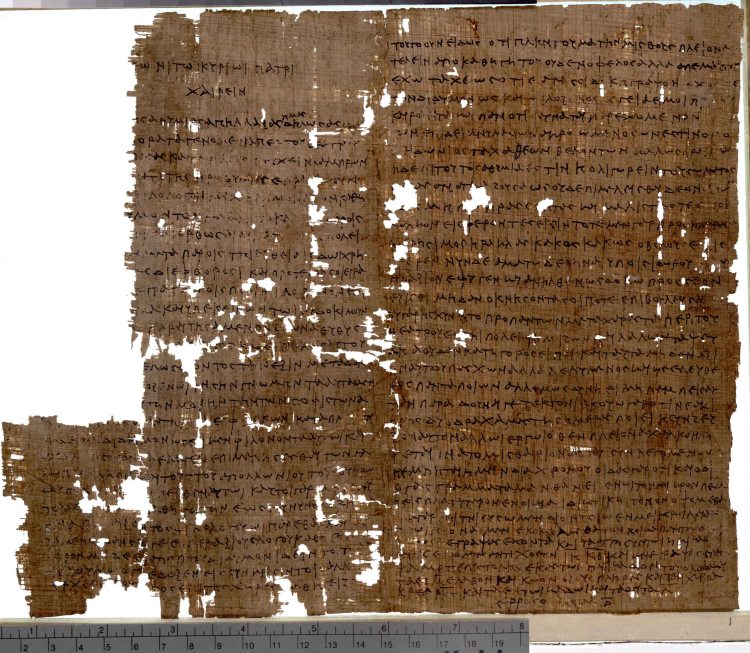
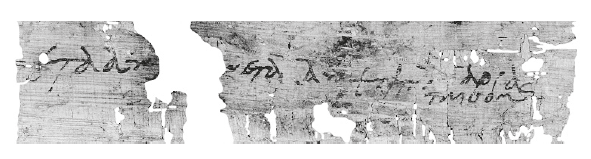
POxy.v0018.n2190.a.01.hires.jpg
P.Oxy. XVIII 2190, online here (c) Egypt Exploration Society


Technical Details

Provenance: Egypt, Oxyrhynchus

Date: ca. 100 CE

Language: Greek

Collection: Sackler Library, Oxford (which houses the Oxyrhynhus papyri for the Egypt Exploration Society)

Designation: P.Oxy. XVIII 2190 = SB XXII 15708 (following the Checklist of Editions)

Bibliography: John Rea (1993) “A Student’s Letter to His Father: P. Oxy. XVIII 2190 Revised” in Zeitschrift für Papyrologie und Epigraphik 99, pp. 75–88; Tim G. Parkin and Arthur J. Pomeroy (2007), Roman Social History: A Sourcebook (London: Routledge), pp. 140–142


For Kom el-Dikka, see also:

Tomasz Derda, Tomasz Markiewicz, and Ewa Wipszycka (eds.), Alexandria: Auditoria of Kom el-Dikka and Late Antique Education. Journal of Juristic Papyrology Supplement 8 (Warsaw: Foundation Raphael Taubenschlag, 2007)
Jealousy, Bullying, and Broken Thumbs

Jennifer Cromwell

While texts from day-to-day life provide immediate insights into the very personal concerns of individuals living in the ancient world, literary works also give glimpses into different aspects of daily life, even if their accounts may be embellished. In the Life and Martyrdom of two saints, Panine and Panew, the story begins with the boyhood friendship of the two, who would later go on to become monks and then martyrs. One episode in the life of Panine sends us back to his classroom, and what follows focuses on the window into the world of education in late antique Egypt that it contains.

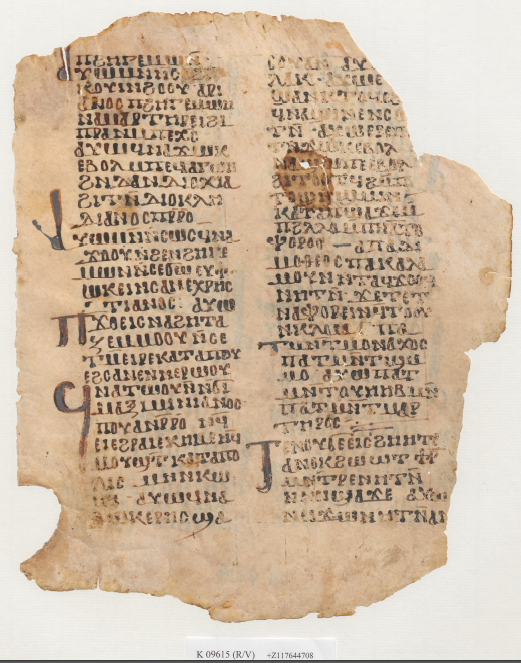
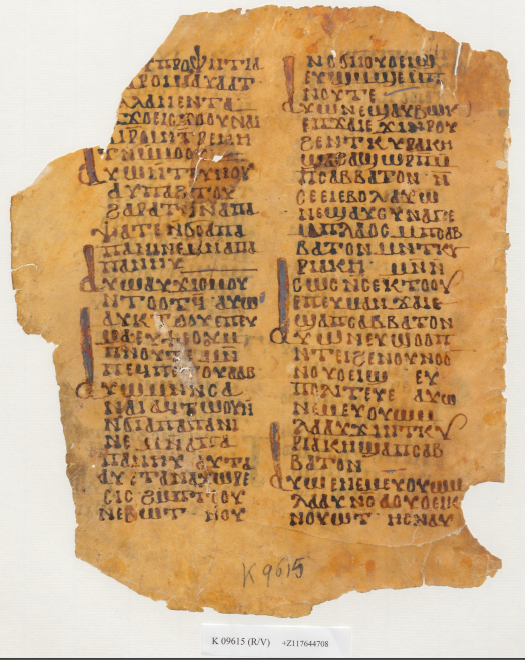
Panine and Paneu - Vienna page (r)
Page from the Vienna Manuscript: P.Vindob K 9615 (recto) (c) Österreichische Nationalbibliothek

The story is preserved in two different manuscripts, which today are in the collections of the Austrian National Library in Vienna and the National Library in Naples, but neither are complete. The manuscripts derive from the library of the White Monastery in Sohag and date to the 9th-11th centuries, although the story was originally composed around the 6th/7th centuries. The first surviving fragments start when Panine’s mother journeys to Antinoopolis to visit her parents. At this point, Panine is still known by his birth name, Symphronios. Whatever reason led his mother, Jonia, to bring him to the city is lost, but her parents rejoiced and immediately entered him into the classroom of a local notarial scribe called Silvanos. And Symphronios quickly excelled at his studies.

“The young boy Symphronios progressed daily through the teaching and the fear of the Lord. The eyes of his mind were enlightened and he quickly learned the art of writing. He began to surpass the older students, who had already received tuition in reading, accounting, and mathematics, and they became jealous of Symphronios, because they saw that he was cleverer than them and had surpassed them in the (study of the) Old Testament. The young boy Symphronios learned day-to-day writing (lit: ‘small hand’) in six months, and then book hand (lit: ‘big hand’) was written out for him.”

The curriculum that the boys followed in this metropolitan setting is here laid out, in terms of literacy and numeracy, as well as the different kind of scripts that they learned. First, they learned to write a common hand, which they would use in their daily writings. Once they had mastered this, they were able to move on to book hand – the type of hand that was used for producing literary works. Symphronios is able to move on to this more advanced writing skill after only six-months; how long the older boys had been learning is not stated, but clearly six-months was extraordinarily fast and earned him the even greater ire of his classmates.

“When the first letter was written for him, the older students on the same day became even more jealous of him. One of them, called Alexandros, who was related to the hegemon Arianos, said to his teacher ‘[…] Symphronios from Terôt-Shmoun, I can teach him and show him the principals of the letters.’ But the schoolteacher Silvanos said to him, ‘He doesn’t need any one of you to help him, because that young boy is clever than you.’”

Not the most subtle of responses from the schoolteacher …

“When Alexandros and the other older students realised that their teacher had made them look like idiots before Symphronios and […] Symphronios. And when their teacher wrote for all of them, he also wrote the second letter for Symphronios. He then left while they were sitting in the school’s courtyard and the teacher went home to eat bread.”

With the teacher, Silvanos, out of the way, the students – led by Alexandros – now take matters into their own hands.

“Alexandros and the older students said to the small young boy, the holy Symphronios, ‘Quickly, show us your writing-board, so that our teacher will not […] us for your aptitude.’ Immediately, the young boy Symphronios got up and showed the letters with great cleverness, like someone who had spent a long time in the classroom. The student Alexandros – the Devil filled all his body – jumped upon the young boy Symphronios. He grabbed his two thumbs, on his left hand and on his right hand, and bent and pulled them until their bones dislocated from their joints. Then he said to him, ‘Try to hold the pen now, peasant!’”

With his mutilated hands, Symphronios remained silent, leaving the matter to the Lord. During this time, Symphronios was friends with another boy, Panew, in whose company he sought solace. Panew informed the teacher that it was Alexandros who had committed the act, but when it was time to fetch him for punishment, Alexandros was nowhere to be found. Symphronios returned to his mother’s house for three nights. On the fourth day, he returned to Panew to go to school, for the Lord had miraculously healed his hands during the night.

The manuscripts break off after this point. But, from this episode Symphronios earned his new name: Panine, ‘he of the thumbs’.

The schoolroom setting allows the God-given cleverness of Symphronios/Panine to be displayed – and sets the scene for the miraculous healing that he received following the assault by Alexandros – but in doing so it provides glimpses into the atmosphere inside a late antique classroom in the city. Here, the young smart kid received the brunt of the jealous anger of the older students. Bullying is certainly nothing new.

Technical Details
Provenance: White Monastery, Sohag, Egypt
Date: 9th-11th century CE (date of manuscripts; composition date 6th/7th century CE)
Language: Coptic (Sahidic)
Collection: Vienna, Austrian National Library (P.Vindob. K 9613, 9614, 9615); Naples, National Library (1B9)
Designation: Life and Martyrdom of Panine and Panew
Bibliography: Walter C. Till (1935) Koptische Heiligen- und Märtyrerlegenden (Rome), pp. 55–71; Tito Orlandi (1978) Il dossier copto del martire Psote, Milan), pp. 93–115; Theofried Baumeister (1991) “Panine and Paneu”, in The Coptic Encyclopedia, ed. Aziz S. Atiya (New York), vol. 6, pp. 1880b–1881a.

See also: Cult of Saints Database entry, ID E03514

Select literature on ancient education:
Scott Bucking (2011) Practice Makes Perfect. P.Cotsen 1 and the Training of Scribes in Byzantine Egypt. Los Angeles.
Raffaella Cribiore (1996) Writing, Teachers, and Students in Graeco-Roman Egypt. Atlanta.
Raffaella Cribiore (2001) Gymnastics of the Mind. Greek Education in Hellenistic and Roman Egypt. Princeton—Oxford.
William H. Harris (1989) Ancient Literacy. Cambridge, MA.
Mark Joyal, Iain McDougall, John Yardley (2009) Greek and Roman Education: A Sourcebook. London.

Panine and Paneu - Vienna page (v)

Page from the Vienna Manuscript: P.Vindob K. 9615 (verso) © Österreichische Nationalbibliothek

Renting, Tenants, and Landlords in Egypt

Jennifer Cromwell

There are several constants in life. Taxes, prostitution, death, and renting. Whether moving to a new city or new country, you need a place to live and for many this means navigating the vagaries of letting agents, landlords, and contracts. Having just moved to a new city – in my third country in seven years – the problems of finding a place to live quickly and going through the process is fresh in my mind. But this is by no means a modern problem.

On 14the June (Paone 20) of a fourteenth indiction year* in the eighth century, the master builder Zacharias signed a contract to rent several rooms in the house of Phoibammon in Hermopolis (Coptic Shmoun, modern el-Ashmunein). The contract survives in two main fragments, one in the Hermitage Museum in St Petersburg and the other in the British Library in London, although it is not complete and holes in the two pieces have caused some loss of information (including the total duration of the rental agreement). However, the key details are remain.

Zacharias rents three rooms and has access to common areas, including the entrance room and the stairs. These rooms include a veranda – a room that would have been open or columned on one side – on the second storey and a bedroom on the third storey of the building. His annual rent, paid in one lump sum at the end of the rental year, is one gold tremis, which equates to one-third of the principal gold coin of the time (Greek nomisma, Coptic holokottinos, often referred to by the Latin term solidus).

“[…] your share of the house in the street [of the Archangel …] i.e., one veranda on the second storey; [… and the] roof over it; the bedroom on the third [storey …]; the share in the entrance room and the hut [… the entrance and exit]; the ascent and descent, [in general] every legality belonging to this share in the houses in this city Shmoun. I will live [with you and pay] you its rent: one gold tremis, being seven carats and a quarter, [i.e.,] 71/4 gold carats. This rent, then, I will pay you at the end of my year, annually.”

The contract also includes a clause making provisions for what should happen should either party terminate the contract early. If the tenant, Zacharias, vacates the property before the end of the year, he will pay the entire annual rent. However, if the landlord, Phoibammon, evicts him before this time, Zacharias only has to pay the rent up to that time.

“[If, then,] at the end of my year, you want me to vacate my share of the house, then I will release it to you, [completely, with] its door with the iron keyhole to the veranda’s door, just as I received it. If I vacate, before the end of my year, I will pay the complete rent. If you evict me from [this share of the house] before its end, then I shall pay the rent for what I have used.”

The contract ends with the signatures of Zacharias and two witnesses, a priest Collouthos son of Theodorake and Hllo son of Apa Theodorake (perhaps brothers), and the scribal statement of the notary Mone.

From the Roman period, houses in Egypt were typically built on a small plot and had several storeys (often three or more). How impressive or standard Phoibammon’s townhouse was is impossible to determine based on this contract. Furthermore, little survives of the city in the archaeological record – as a result of the long and continuous occupation history at the site – and it is difficult to reconstruct the domestic spaces of Hermopolis. The remains of houses in other, smaller towns and villages, give an idea of what the house may have looked like, for example the houses excavated at Karanis in the Fayum or Djeme in western Thebes (parts of the latter can still be seen today on top of the mudbrick enclosure wall of Medinet Habu). Terracotta models from Roman Egypt also provide a glimpse of these tall, thin Roman house-types that Zacharias would have lived in.

houses.001
Left: Two model houses in the collection of the Petrie Museum, London (UC33427 and UC50615); Top right: excavations at Karanis (image from Kelsey Museum of Archaeology, University of Michigan); Bottom right: remains of late houses at Medinet Habu (photo my own, taken March 2010)

*Indiction years refer to a fifteen-year tax cycle, introduced during the reign of the emperor Diocletian. Without any further information (or a fixed reference point), it is not possible to ascribe an absolute date to an indiction year.

Technical Details
Provenance: Hermopolis (al-Ashmunein), Egypt
Date: 8th century CE
Language: Coptic (Sahidic)
Collection: Hermitage Museum, St Petersburg (no inventory number) and British Library (Or. 5993)
Designation: P.Hermitage Copt. 1 + P.Lond.Copt. I 1017 = SB Kopt. III 1401 (for papyrological sigla, see the Checklist of Editions)
Bibliography: T. Sebastian Richter (2002) “Koptische Mietverträge über Gebäude und Teile von Gebäuden,” Journal of Juristic Papyrology 32: 113–168 (pp. 127–130).

Further reading on houses in Roman and late antique Egypt:
Richard Alston (2001) The City in Roman and Byzantine Egypt. London.
Anna Boozer (2015) “Inside and Out: Romano-Egyptian Housing from the Fayyam and Dakhleh,” in Housing and Habitat in the Ancient Mediterranean: Cultural and Environmental Responses, edited by Bruce E. Parr, Angelo A. Di Castro, and Colin A. Hope. Leuven.
Geneviève Husson (1983) Oikia. Le vocabulaire de la maison privée en Egypte d’après les papyrus grecs. Paris.

Baby Exposed, Baby Snatched, Roman Egypt-Style

Katherine Blouin

Babies being abandoned by or snatched from their family is, sadly, not a recent phenomenon. One papyrus from 1st-century CE Oxyrhynchus offers a glimpse into how these scenarios were legally dealt with when Egypt was ruled by the Romans.

Grenfell-hunt-1896
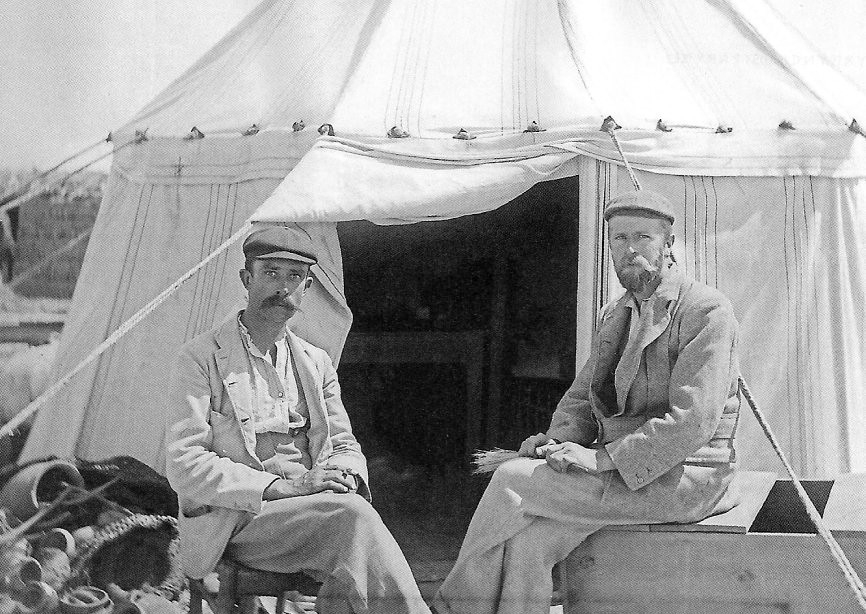
Bernard Pyne Grenfell and Arthur Surridge Hunt at Oxyrhynchus (c) Egypt Exploration Society

The document contains extracts from the court proceedings of Tiberius Claudius Pasion, who was the strategos (top official) of the Oxyrhynchite Nome or district. It is the earliest such legal document from Roman Egypt to have come to us. It was, however, not found in an administrative building, but rather in a pile of rubble, together with other documents that were once the personal archive of a man named Trypon. In total, the archive currently includes 44 documents, whose dating ranges from c.15–16 to 83 CE. Thanks to these, we know, among many other things, that Tryphon was a resident of Oxyrhynchus, that he was weaver by trade, and that he got married twice. His second wife, named Saraeus, is one of the main actors here.

On 3 January 46 CE, Saraeus gave birth to a baby boy named Apion (his birthdate can be deduced thanks to his horoscope, which was also found; P.Oxy. II 307). Having breastfed then weaned Apion, she undertook a wet-nursing contract for a man named Pesouris (the document was actually signed by Pesouris’ son Theon). Pesouris had rescued the “male slave” in the rubbish heap – that is at the outskirt – of Oxyrhynchus. In other words, the baby had been abandoned there by his birth family. Since the contract was drawn on year 7 of the emperor Claudius (46–47 CE), we can deduce that little Apion was between 8 and 20 months when his mom started nursing the other baby.

Now things turned sour when, some time after the contract expired and money was exchanged, the little foundling, then aged around two, passed away. This led Pesouris to snatch Apion, alleging that he was his slave. After Saraeus broke into his home to get little Apion back, Pesouris brought the case forward in front of the strategos, Tiberius Claudius Pasion:

“Pesouris against Saraeus. Aristokles was advocate for Pesouris.”

Note how Pesouris, who is the plaintiff, was represented by a lawyer. This, as well as the fact that he could afford to hire a wet-nurse for the baby he rescued, indicates that he was substantially more affluent than Saraeus, who rented her services as a wet-nurse and, according to the text preserved on the papyrus, represented herself in court.

The court hearing quotes both parties’ versions of the events. Judging from the native names of many of Tryphon’s family members (the name Saraeus is of unknown origin) and of Pesouris, the protagonists of our legal story were not part of the ethno-civic “Greek” élite, but rather belonged to the (potentially mixed or Hellenized) Egyptian community of Oxyrhynchus. Whether Saraeus could speak Greek fluently enough to plead in court is unknown. Should that not have been the case, she could very well have had her speech translated by an interpreter. As for Aristokles, since he was a professional lawyer and Greek was the only official language accepted by the Roman administration in the province, chances are he was fluent in Greek. His speech is quoted first:

“Pesouris, for whom I am speaking, raised up from the dung-heap a male slave child named Heraklas in year 7 of Tiberius Claudius Caesar (= 46–47 CE). He turned the baby over to the defendant, and a nursing contract was handed over here (=in Oxyrhynchus) to Pesouris’ son. In the first year she took her wages for nursing. When the stipulated day came round in the second year she also took them again. The proof that I speak the truth is the written receipt through which she agreed that she had received her wages.”

 In Hellenistic and Roman Egypt, the “exposure” (that is, abandonment) of unwanted newborns was more commonly associated to Greek communities of higher socio-economic status than to native ones (it was, in other words, an “import” from the Greek world). As Marilyne Parca observes in a recent article on wet-nurses in Hellenistic and Roman Egypt, “[c]hild exposure was … not rare in the Greek communities of Roman Egypt, and we may recall how Diodorus Siculus (1.80.3) and Strabo (17.2.5) singled out the Egyptian practice of bringing up all the children born to them as the mark of a deep cultural gap between Egyptians and Greeks”. Parca also highlights how a substantial proportion of the babies attested in known wet-nursing contracts seem to have been “”taken up” (ἀναίρετον) from the rubbish (ἀπὸ κοπρίας) and to be raised (and sometimes sold) as slaves: σωμάτιον ὃ ἀνείρεται ἀπὸ κοπρίας εἰς δουλείαν (CGP I 14, 15, 23).” Seen in that light, then, to have an exposed Greek baby taken, entrusted to a paid wet-nurse, and raised as a slave in an Egyptian family such as Pesouris’ was not, as far as rescued babies were concerned, out of the ordinary.

Yet such practices, as well as the apparent adoption of foundlings by some Egyptian families, were not to the liking of Roman authorities. Thus the Gnomon of the Idios Logos (= BGU V 1210; P.Oxy. XLII 3014; a document meant to “guide” the high official in charge of all matters dealing with confiscated and abandoned properties such as productive and unproductive land, temple properties and offices, and issues dealing with inheritance and civil status) stipulated that Egyptians who either adopted exposed babies or “raised up” male foundlings from the rubbish heap were to see 25% of their property confiscated at death (par. 41 and 107). What seems to have bugged the Romans is the idea whereby babies from a higher ethno-civic status (“Greek”, that is either citizens or, in metropoleis like Oxyrhynchus, members of the local “gymnasium” class) were integrated into “native” (laoi; a status which applied to the vast majority of the population and came with the highest set of fiscal burdens) families. Be it as it may, judging from known papyri documenting the hiring of wet-nurses for babies who had been raised up from the dung-heap, either these Idios Logos policies did not exist or they weren’t properly implemented before the 2nd century CE.

Screen Shot 2018-06-28 at 18.15.03
P.Oxy. I 37;  from M. M. Masciadri and O. Montevecchi. 1984. I contratti di baliatico (Milano).

Let’s now get back to Pesouris’ version of events. Aristokles goes on:

“When the slave child became emaciated, Pesouris snatched him away. After this, when Saraeus found an opportune moment, she penetrated the house of my client and grabbed the child away, and she wants to carry the slave child off on the pretext of (its being) freeborn. I have, first of all, the written contract of nursing; and second, I have the receipt (of wages) for nursing. I ask that these contractual agreements be safeguarded.”

So according to Aristokles, Saraeus snatched Heraklas after Pesouris took him away from her due to him being dangerously thin. Note how there is no mention of Apion nor of any baby dying. Let’s now see what Saraeus had to say:

“Saraeus: I weaned my own baby, and their slave child was turned over to me. I received from them eight staters in all.”

Jane Rowlandson, whose translation I borrow here, observes that the wages provided to Saraeus in exchange for her nursing of Heraklas is “a low salary in comparison with contemporary nursing contracts”. She wonders whether the scribe made a mistake. If not, then, it seems like Pesouris was cheap or Saraeus desperate for money, or both.

Saraeus continues:

“After this the child died, although x staters remained for me. Now they want to snatch away my own child.”

Follows a quick note by Theon, Pesouris’ son:

“We have documents concerning the slave child.”

How did the strategos rule? In that case, version of the events did not prevail. His decision relied on two main points: The resemblance between Apion and Saraeus; and previous “rulings” from the prefect (governor) of the province:

“The strategos ruled: ‘Since from its appearance the baby seems to belong to Saraeus, if she and her husband will sign a sworn affidavit that the slave child turned over to her by Pesouris has died, my opinion, in accordance with the rulings of our lord prefect, is that she should have her own child, provided she pays back the money she received.”

Pasion’s verdict indicates that little Apion – who was then a toddler – was either present in court, or had been seen by witnesses or official staff. The fact that he looked like Saraeus is invoked as a proof of his biological link to her. In a world where many children were breastfed and raised by other individuals besides their biological parents or even family members (the case of Heraklas being one of those), to resemble one’s parent was the closest one could get to a DNA test. This was enough to invalidate Aristokles’ twisted (as Tryphon’s overall archive confirms) narrative. As for Saraeus needing to give back the money she had received from Pesouris, this decision is in line with standard clauses from other nursing contracts, which stipulate that wages have to be repaid in the case where the child dies. That being said, we are of course in the dark as to the actual cause of Heraklas’ death. We also need to keep in mind that according to available data, the mortality rate among children younger than 5 years old was high.

Our story doesn’t end here. In a petition dated from 49 CE (thus written seemingly a few months after the court hearing), Tryphon complained to the prefect that Pesouris (called Syrus this time) “refuses to comply with the judgement, and hinders [him] in [his] trade” (P.Oxy. I 38). How Pesouris hindered Tryphon’s weaving trade is unknown. What is known, though, is that Apion did remain with his family after all. On 14 June 56 CE, a receipt for the weavers’ tax (SB X 10247) was issued in the name of the apprentice Apion, son of … Tryphon.

Technical Details
Provenance: Egypt, Oxyrhynchus
Date: 29 March 49 CE, and some time after that date
Language: Ancient Greek
Collection: London, British Library (inventory: Papyrus 746)
Designation: P.Oxy. I 37 = CPGr. I 19 (signal according to the Checklist of Editions)
Select bibliography: Roger S. Bagnall and Bruce Frier (1994) The Demography of Roman Egypt (Cambridge: CUP) chapter 7; Maria Biscottini (1966) “L’archivio di Tryphon, tessitore di Oxyrhynchos,” in Aegyptus 46.1: 60–90; James Keenan, Joe Manning, and Uri Yiftach-Firanko, eds. (2014) Law and Legal Practice in Egypt from Alexander to the Arab Conquest : A Selection of Papyrological Sources in Translation, with Introductions and Commentary (Cambridge: CUP) pp. 487–489 (=10.3.1); Maryline Parca (2017) “The Wet Nurses of Ptolemaic and Roman Egypt,” in Illinois Classical Studies 42: 203–226; Monica Piccolo (2003) “Osservazioni ad alcuni papiri dell’archivio di Tryphon,” Aegyptus 83: 197-213; Jane Rowlandson, ed. (1998) Women and Society in Greek and Roman Egypt: A Sourcebook (Cambridge: CUP) pp. 112–118; Jean A. Straus (1988) “L’esclavage dans l’Égypte romaine,” in ANRW Principat 10.1: 854–856.

Bee Stories

Jennifer Cromwell

44e9e7f3aed1aab342a7a8e2d97e343a
‘King of Lower and Upper Egypt’; Karnak

In honour of World Bee Day: 17 August

Whether it was for consumption, offerings to the gods, or for healing wounds, honey was important in ancient Egypt and so were bees. The honey bee is one of the earliest known hieroglyphs and was a symbol of kingship itself – together with the sedge sign, it represented the King of Lower and Upper Egypt. Here are some short stories about honey and bee-keeping from the Middle Kingdom, Ptolemaic Period, and late antiquity. These are just a selection of the huge volume of texts that could have been chosen – here’s to many more stories about bees for centuries to come (#savethebees).
A short book on bees and apiculture in ancient Egypt provides easy access to a lot more information: The Tears of Re: Beekeeping in Ancient Egypt by Gene Kritsky.

Egyptian_bee_hieroglyph
Horizontal, cylindrical beehives from the tomb of Pabasa (TT279), western Thebes, Saite Period (6th century BCE)

Late Middle Kingdom
The collection of the Petrie Museum of Egyptian Archaeology in London holds a large body of papyri from the Middle Kingdom town of Lahun (also known as el-Lahun and Kahun). One letter, the central section of which is lost, reports an incident in which honey assigned to a servant was eaten by an unnamed Asiatic. And why? Because it was too sweet. And who can blame him.

 “… given that, as for the hin (ca. half a litre) of honey (already) assigned to the servant-there, the servant-there has discovered that the Asiatic has drunk it up, reporting to the servant-there: ‘Look, it was the sweetness that made me do it!’”

UC32124
wwwopac.exe
UC32124: Letter from Lahun. (c) UCL

Ptolemaic Period
In July 256 BCE, the widower Senchons wrote to the well-known figure Zenon about her donkey, which she needs returned to her in order to move her beehives to higher ground, so that they don’t get destroyed during the inundation. Zenon was the secretary to an important governmental official and lived in Philadelphia, in the Fayum region. The documents associated with him are among the earliest Greek texts from Ptolemaic Egypt, dating to the reigns of Ptolemy II (283–246 BCE) and Ptolemy III (246–222 BCE).

“To Zenon, greetings from Senchons. I petitioned you about my female donkey, which Nikias took. If you had written to me about her, I would have sent her to you. If it pleases you, order him to return her, so that we can transport the hives to the pastures, so that they won’t be ruined and of no profit to yourself or the king. And if you examine the matter, you will be persuaded that we are useful to you.”

P.Mich. I 29
native
P.Mich. I 29: Letter to Zenon (c) University of Michigan

Late Antique Egpyt
On the 12 June of an uncertain year, three monks (Elias, Papnoute, and Germanus) from the monastery of Apa Apollo near Hermopolis lease 214 beehives from the beekeeper Lazarus. This is just one contract with beekeepers that the monastery had, showing the importance of honey in their monastic diet. Individual monks also kept bees (and the document protects Lazarus from any complaints from a rival beekeeper, Enoch).

“I, the papa Elias with Brother Papnoute and the notary Germanus, the monks of the topos of Apa Apollo, write to Lazarus the son of Apollo, the beekeeper from Tbake. You drew up a lease for us for 214 beehives. Now, we are liable to you for Enoch, the beekeeper, so that he does not sue you over them. If he or anybody associated with him sues you, you are safe from them, for we have reached an agreement with him.”

P.Mon.Apollo Ι 47

In the Valley of the Kings, the tomb of Rameses IV (KV2) was later reoccupied by monks. The monks left behind themselves many signs of their habitation. As well as graffiti throughout the tomb, the excavators also found upturned jars (amphorae) that had been used as beehives.

Technical Details: Hieratic Document
Provenance: Egypt, Lahun.
Date: Late Middle Kingdom (ca. 19th century BCE)
Language: Middle Egyptian; hieratic script.
Collection: Petrie Museum, London: UC32124.
Bibliography: Mark Collier and Stephen Quirke. 2002. The UCL Lahun Papyri: Letters. Oxford: Archaeopress. Pp. 58–59.

Technical Details: Greek Document
Provenance: Egypt: Philadelphia, Arsinoite nome (Fayum).
Date: July 256 BCE.
Language: Greek.
Collection: University of Michigan, Papyrus Collection: P.Mich.inv. 3198.
Designation: P.Mich. I 29 (according to the Checklist of Editions)
Bibliography: John L. White (1986) Light from Ancient Letters (Philadelphia: Fortress Press) [#20].

Technical Details: Coptic Document
Provenance: monastery of Apa Apollo, Bawit (near Hermopolis)
Date: 12 June, uncertain year (7th century)
Language: Coptic (Sahidic)
Collection: Princeton, University Library (inv. AM 15960 G)
Designation: P.Mon.Apollo I 47; SB Kopt. I 52 (according to the Checklist of Editions)
Bibliography: Helmut Satzinger and Pieter J. Sijpesteijn. 1988. ‘Zwei koptische Papyri aus der Papyrussammlung aus der Princeton University,’ in Enchoria 16: 49–53.

Potential Paternity Problem

Jennifer Cromwell

Where in the ancient world could you turn when you had a serious family scandal to talk about? Well, in western Thebes in the early 7th century, one option was to write to local church figures. A papyrus preserves a letter from a man, seeking advice about another man’s paternity problem. The beginning of the letter is lost, but the juicy details survive:

“After they were united, they fought and bickered constantly. [Then] she left him, up until now. Yet, look, she gave birth this month and he came to me, saying ‘The little girl that she gave birth to is not mine! She conceived her, deceiving me, for it has been six months since I united with her.’ Here, then, I have sent him to you. Please, listen as he recounts his business. What you shall command, write it to us!”

P.Pisentius 17

A tempestuous relationship and questioned paternity – the things talk shows are made of. As the infant girl here seems to have survived, it is unlikely that she was born so premature. So, if the man’s claim is correct, that they were only together for six months, then it surely wasn’t his daughter.

Unfortunately, the letter’s address, with the name of the sender and the recipient, is lost, as are the names of the couple concerned (if they were mentioned by name, that is). But, this letter is believed to be one of many that were written to bishop Pisentius.

Pisentius was bishop of Coptos (Coptic Keft, modern Qift) in the early 7th century. He fled south to western Thebes during the Persian invasion and conquest of Egypt in the 620s (a short-lived conquest of a decade during the Byzantine-Sassanian War, before emperor Heraclius regained the country in 629). Local villagers – both men and women – sought his council on a range of affairs.

In this instance, we have only the man’s side of the story. If the bishop wrote down his response, as requested, that letter is lost (or maybe remains to be discovered!). And how the woman’s story may have differed will never be known.

Technical Details
Provenance: Western Thebes, Egypt.
Date: Early 7th century CE (after 620).
Language: Coptic (Sahidic dialect).
Collection: Louvre Museum / Musée du Louvre, Paris (inventory number unknown)
Designation: P.Pisentius 17 (for this sigla, see the Checklist of Editions).
Bibliography: A new edition of this text and others associated with bishop Pisentius is nearing completion by Prof. Jacques van der Vliet (Leiden University). Until this is published, T. G. Wilfong, Women of Jeme (2002, University of Michigan Press) discusses some of the letters written to Pisentius and his role in the Theban communities.

1024px-SFEC_AEH_-ThebesNecropolis-2010-FULL-Overview-039
There is no published image of the papyrus (yet), so instead here is an aerial view of western Thebes, the setting of our story, by Steve Cameron.

A Harvester’s Plea

Gareth Wearne

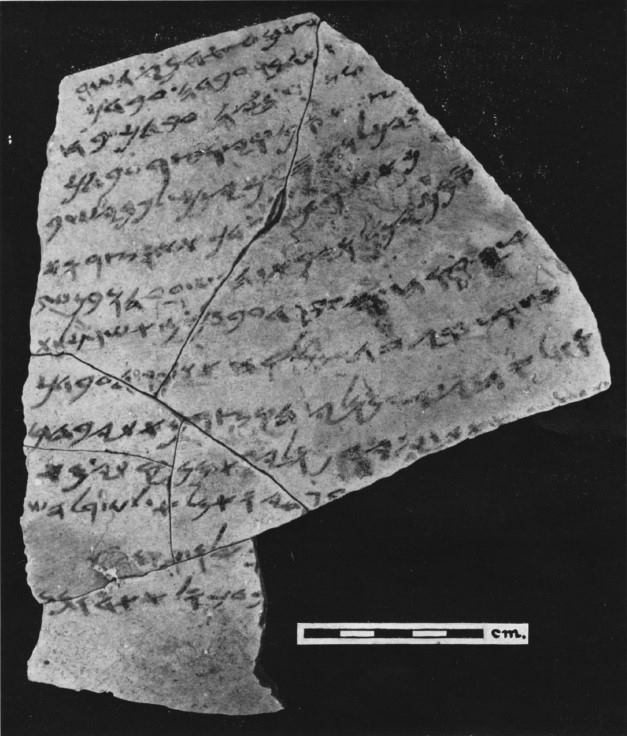
What legal rights did a farm labourer have in ancient Israel? A rare glimpse is offered by an ostracon (inscribed pot-sherd), which was discovered in 1960 in the guardroom of a small Iron Age fortress, approximately 17 km south of Tel Aviv.

The ostracon contains a judicial petition from a harvester to the commander of the fortress. In it, the worker, who does not identify himself by name, asks the commander to intervene and ensure the return of his garment, which had apparently been confiscated for his alleged failure to meet a work quota. The petition reads:

“May my lord the governor hear the appeal of his servant: Your servant was harvesting in Hazar-asam. Your servant harvested and measured as always before stopping. And when your servant had measured the harvest and stored it as always, Hoshavyahu ben Shobay came and took your servant’s garment. When I had measured my harvest as always he took the garment of your servant! All my brothers will testify for me; those harvesting with me in the heat of the sun, they will confirm that it is so. I am innocent of guilt. Now, please return my garment. Again, I petition the commander to return the garment of your servant. Grant him mercy and return the garment of your servant and do not confound me!”

The custom of taking a garment as surety is attested in the Hebrew Bible (e.g. Exodus 22:26–27; Deuteronomy 24:17; Amos 2:8), where there is a special concern for the plight of the poor and vulnerable (cf. Deuteronomy 24:12–15).

Although the phrasing of the petition reflects the usual politeness of someone writing to a social superior, the wording is repetitive and gives some sense of the worker’s anguish – notice the ad hoc manner in which the appeal switches between the first, second, and third persons. Even so, the ostracon seems to have been written by a trained scribe, since it is unlikely that a poor farm labourer in Iron Age Israel would have been able to read and write. Was it commissioned as a formal letter of appeal? Or is it a transcription (or summary) of a spoken plea?

Sadly the governor’s decision is not recorded, so we don’t know the outcome of the petition – after all, we only have the harvester’s word that he filled his work quota. Whatever the case, it is remarkable that even a poor labourer could have recourse to a formal appeal such as this.

34340334_10155523001595732_768406096346873856_n
Photo J. Schweig; Israel Exploration Journal 10/3: Plate 17

Technical Details
Provenance: Meṣad Ḥashavyahu (near Yavneh Yam), Israel
Date: 7th century BCE
Language: Hebrew
Collection: Israel Museum, Jerusalem
Designation: KAI 200
Bibliography: J. Naveh (1960) “A Hebrew Letter from the Seventh Century B.C.,” in Israel Exploration Journal 10/3: 129–39; J. M. Lindenberger (2003) Ancient Aramaic and Hebrew Letters. 2nd edition. Atlanta: Society of Biblical Literature [see pp. 107–110].


A Runaway Child Bride

Jennifer Cromwell

How early was too early to marry in the ancient world? If the answer is connected to being an adult, then what is an adult? And does that question differ for men and women? Is it simply a question of reaching sexual maturity (puberty), which was older in the ancient world than it is today, or are there different societal constraints on what it means to be grown up? While we’re asking questions, how much do modern, western views (with our longer life expectancies and lower child and childbirth mortality rates) impact our understanding of this issue?

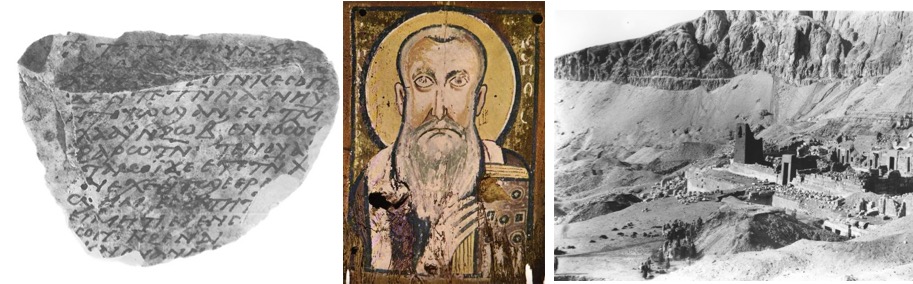
A letter written on a limestone ostracon by “the humblest Mark”, a well-known figure and priest, to a couple, Papnoute and Elisabeth, concerns a “young girl” that is in their care, who has run away from her husband:

“You know that I wrote, advising you, again, saying “You are my brethren and I do not want to hear anything ugly against you!” Now, I have been informed that you are holding onto the young girl who is with you. … If you continue not to teach the man’s wife that she is to join him and obey him, just like every wife, and to do his bidding, then know that I will excommunicate you, until she stops being so disturbed.”

O.Lips.Copt. 24

The tone and content, advocating subservience of the wife to her husband – and stating that any other behaviour is “disturbed” –, is jarring to many modern readers. But to an early Christian audience, leaving your spouse without just cause was not permitted, and the only just cause was adultery. In a letter, bishop Abraham, who founded a monastery at Deir el-Bahri (on top of the mortuary temple of Hatschepsut), expounds against divorce (O.Crum 72): “I have been further informed that some have divorced their wives, without reasons of adultery.” Anybody culpable in divorce will be excommunicated, including:

  • the woman who abandons her husband and marries another;
  • the person who causes a married couple to separate;
  • the scribe who draws up a divorce document.

In order to support his stance, Abraham quotes Luke 16:18: “Everyone who divorces his wife and marries another is an adulterer, and he who marries a divorced woman is an adulterer.”

For the church, the ideal state was for a man and wife to remain together. In our first letter, the bride is called a young girl. Does Mark’s use of this designation mean that she (and she is never named) was considered young for marriage, even by the standards of the day – maybe only on the cusp of puberty? Perhaps Papnoute and Elisabeth were her parents, to whom she fled, away from her older husband.

No further letters from Mark to or from Papnoute and Elisabeth are known; we are left with only silence surrounding the ultimate fate of the girl.

oLipsCopt 24 + Abraham + DeB.jpg
Left: O.Lips.Copt. 24 (c) Ägyptisches Museum – Georg Steindorff; Centre: Apa Abraham. Icon of Apa Abraham in the Bode Museum Berlin. (c) Staatliche Museen zu Berlin; Right: monastery on top of Deir el-Bahri – see W. Godlewski. 1986. Le monastère de St. Phoibammon. Warsaw: PWN–Éditions scientifique de Pologne. The photographs of the site that Godlewski publishes, including this, were taken by Howard Carter in 1894/5 and are now in the archives of the Egypt Exploration Society (c) EES.

Technical Details (Text 1)
Provenance: Western Thebes, Egypt.
Date: Early 7th century CE.
Language: Coptic (Sahidic dialect).
Collection: Egyptian Museum / Ägyptisches Museum, University of Leipzig, Leipzig (inv. 502).
Designation: O.Lips.Copt. 24 (previously O.Crum Ad. 13); see Checklist for publication information.
Bibliography: T. Sebastian Richter (2014) “Daily Life: Documentary Evidence,” in Coptic Civilization: Two Thousand Years of Christianity in Egypt, edited by Gawdat Gabra, 131–144. Cairo: American University in Cairo Press. (see pages 135–136).

Technical Details (Text 2)
Provenance: Western Thebes, Egypt.
Date: Late 6th / early 7th century CE.
Language: Coptic (Sahidic dialect).
Collection: British Museum, Department of Ancient Egypt and Sudan (EA32886).
Designation: O.Crum 72; see Checklist for publication information.

An Angry Tax Man

Jennifer Cromwell

Following the Arab conquest of Egypt in 641 CE (or Islamic conquest, it’s frequently referred to as both or either), a new tax was added to the growing list of impositions placed on the country’s population: the poll tax, payable by all non-Muslim adult males. For over two centuries after the conquest, the majority of Egyptians were Christian, creating at least in theory a considerable body of men liable for paying this tax.

A large body of documentation survives concerning how taxes were managed, including registers, demands, and receipts. Letters from or to tax officers also reveal different aspects of the system, especially problems. Of the Coptic evidence from the eighth century, one letter in particular stands out. It was written from a Muslim official, Ibrāhīm ibn ‘Abd al-Raḥmān to a Christian man, Theodore, from the village Titkooh (closely linked with the monastery of Apa Apollo at Bawit near Hermopolis).

Screen Shot 2018-05-24 at 23.03.29
P.Mich.Copt. 15 (c) University of Michigan, Papyrology Collection

“So that you know that I have appointed Serenos over you to [collect? the] tax. I have not appointed him over you so that he may pay anything for you. So then, pay the stipulated amount as your instalment. Collect and bring it to this person (i.e., Serenos). If you seek to break anything in it, I will send one who will extract it from your bones.”

P.Mich.Copt. 15

Chilling stuff. The threat is not subtle. The content is direct, without any framing that is typical of letters. How should we understand this short text? Is its tone reflective of increasing tensions between the minority Muslim rulers and the Christian majority? Or was religion not a factor and the harsh warning is issued from a frustrated tax official to a non-paying citizen? Threatening tax officials aren’t exactly unfamiliar nowadays, and neither is tax evasion, for which the evidence in the ancient world is ripe (and if the tax man can bring down Al Capone …).

Other letters from the same period show much more conciliatory language between Muslims and Christians. A roughly contemporary letter (it, like the previous one, is not dated) from Ṣāliḥ to Chael son of John concerns an instruction for the latter to collect and deliver money. However, the tone is much gentler and polite, and Ṣāliḥ calls Chael ‘my beloved brother’ (CPR II 237). Taking each letter in isolation seems to present very different pictures of relationships between Muslims and Christians. Yet, religion is just one part of the story and the true nature of relationships are more complex: do the parties know each other, what are their respective roles in the situations, where does power lie? Interpretation is in the eye of the beholder, but that’s only one way to look at things.

Technical Details
Provenance: Titkooh, Hermopolite nome. Egypt.
Date: 8th century CE.
Language: Coptic (Sahidic dialect).
Collection: Papyrology collection, University of Michigan (inv. 6861).
Designation: P.Mich.Copt. 15 (sigla following the Checklist of Editions).
Bibliography: Alain Delattre (2015) ‘Le monastère de Baouît et l’administration arabe’, in Documents and the History of the Early Islamic World, edited by A. T. Schubert and P. M. Sijpesteijn, pp. 43–49 (Leiden: Brill).


“My milk being good from both breasts”

Jennifer Cromwell

In a Coptic letter from the 7th century CE, a wet nurse Maria expresses her grief and condolences over the death of a young girl (P.Amh. II 188 desc.; edition by Alain Delattre et al., 2018).

“My heart grieved when I heard about my daughter, that she had died.”

Maria then goes on to wish a long life to another girl, Anastasia. Rather than reading the text literally, the girl who died is most likely the daughter of the recipients of the letter, not Maria. What seems to be the clinching detail in understanding the relationships in this letter is that Maria identifies herself as a wet nurse in the letter’s address:

“Give it to my sister Talau, from the wet nurse Maria.”

P.Amh. II 188 descr. verso: address with Maria’s name (c) Pierpont Morgan Library

The letter is short and its contents incredibly sad. But – and here is where some scholarly distance comes in to play – one of the most notable features is the identification of Maria as a wet nurse. There are almost no Coptic documents that involve a wet nurse (the Coptic word is moone) – the title occurs in a list on a papyrus in the Austrian National Library in Vienna (CPR XII 5; inv. K. 4494), but we know nothing about the individual mentioned there. Why are wet nurses almost never mentioned, then, in Coptic texts?

In Ptolemaic and Roman Egypt (ca 3rd century BCE to 4th century CE) there isn’t the same absence. Wet nurse contracts are known from this period in which a woman is hired to nurse an infant. The earliest contract that we know of comes from the site Tebtunis in the Fayum and dates to 7 May 231 BCE. The bulk of the document is written in Demotic (P.Cairo dem. 30604), with Greek lines noting its place and date of registration (P.Tebt. II 297). In this case, the woman Sponnesis daughter of Horus and Taues is contracted by the man Phanesis son of Nechtyris to nurse his son Petesouchos for three years: “I am for you the wet nurse, my milk being good from both breasts.” She promises to care for, nurture, and protect the boy. (For more about this text and other early wet nurse contracts, see Parca 2017, noted below.)

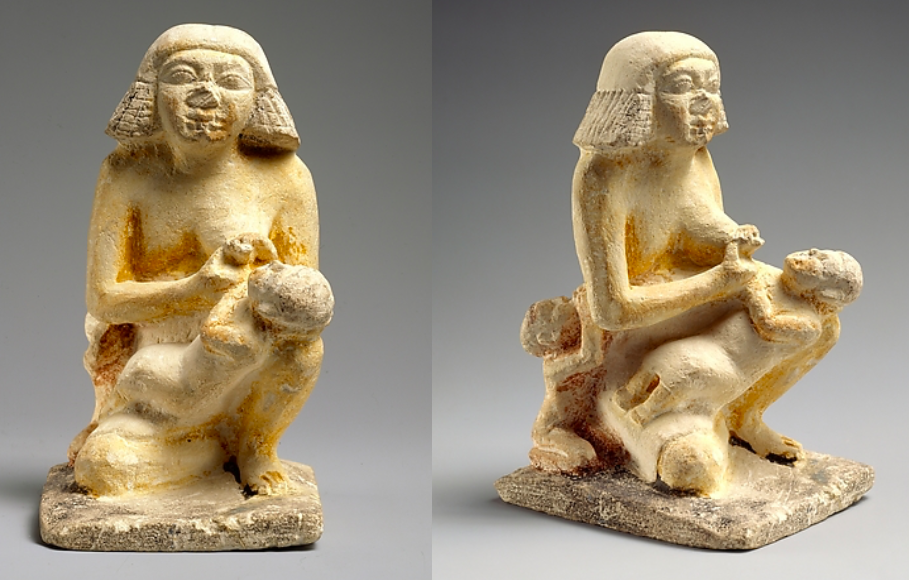
MMA (26-71405) Nursing Woman - composite
Woman breastfeeding, 5th Dynasty (c) Metropolitan Museum of Art (26.7.1405)

In earlier periods of Egyptian history, breastfeeding is not an uncommon topic in art. One of my favourite statues (shown above) dates to Egypt’s Old Kingdom and is today on display in the Metropolitan Museum of Art in New York. A woman kneels down with a child on her knee and she holds out her breast for the child to suckle, while another child takes matters into his own hand and pulls her other breast under her other arm in order to feed as well. Dating over a thousand years later, a sketch on a limestone ostracon from the village Deir el-Medina (on the west bank of the Nile opposite Karnak/Luxor) in the British Museum’s collection shows a woman sitting and breastfeeding (shown below).

DelM nursing woman [EA8506]
Ostracon, Deir el-Medina, New Kingdom (c) Trustees of the British Museum EA8506

And so why are wet nurses – or breastfeeding itself – so rare in Coptic documents? In Coptic literature concerning the holy family, passages state that Mary was breastfed until she was three years old, while she in turn breastfed the infant Jesus until he was the same age. At the same time, paintings of Mary suckling Jesus adorned churches across the Mediterranean world. There was no censor of the idea or the image.

This brings us to a wee problem in using written sources for the study of the ancient world. There is so much about which we may want to know that simply is never mentioned. Why would somebody need to write to somebody else about their breastfeeding plans? If they ever had to discuss the matter, they’d do so in person. For many periods and places, using a wet nurse may have been such a common event that it did not need to be written down in a formal contract. The Coptic letter from Maria reminds us, in case we were in any doubt, that wet nurses existed, even if we rarely read about them.

Technical Details (Papyrus)
Provenance: Unknown. 
Date: 7th century? CE 
Language: Coptic; Sahidic dialect. 
Collection: Pierpont Morgan Library, New York (purchased 1912 from the Amherst collection). 
DesignationP.Amh. II 188 descr. (note: ‘descr.’ indicates that no edition was published, just a description; for the papyrological sigla, see the Checklist of Editions).
Bibliography: Alain Delattre, Perrine Pilette and Naïm Vanthieghem (2018) “Papyrus coptes de la Pierpont Morgan Library II: Lettre de condoléances d’une nourrice,” Journal of Coptic Studies 20: 1–10 (available online here). 

Technical Details (Object #1)
Provenance: probably tomb of Nikauinpu, Giza, Egypt
Date: Dynasty 5, Old Kingdom (ca. 2420–2389 BCE). 
Collection: Metropolitan Museum of Art: 26.7.1405 – on display in Gallery 103. 

Technical Details (Object #2)
Provenance: Deir el-Medina, Egypt 
Date: Dynasty 19 or 20, New Kingdom (1295–1069 BCE). 
Collection: British Museum, Department of Ancient Egypt and Sudan: EA8506

Some bibliography
Burt Kasparian (2007) “La condition des nourrices sous le Moyen Empire,” Bulletin de l’Institut français d’archéologie Orientale 107: 109–126 (available online here – open access). 
Maryline Parca (2017) “The Wet Nurses of Ptolemaic and Roman Egypt,” Illinois Classical Studies 42: 203–226 (available online here – if you have JStor access).