Birthday Parties on the Roman Frontier

Jennifer Cromwell

The Roman fort Vindolanda is located just south of Hadrian’s Wall in northern England. Occupied approximately from 85–370 CE, the fort guarded the Stanegate, the Roman road that ran from the River Tyne to the Solway Firth. In addition to the archaeological remains of the site, a large number of Latin texts written on postcard-sized thin wooden boards provide snapshots of daily life on the Roman frontier. While Vindolanda was a military outpost, the tablets don’t just talk about military affairs. The officers stationed at the fort lived there with their families, and letters, lists, and other records give remarkable insights into their lifestyle and social and economic activities.
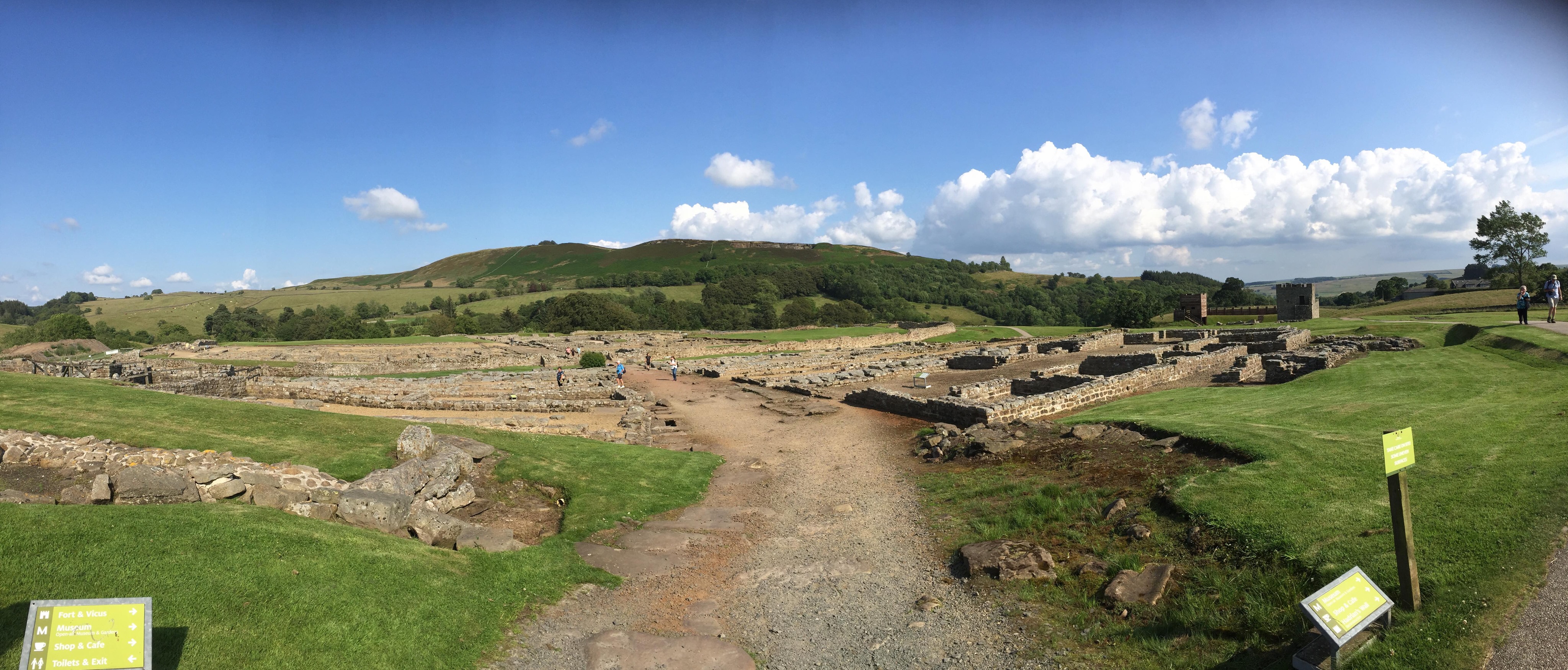
Vindolanda.jpg
Vindolanda: Photo taken July 2019 by J. Cromwell

One day in late summer, Claudia Severa, wife of Aelius Brocchus, wrote to Sulpicia Lepidina, wife of Flavius Cerialis, inviting her to come to Vindolanda to join her birthday celebrations on 11th September. This invitation is perhaps the best-known of the Vindolanda tablets, and is  probably the most striking text to a modern audience, with its recognisable activity and presentation of personal relationships.

“Claudia Severa to her Lepidina, greetings. On the third day before the Ides of September, sister, for the day of the celebration of my birthday, I give you a warm invitation to make sure that you come to us, to make the day more enjoyable for me by your arrival, if you are present(?). Give my greetings to your Cerialis. My Aelius and my little son send him (?) their greetings.

I shall expect you, sister. Farewell, sister, my dearest soul, as I hope to prosper, and hail.

To Sulpicia Lepidina, (wife) of Cerialis, from Severa.” (translation: Bowman 1994)
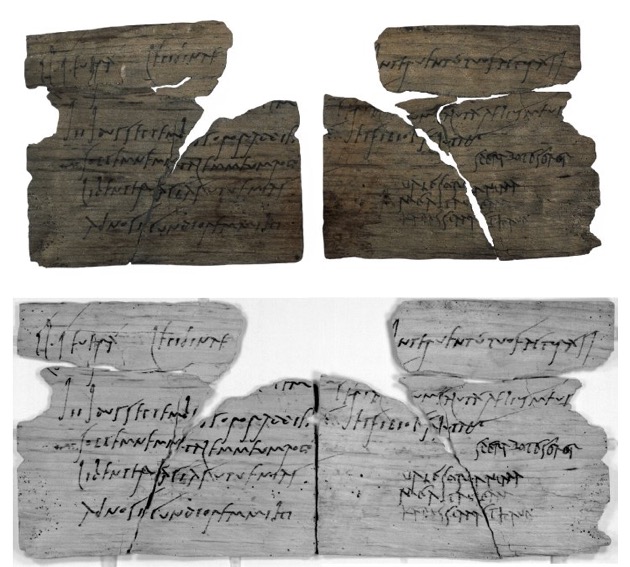
tVindol II 291.jpg
T.Vindol. II 291 (c) British Musum (1986,1001,64)

This party invite isn’t our only evidence for Romans celebrating the birthdays of individuals. Latin birthday poems were written by authors such as Horace, Ovid, and Martial in honour of the birthdays of particular people – and the poems themselves are often intended as birthday presents. These poems give us an idea about how Romans celebrated, by wearing white clothing, bedecking an altar with garlands, burning incense, and sometimes eating cakes and drinking wine (as we see in Ovid’s poems Tristia III.13, about his own birthday, and Tristia V.5 about his wife’s).

Severa didn’t live in Vindolanda but in another fort, Briga – one of the places named in the tablets that hasn’t yet been identified (the word is a common Celtic place-name meaning ‘hill’, but which hill?). Did Lepidina join the birthday party? We don’t have any definite proof, but other letters between the two women indicate that they did regularly travel to see each other, as Severa notes in another letter: “just as I had spoken with you and promised that I would ask Brocchus and would come to you, I asked him and he gave me the following reply, that it was always readily permitted to me … to come to you in whatever way I can” (T.Vindol. II 292; translation Bowman 1994). Hopefully Lepidina was able to make the party and eat cake and drink wine with Severa!

One final point about this letter needs to be made. While most of the letter is written probably by a professional scribe, Severa wrote her final greeting herself. Her personal note to Lepidina is written in the bottom right side of the tablet. Apart from being an indication of her affection for her friend, this short message is the earliest known example of writing in Latin by a woman. It’s not just the words that are important for our understanding of life in the ancient world, but how they were written as well.

Technical Details
Provenance: Vindolanda (Chesterholm), England
Date: 97–103 CE
Language: Latin
Collection: British Museum (inv. 1986,1001.64)
Designation: T.Vindol. II 291 (abbreviation according to the Checklist of Editions)
Bibliography: Kathryn Argetsinger (1992), “Birthday Rituals: Friends and Patrons in Roman Poetry and Cult,” Classical Antiquity 11/2: pp. 175–193; Alan Bowman (1994), Life and Letters on the Roman Frontier (London: British Museum), p. 127 (#21); Alan Bowman and J. David Thomas (1987), “New Texts from Vindolanda”, Britannia 18: pp. 137–139 (#5); David Campbell (1994) The Roman Army, 31 BC – AD 337: A Sourcebook (London: Routledge) #254. 

Imperial Decrees, Animal Sacrifices, and Christian Persecution

Jennifer Cromwell

On 17 June 250 CE, Aurelius Sakis had a certificate drawn up that proved he and his children Aion and Heras had participated in the sacrifice of an animal to pagan gods. Two other men, Aurelius Serenus and Aurelius Hermas witness the declaration, confirming that they had actually witnessed the sacrifice.

“To those appointed to oversee the sacrifices, from Aurelius Sakis from the village of Theoxenis, with his children Aion and Heras, staying in the village Theadelphia. We have always sacrificed to the gods and now, too, in your presence, in accordance with the decree we have sacrificed and we have poured a libation and we have eaten of the sacrificial offering, and we ask you to undersign. May you continue to prosper.

We, Aurelius Serenus and Aurelius Hermas, saw you sacrificing.

The Year 1 of the Emperor Caesar Gaius Messius Quintus Traianus Decius Pius Felix Augustus, Pauni 23.”

(P.Mich. III 157; translation by A. D. Lee)
pMich III 157.jpg
P.Mich. III 157 (c) University of Michigan (P.Mich. inv. 262)

Over forty such certificates written in the same year survive from Egypt and provide the only contemporary evidence of the edict ordered by emperor Decius (249–251 CE) that everybody in the Roman Empire was to perform a sacrifice to the Roman gods and the well-being of the emperor. Why would the emperor introduce such a policy? On one hand, the sacrifices were proof of loyalty to Decius, but they also were the first example of legislation that persecuted against Christians, as whoever refused to sacrifice would be punished. This leads to the question of who had to demonstrate that they were sacrificing: everybody, or just those accused of being a Christian? We don’t have enough information to answer this particular question.

Map – Barrington Atlas.jpg
Map showing the Fayum and Oxyrhynchus (from Barrington Atlas, Map 75)

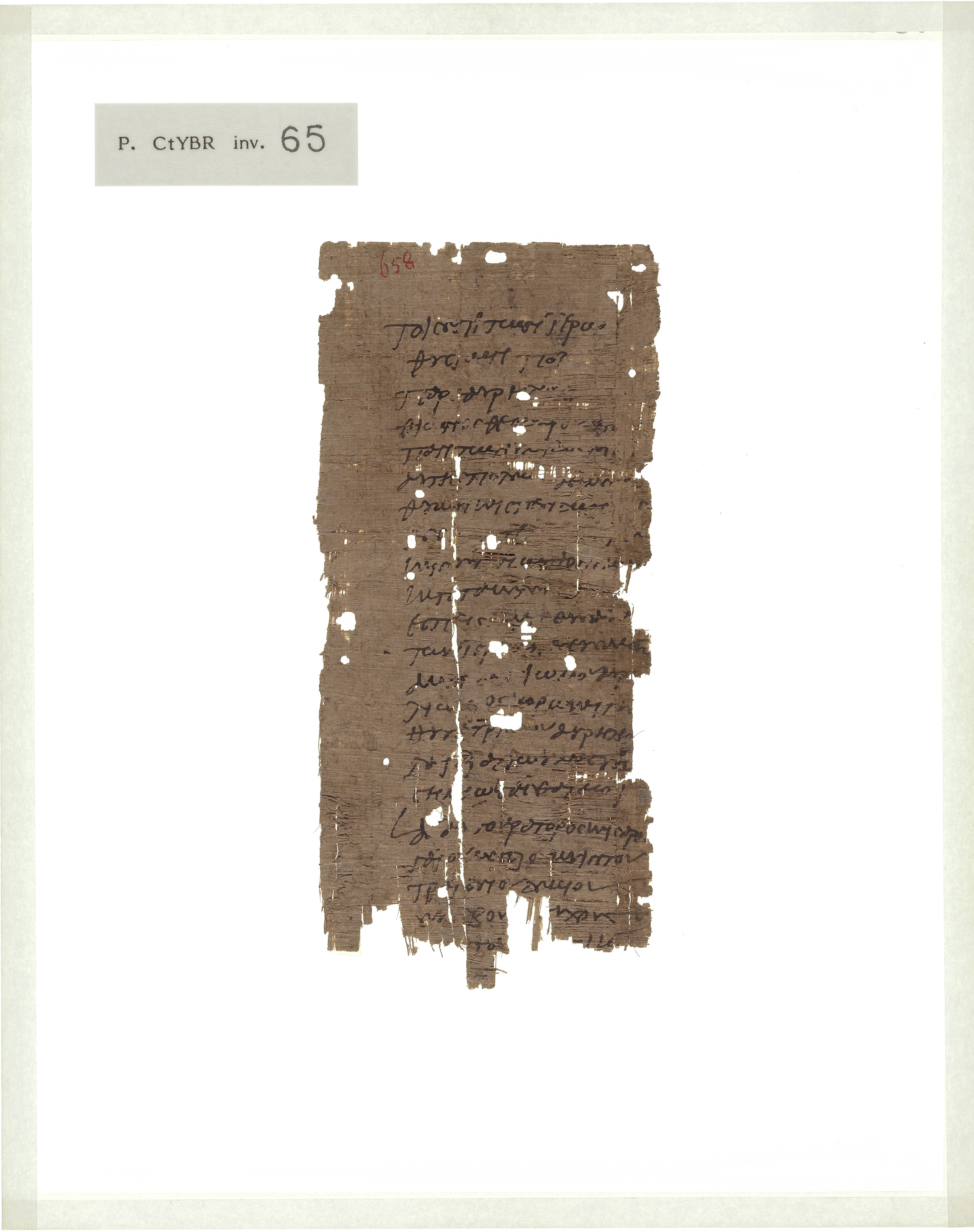
The majority of the known Decian libelli (a word used to refer to short documents, especially official ones) come from the Fayumic town Theadelphia (modern Batn el-Harit), located 30 km northwest of Medinet al-Fayum. Smaller numbers, however, do survive from other sites, including Narmouthis and Oxyrhynchus – for the locations of all known libelli, see the table at the end of this post. P.Oxy. IV 658 is an example from Oxyrhynchus. Most of the man’s name is lost, but his children’s names survive, his son Dioscorus and his daughter Lais. The witness statements from this text are also now lost – only the smallest of traces survive of them.

“To the commissioners in charge of the sacred victims and sacrifices of the city. From Aurelius L[…]thion son of Theodorus and his mother Pantonymis, of the same city. Always have I continued sacrificing and pouring libations to the gods, and now in your presence in accordance with what has been ordered I have poured a libation and I have sacrificed and I have tasted of the sacrifices, together with my son, Aurelius Dioscorus, and my daughter Aurelia Lais. I request you to certify this for me below.

The year one of the Emperor Caesar Gaius Messius Quintus Traianus Decius Pius Felix Augustus, Pauni 20.”

(P.Oxy. IV 658; translation from Blumell & Wayment)

This certificate shares many of the same features as the text from Theadelphia. Note that gods generally are mentioned – there is no specificity regarding to which gods sacrifices should be made. Imperial officials recording these sacrifices probably weren’t concerned about the identity of the gods, which almost certainly changed from place-to-place across the empire, only that the sacrifices took place.

pOxy IV 658 (Yale).jpeg
P.Oxy. IV 658 (c) Beinecke Library, Yale University (P.CtYBR 65)

The similarities between the texts indicate that the process of monitoring and recording the sacrifices was highly organised. The two examples given here are also very close in date – the Oxyrhynchus text was written only three days before the one from Theadelphia. In fact, nearly all of the known libelli date to June 250, approximately six months after Decius issued his decree. This six-month gap may suggest that the decree was not immediately adhered to, and so increased monitoring of sacrifices took place to ensure the emperor’s command was being carried out. However, it may simply be a case that communication of the order took this long to reach Egypt. Whatever the reason, these documents mark the beginning of a period of persecution of Christians across the empire, before the adoption of Christianity as its official religion in the fourth century.

*Note that the designation ‘Aurelius’ (‘Aurelia’ for a woman) marked somebody as a citizen of the Roman empire. Following the Edict of Caracalla (or Antonine Constitution) of 212, all free men in the empire were granted full Roman citizenship.

Technical Details (Text 1)
Provenance: Theadelphia, Fayum (Egypt)
Date: 17 June 250 CE
Language: Greek
Collection: Papyrus Collection, University of Michigan, Ann Arbor (P.Mich. inv. 262)
Designation: P.Mich. III 157 (according to the Checklist of Editions)
Bibliography: Clifford Ando, Imperial Rome, A.D. 193 to 284 (Edinburgh: Edinburgh University Press, 2012), pp. 134–141; Régis Burnet, L’Égypte ancienne à travers les papyrus. Vie quotidienne (Paris: Flammarion, 2003), #28; A. Doug Lee, Pagans and Christians in Late Antiquity: A Sourcebook (London: Taylor and Francis, 2001), pp. 50-51

Technical Details (Text 2)
Provenance: Oxyrhynchus (Egypt)
Date: 14 June 250 CE
Language: Greek
Collection: Beinecke Library, Yale University, New Haven (P.CtYBR 65)
Designation: P.Oxy. IV 658 (according to the Checklist of Editions)
Bibliography: Clifford Ando, Imperial Rome, A.D. 193 to 284 (Edinburgh: Edinburgh University Press, 2012), pp. 134–141; Lincoln H. Blumell & Thomas A. Wayment (eds.), Christian Oxyrhynchus: Texts, Documents, and Sources (Waco, TX: Baylor University Press, 2015), pp. 380–384 [#106]; John R. Knipfing, “Libelli of the Decian Persecution,” The Harvard Theological Review 16 (1923), pp. 365­–366; J. B. Rives, “The Decree of Decius and the Religion of Empire,” The Journal of Roman Studies 89 (1999), pp. 148–149

Further bibliography:
Robin Lane Fox, Pagans and Christians in the Mediterranean World from the Second Century AD to the Conversion of Constantine(Harmondsworth: Penguin, 1986)
Paul Keresztes, “The Decian libelli and contemporary literature”, Latomus 34 (1975), pp. 761–781
John R. Knipfing, “Libelli of the Decian persecution”, Harvard Theological Review 16 (1923), pp. 363–390
James B. Rives, “The Decree of Decius and the Religion of Empire,” The Journal of Roman Studies 89 (1999), pp. 135–154

List of Decian Libelli
The following table provides a list of all published certificates. It has been compiled from the Trismegistos archive database (Decian libelli from Theadelphia) and a search of the papyrological website papyri.info.

Text

Provenance

Date

SB I 4439Theadelphia26 May – 24 June 250
P.Wisc. II 87Narmouthis4 June 250
Tyche 30 (2015), 13–18Theadelphia4 June–14 July 250
SB I 4435Theadelphia12 June 250
P.Hamb. I 61aTheadelphia13 June 250
SB I 4436Theadelphia14 June 250
SB I 4437Theadelphia14 June 250
P.Oxy. IV 658Oxyrhynchus14 June 250
P.Ryl. I 12Theadelphia (written in Crocodilopolis)14 June 250
PSI V 453Theadelphia14–23 June 250
SB I 4438Theadelphia15 June 250
SB I 4440Theadelphia16 June 250
SB I 5943Theadelphia16 June 250
P.Lips. II 152Theadelphia (written in Euhemeria)16 June 250
P.Mich. III 157Theadelphia17 June 250
SB I 4441Theadelphia17 June 250
SB VI 9084Theadelphia17 June 250
SB I 4442Theadelphia19 June 250
SB I 4443Theadelphia19 June 250
P.Ryl. II 112aTheadelphia20 June 250
P.Mich. III 158Theadelphia21 June 250
P.Hamb. I 61bTheadelphia21 June 250
SB III 6827Theadelphia21 June 250
SB I 4444Theadelphia21 June 250
SB I 4445Theadelphia22 June 250
P.Ryl. II 112cTheadelphia22 June 250
SB I 4446Theadelphia23 June 250
SB I 4447Theadelphia23 June 250
SB I 4448Theadelphia23 June 250
SB I 4449Theadelphia23 June 250
BGU I 287Theadelphia (written in Alexandrou Nesos)26 June 250
PSI VII 778Fayum(?)26 June 250
P.Meyer 15Theadelphia27 June 250
P.Oxy. XII 1464Oxyrhynchus27 June 250
SB I 4450Theadelphia14 July 250
P.Meyer 16Theadelphia250
P.Meyer 17Theadelphia250
SB III 6828Theadelphia250
P.Ryl. II 112bTheadelphia250
SB I 4451Theadelphia250
SB I 4452Theadelphia250
SB I 4453Theadelphia250
SB I 4454Theadelphia250
Chr.Wilck. 125Ptolemais Euergetis (written in Crocodilopolis)250
P.Oxy. XLI 2990Oxyrhynchus

His Mind is Shrouded in Darkness

Jennifer Cromwell

Perhaps one of the best-known aspects of the Egyptian mummification process is that the brain was removed from the body and discarded. The brain’s function and importance were not understood. Instead, the heart was not only recognised as a beating organ that pumped blood, for the ancient Egyptian it was also the source of intelligence, emotions, and memory. After death, amulets were placed on the mummy to protect the heart and ensure that the deceased retained its intellectual functions in the afterlife.

heart amulets.jpg
Heart amulets (c) Metropolitan Museum of Art, New York (left: 10.130.1804; centre: 10.130.1782; right: 10.130.1795)

This dual function means that words for heart (mostly ib, also HAti) don’t always refer simply to the organ, they can also refer to the mind. When texts talk about problems affecting the heart, it is not simply a case that physiological conditions are meant, psychological factors may need to be considered as well.

Dating to the early 18thDynasty (late 16th– early 15thcentury), a medical scroll records a large number of illnesses and injuries and their remedies. Papyrus Ebers – named after Georg Ebers who acquired the papyrus in 1872/3 – is the largest and only complete surviving medical scroll from ancient Egypt. At over 18.5 m in length, the scroll bears 110 columns of hieratic writing that contain 879 individual entries. A range of symptoms are recorded, dealing with both internal and external illnesses: the respiratory system, stomach and intestinal pain, eye illnesses, skin illnesses, gynaecological illnesses, and issues affecting the heart. And it is this last category that we need to examine for evidence for psychological illnesses.

Some entries are certainly about the physical heart: “As to: His heart is weak(?). A vessel called ‘the receiver’ is the one that causes it. It is this vessel that gives water to the heart” (entry 855c). Egyptian knowledge of the inner workings of the human body was limited: physicians rarely practiced internal surgery, and by the time bodies got to the embalmers for mummification, the organs were no longer functioning. However, from passages such as this one, it is clear that Egyptians did understand how the heart worked in many respects.

In addition to these entries, others seem to mean the mind rather than the heart – the same Egyptian word is used, but a great difference is created if we translate ib in these cases as ‘mind’. In these passages, we see mood change, depression, forgetfulness. However, as these entries are not dealing with individual or specific cases, it is difficult to tell if we are seeing mental health issues or issues connected with aging or degenerative conditions.

“As to: Vanishing of the mind (and) forgetfulness of the mind. The breath of the (harmful) doing of the Cherheb-priest is the thing that does it. It penetrates into the lung as a case of sickness and it happens that the mind is confused as a result.” (855u)

“As to: His mind is overflooded. This means that his mind is forgetful like one who thinks of something else.” (855z)

It is difficult to map modern diagnoses onto ancient symptoms, but these entries don’t simply refer to everyday forgetfulness, rather more serious periods of memory loss and confusion. Another entry mentions the mind being shrouded in darkness, resulting in feelings of powerlessness. It doesn’t seem like too far a stretch to recognise here depression and its debilitating effects.

“As to: His mind (ib) is shrouded in darkness, he (the man) tastes his heart (HAti). This means that his heart (ib) is narrowed and dark in his belly as a result of dmud; it causes fits of powerlessness.” (855w)

One more entry, 855k, talks about the ‘kneeling of the heart’ and the heart being tied up. Is this heart pain, or is it a breakdown of the mind, of mood swings and emotional and mental constriction rather than physical?

The above entries mention symptoms and identify possible causes. An earlier entry in the papyrus seems to deal with various conditions of the mind, including forgetfulness, concentration problems, and other injuries, for which it provides a remedy.

“Another, to eliminate the aAa-poison-matter on the heart, to eliminate forgetfulness of the mind, flight of the mind, stitches of the mind: ins.t-plant 1/8; figs 1/8; celery 1/16; ochre 1/32; valerian(?) 1/8; honey 1/32; water 10 ro; likewise.” (227)

The meanings of many words that occur in medical texts (both concerning symptoms and ingredients in remedies) are unknown, and we simply transcribe rather than translate these terms. But what is clear is that the ancient Egyptians recognised that emotional and mental health – even if they would not have recognised that modern term – needed to be taken care of and treated, exactly in the same way as physical health.

Papyrus Ebers, Column 37. Note the use of red ink for headings and quantities. (c) Leipzig University (for more, see here)

Technical Details
Provenance: Egypt, perhaps Thebes (purchased on the antiquities market, 1872/3)
Date:  1514–1494 BCE (reign of Amenhotep I: year 9 of his reign is mentioned on the back fo the papyrus)
Language: Late Egyptian (hieratic script)
Collection: Leipzig University
Designation: P.Ebers
Bibliography: Thierry Bardinet (1995), Les papyrus médicaux de l’Égypte pharaonique: traduction intégrale et commentaire(Paris); Georg Ebers (1875), Papyros Ebers. Das hermetische Buch über die Arzneimittel der alten Ägypter in hieratischer Schrift(Leipzig); Paul Ghalioungui (1987), The Ebers Papyrus. A New English Translation, Commentaries, and Glossaries (Cairo); Bernard Lalanne & Gérard Métra (2017),Le texte medical du Papyrus Ebers. Transcription hiéroglyphique, transliteration, traduction, glossaire et index(Brussels); Reinhold Scholl (2002), Der Papyrus Ebers. Die größte Buchroole zur Heilkunde Altägyptens (Leipzig); Wolfhart Westerndorf (1999), Handbuch der altägyptischen Medizin (Cologne)

A Donkey Called Rameses

Jennifer Cromwell

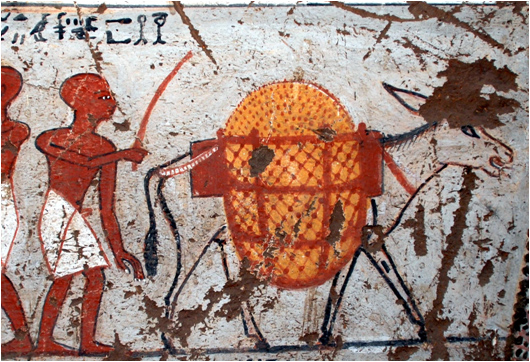
In the village of Deir el-Medina, the home of the workmen who built the royal tombs of the Valley of the Kings, donkeys were big business. While scenes from the New Kingdom show pharaoh riding a horse-drawn chariot into battle, neither horses nor camels played a part in the day-to-day lives of villagers – camels weren’t even introduced into Egypt until a millennium later (see here). Donkeys were the principal beast of burden, and still play an important part in village life in Egypt today.

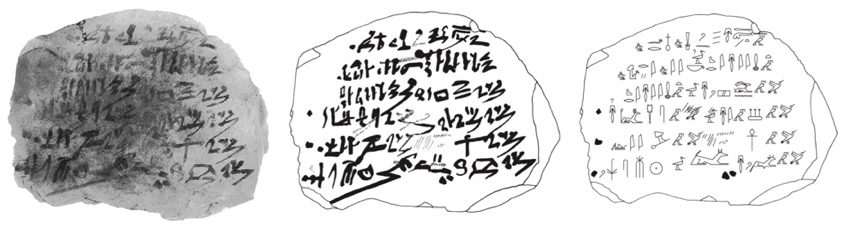
During the Ramesside period (ca. 1,295–1,069 BCE), a man called Sennefer had a short text drawn up on a limestone flake. On first sight, this text – a list – seems pretty innocuous, but it provides the first evidence that ancient Egyptians named their donkeys, just as we do today.

The donkeys of Sennefer:

Tamytiqeret daughter of Kyiry

Paounsou son of Tamytiqeret

Pasaiou son of Pasab

Paankh [son of?] Pakheny

Paiou son of Ramessou

oIfao 10044.jpg
Ostracon O.IFAO 10044 (from Grandet 2003)

All of these names have meanings. Tamytiqeret, the only female donkey, means ‘the excellent cat’ – and this isn’t the only animal name among the donkeys. Five of the other names belong to other four-legged beasts: Paounsou, ‘the wolf’; Pasaiou, ‘the pig’; Pasab, ‘the jackal’; Paankh, ‘the goat’ (or perhaps instead ‘the living’); and Paiou, ‘the dog’. Why give animals the names of other animals? Do they reflect the donkeys’ individual characters, behaviour, or appearances? As for the other names, Kyiry translates as ‘another companion’, Pakheny as ‘the rower’, and as for Ramessou, what was it about this donkey that reminded Sennefer of his king, Rameses?

Why did Sennefer have this list drawn up? Was he doing inventory? Or was he asserting his rights of ownership? In answering this point, it may be significant that all the donkeys are identified by their ancestors. At least three of the named donkeys are related: Kyiry sired Tamytiqeret, who gave birth to Paounsou. By demonstrating that he owned several generations of animals, Sennefer was asserting his rights to both rent or sell them. And the economic activity surrounding donkeys in Deir el-Medina is well-attested, with the majority of relevant textual evidence collected in Jac Janssen’s 2005 book on the topic.

Met Donkeys (11.150.8).jpg
Two Donkeys with Drivers, from Meir, Dynasty 11/12, ca. 2,030–1,850 BCE (c) Metropolitan Museum of Art (11.150.8)

Donkeys were hired by water-carriers, woodcutters, and washermen from workmen, scribes, and policemen in the village. Rental periods could last anything from a few days to a few months. Not all transactions would have been written down, and we know most about those situations when things went wrong. In the following text, from year 20 of the reign of Rameses III (ca. 1,164 BCE), the owner (whose name is not known) suffered problems with the unnamed water-carrier who rented his female donkey.

“After you have worked all day with the female donkey, you should bring her back. She [should spend the night] here with me, for her foal needs her.” When he had loaded her with grain in the evening, I sent Horemwia the son of Iyernef with the words: “Bring her back”. But he (the water-carrier) quarrelled with him and did not give her to him.

After two days, he came, saying to me: “She [died?]”, and he seized her foal, saying: “I will raise it”. And he was reported in the court, and the court (instructed?) the scribe Amenakhte son of Ipuy to condemn him.

The following part of the text has suffered some damage. The water-carrier’s punishment included recompense for the owner, which he did not pay, and then the provision of another donkey. At the time of writing, the owner hadn’t been provided with anything. He ends the text: “Now, I sit without until today, neither the female-donkey nor her foal.”

Donkeys were essential, for the practicalities of life in the Theban mountains and for the livelihoods of their owners. And some were important enough to name Rameses.

donkey in TT16 (Panehsy and Tarenu in Dra abu el-Naga).jpg
Scene from the New Kingdom tomb of Panehsy and Tarenu, TT16 (Dra Abu el-Naga)

Technical Details (Text 1):
Provenance: Deir el-Medina, Egypt
Date: Ramesside Period (Dynasties 20/21); ca. 1,295–1,069 BCE
Language: Late Egyptian (written in hieratic script)
Collection: Institut français d’archéologie orientale (Ifao), Cairo
Designation: O.IFAO 10044 = O.DeM 10087 (see The Deir el-Medina Database)
Bibliography: Pierre Grandet, ‘Les ânes de Sennéfer (O. Ifao 10044),’ BIFAO 103 (2003), pp. 257–265 (available online here); Pierre Grandet, Catalogue des ostraca hiératiques non littéraires de Deir el Médînéh X (Nos. 10001–10123) (Cairo, 2006), pp. 90–92.

Technical Details (Text 2):
Provenance: Deir el-Medina, Egypt
Date: Dynasty 20 (year 20 of Rameses III): ca. 1,164 BCE
Language: Late Egyptian (written in hieratic script)
Collection: Ashmolean Museum, Oxford
Designation: O.Ashmolean Museum 54 (see The Deir el-Medina Database)
Bibliography: Shafik Allam, Hieratische Ostraka und Papyri (1973), pp. 159–160 [#156]; Jaroslav Černý and Alan Gardiner, Hieratic Ostraca (Oxford, 1957), p. 15; Jac J. Janssen, Donkeys at Deir el-Medina(Leiden, 2005), pp. 30–31; Kyra van der Moezel, “Donkey-Transactions: Some notes on decontextualization and accountability”, in Ben J. J. Haring et al. (eds.), The Workman’s Progress: Studies in the Village of Deir el-Medina and Documents from Western Thebes in Honour of Rob Demarée(Leuven–Leiden, 2014), pp. 155–174 (esp. 168–170).

“Schoolboy, where have you been going so long?”: The Old Babylonian Student and School

Moudhy Al-Rashid

Amid the ruins of Nippur is a house, inspiringly named “House F”, made up of a small courtyard with four rooms. The crumbled remains of benches appear in one room and in the courtyard, where there are also three recessed boxes constructed from mud brick. In these boxes were fragments of tablets and pots, and dried piles of clay once used by scribes in training to make cuneiform tablets.

In the 18th century BCE, a scribal student might have reached into one of the boxes to pinch off a lump of clay, small enough to fit into their hand but large enough to carry the text assignments for the day. Or, more likely, the lenticular tablets were ready and waiting for them (many school tablets, after all, have a teacher’s writing on one side and the student’s attempted copy on the other). They might have found a space to sit on a bench in the courtyard of House F, which 4,000 years ago would have been called an Edubba — “Tablet House” in Sumerian — and begun to pinch and shape the slippery grey lump until it resembled a very large lentil.

The tablets found in House F and other schools have allowed for the Babylonian school curriculum to be reconstructed with some confidence. The first phase would have taught students writing techniques beginning with the most basic sign form, a single wedge, from which the word, cuneiform, takes its name (cuneus is the Latin word for “wedge”). The second phase involved basic lists of nouns, and the third phase, more advanced lists and mathematics. The final phase introduced more complex compositions, like works of Sumerian literature, model contracts, and proverbs.

Cuneiform was a writing system used to write more than one language, including the language it was originally developed to record, Sumerian, and the unrelated Akkadian language. Although Sumerian was no longer spoken in the Old Babylonian period, when House F and similar schools were in operation, it continued to be learned and used as a written language, the domain of students and scholars. One of the goals of scribal education, therefore, was to master the long dead language of Sumerian.

“A scribe who does not know Sumerian,” reads one proverb that would have been copied down by a Babylonian scribal student, “what kind of scribe is that?”

Occasionally, school texts provide hints about the lives of ancient Babylonian students in the Edubba. “Schoolboy, where have you been going so long?” reads the opening line to one such composition in Sumerian known today as Schooldays.

“I have been going to the Edubba.”

“What have you been doing at the Edubba?”

“My tablet, I recited. My lunch, I ate.

“My tablet, I prepared, wrote, finished.”

The work describes a student who goes to school, comes home, and goes to school again. His mother packs him a lunch of “two breads”, and his schoolteacher recites the tablet for him to copy. Although this literary work begins innocently enough, it does go on to describe how the student gets into trouble for various things, like having bad handwriting or speaking in Akkadian (side note: I would have made a terrible Babylonian scribe!).

Widely agreed to be a literary composition rather than a diary – and therefore, somewhat embellished – Schooldays, like any work of fiction, must have drawn some elements from reality. It humanises scribal students, their teachers, and their families, and suggests that they all must have worked hard and experienced various frustrations in pursuit of the twin goals of educating and being educated.

School texts are interesting for what they tell us about education and scholarship, language and translation, literacy and learning in ancient Babylonia. But these texts are also interesting for another reason: they leave behind fragments of the lives of children.

Whether it’s the messy handwriting of a new scribe in Nippur.

Screenshot 2019-09-23 at 09.08.16.png
School exercise text from Nippur, University of Pennsylvania Museum (UM 29-13-081)

Or a fish doodle by (perhaps) a bored new student in Kish.

School exercise text with drawing from Kish, Ashmolean Museum (Ashm 1930-0231b)

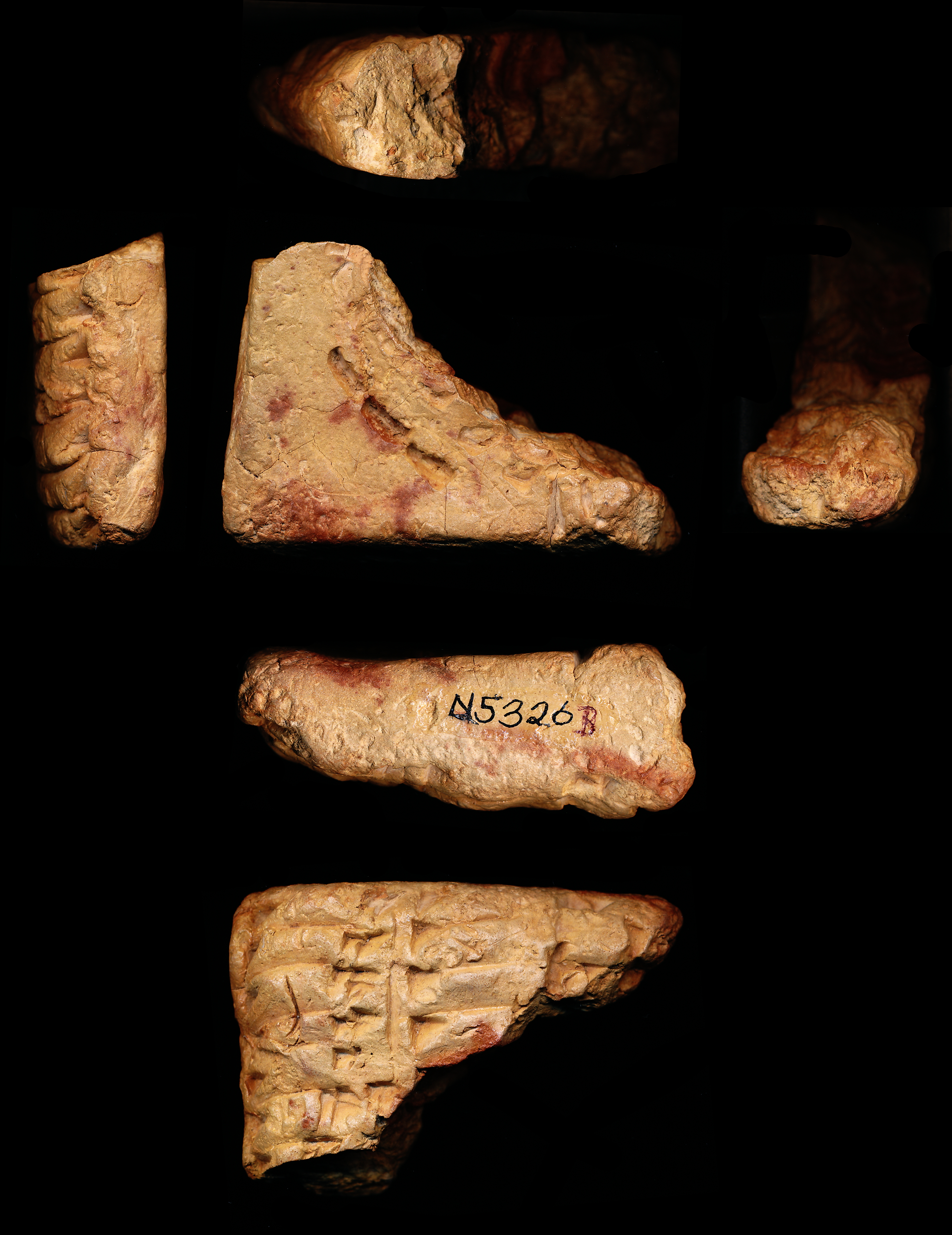
Or even the bite marks of a 12- or 13-year-old boy.

School exercise text from Nippur with bite marks, University of Pennsylvania Museum (N 5326B)

As we return to our classrooms from the holidays, it is comforting to know that we are part of a longer tradition of bad handwriting, packed lunches, and distracted doodles. Millennia ago in southern Iraq, students were also finding seats on benches in a Tablet House, teachers were prepping their clay tablets, and all were bracing themselves for the term ahead.

What is an Ostracon?

Jennifer Cromwell

When dealing with ancient texts, the term ostracon refers to pottery sherds and limestone flakes that were reused to write documents. Pottery is by far the more common material used, but some areas show a particular preference for limestone. They are especially well-known from Egypt, but the practice occurs across the ancient world; see, e.g., this example from Israel. The term itself comes from ancient Greece and the practice of writing names of individuals expelled (ostracised) from Athens on potsherds.

Typically, the sherds used are large enough (or small enough) to be held comfortably in one hand. However, on occasion an abnormally large piece was used. One of the best-known examples of a huge limestone ostracon comes from late New Kingdom Egypt (ca. 1,295–1,069 BCE) and the village Deir el-Medina in western Thebes. Now in the Ashmolean Museum, Oxford, this ostracon is about 1 m in length and bears the text of the literary work The Tale of Sinuhe. Another unusual example, this time on pottery, comes from Roman Egypt and the site of Mons Claudianus in the eastern desert. This pot was used to write two-syllable words beginning with the Greek letter pi and also has a drawing of a man. The text is written on the neck and shoulder of the original amphora, turned upside down (so the entire top section of the vessel). How was it written? Did the writer plant the narrow end in the sand in front of them as they sat cross-legged on the ground?

Sinuhe and oClaud II 415
Left: Ashmolean Ostracon of Sinuhe; right: O.Claud. II 415. Images not to scale!!!!

But what were ostraca used for? What are their modern equivalents? Being plentiful, easily accessible, and freely available, they were used for a wide variety of purposes: scrap paper, post-it notes, notebooks, text messages/SMS, postcards, cards, emails. Despite their reused nature, they could be used for correspondence between officials or receipts for purchases or tax payments, while also being used to doodle or draw cartoons. Figural sketches from the New Kingdom on limestone flakes show a range of subject matter, from the sublime to the ridiculous (including satirical cartoons showing societal and natural order turned upside-down), from the bawdy to the serious.

figural ostraca
Left: Brussels Museum (E.6727). Centre: British Museum (EA8506). Right: Manchester Museum (acc. 5886) – read more about it here.

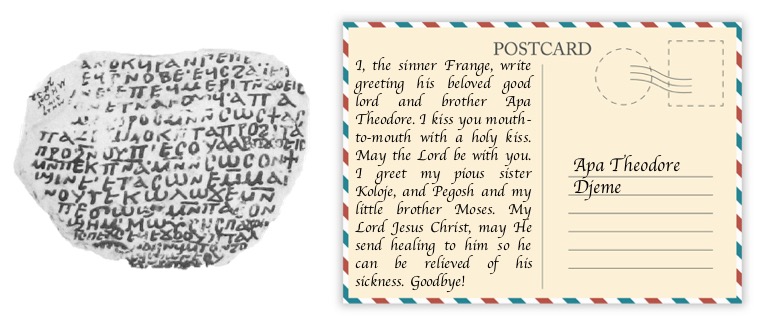
A couple of case studies written by a monk living in early 8th century CE western Thebes show the kind of day-to-day messages that ostraca were used for. Frange lived in what is now referred to as Theban Tomb 29, on Sheikh Abd el-Qurna. For most of his time there, he lived alone, but hundreds of texts written in Coptic found in the tomb and in other places reveal his social networks and how and why he interacted with people – other monks and villagers alike. Some messages were short and contained a short question or request – the kind of thing that we would send a quick text message about today. Other messages were longer, but mostly polite with generic questions about health and well-being, and maybe adding a question or two – like an ancient postcard or short letter.

Two ostraca by Frange fitting these descriptions were found from the village Djeme (Medinet Habu), a kilometre or so from where he lived. In the first, after polite hellos, he asks a man Pher to come visit him. In the second, Frange writes to Theodore, but adds greetings to other people that he knows and prays that one of them recovers from his illness. Today we have an abundance of ways to communicate such messages, in typed or handwritten form. But in the ancient world, ostraca fulfilled all these functions. Perhaps they weren’t the text message of the ancient world, but they weren’t all that dissimilar.

oMedinHabuCopt 138 as text message
A short note from Frange, O.Medin.Habu Copt. 138; translation shown as a text message
oMedinHabuCopt 139 as postcard
A short note from Frange, O.Medin.Habu Copt. 139; translation shown as a postcard

One of the great advantages of ostraca over other media, such as papyrus or parchment, for the study of the ancient world is their often ephemeral and informal nature. They provide a window into people’s lives that we typically don’t see from papyrus. Being more expensive and harder to get hold of for many people, papyrus documents typically contain more formal types of texts, recording major events, whether personal or public. But the stories that ostraca tell are often more intimate, revealing the minutiae of daily life and relationships, and the very real and practical concerns of the men and women who wrote them.

Technical Details (Greek amphora)
Provenance: Mons Claudianus, Egypt
Date: 2nd century CE
Language: Greek
Collection: storeroom in Qift, Egypt (inv. 7861)
Designation: O.Claud. II 415 (according to the Checklist of Editions)

Technical Details (both Coptic ostraca)
Provenance: Djeme, western Thebes, Egypt
Date: Early 8th century CE
Language: Coptic (Sahidic dialect)
Collection: Egyptian museum, Cairo? (possibly the Coptic Museum; they were returned to Egypt from Chicago after they were published in 1954)
Designation: O.Medin.Habu Copt. 138 and 139 (according to the Checklist of Editions)


Protecting the Tax-Payer, Protecting the Tax Man

Jennifer Cromwell

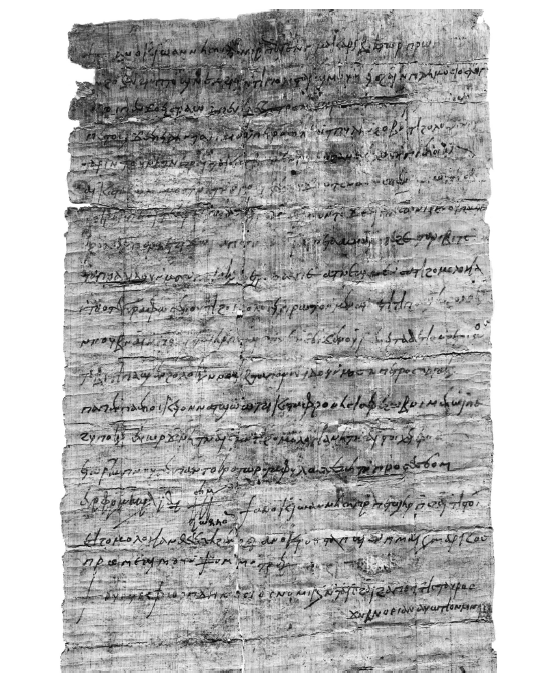
On 17 April 731, an Egyptian priest John son of the late Victor wrote a declaration for the state treasury, represented by the Muslim official Rashid. He had paid two gold coins (holokottinos in the document) for his village’s taxes, representing the headman, Peter. However, it turned out that he – and so his village – had paid half a gold coin too much.

“I, the humblest priest John the son of the late Victor from Tpulê-nHobn in the northern district of this city, Shmoun, write to the state treasury, namely our lord Rashid the most famous amirof this city Shmoun and its nome. The deacon Peter, the head of Tpulê-nHobn, gave two gold coinsso that I could bring them to you and pay them for the stichos-tax of this village. I have paid them to you today, Parmoute 22 in this 14thindiction year, but I paid halfa gold coin too much, beyond what was incumbent upon me and what was assigned to me, and you returned it to me, so that I can take it and repay it to the deacon Peter, the headman.”

The particular tax here, the stichos, was not a regular tax but an exceptional one. It occurs infrequently in our records and the amount involved is only small, especially as this is on behalf of the whole village of Tpulê-nHobn, part of the city Hermopolis (Coptic Shmoun, modern el-Ashmunein) – even though John says ‘what was assigned to me’, it’s clear that the money is from his whole community.

Or 6201 – overpayments
British Library, Or. 6201/A2 (C) British Library Board (image from Schenke 2014)

The early decades of the eighth century witnessed a huge increase in the volume of taxation documentation throughout the country, written in each of the three languages used in Egypt at that time: Arabic, the language of the rulers (who had conquered Egypt in 642); Greek, the language of the previous rulers and for a millennium the language of Egypt’s administration; and Coptic, the last phase of the ancient Egyptian language. Tax payments didn’t always come in on time – in fact, a lot of our evidence shows that taxes were frequently paid in arrears and officials often had to resort to strong language and measures (see this threatening letter, for example). But, on the other hand, this document demonstrates that when Egyptians did pay too much, the excess was returned.

To make sure that the money was returned to Peter and the village – and that John didn’t take it and run – Rashid asked John to have this declaration drawn up. Not only would this document help ensure the money went back to the right place, it also protected the state treasury from accusations of unfair treatment. Such behaviour and careful recording of tax payments and overpayments may be the result of accusations of unfair tax allocation and mistreatment of Egyptian taxpayers.

“You asked for this declaration from me, in writing. Now, I declare, first, that you gave this half a gold coin to me, today – as already recorded – from your hand to mine. Afterwards, I am ready to take this half a gold coin and give it to the deacon Peter, the headman of my village, complete and without contempt, everything of mine being pledged.”

At the end of the document, the scribe of the document, the public notary Eustephios, signs on behalf of John, who is illiterate. Another man, Justa son of the late Mark, also witnesses the document.

As for the official named in the text, Rashid can be identified as the well-known official Rashid ibn Chaled, who was pagarch of Hermopolis at this time, having previously served as pagarch of Heracleopolis (the pagarch was the most senior official of a region, known as a pagarchy, or nome). It is very doubtful that he himself was involved in this situation, rather that his name is invoked as the senior local official and representative of the government. Both parties benefit from this declaration: the state can’t be accused of unfair behaviour, nor can it exact more money from the villagers for this particular tax. This is not to say that every Christian tax payer had the same experience of Muslim officials, but a series of checks and measures were clearly in place to help ensure that the system ran as smoothly as it possibly could.

Technical Details
Provenance: Hermopolis (el-Ashmunein), Egypt
Date: 17 April 731 CE
Language: Coptic (Sahidic dialect)
Collection: British Library, Or. 6201/A2
Designation: SB Kopt. V 2221 (siglum according to the Checklist of Editions); see also Trismegistos TM 322181.
Bibliography: Gesa Schenke (2014), “Rashid ibn Chaled and the Return of Overpayments,” Chronique d’Égypte 89, pp. 202–209

Living (and Dying) in Interesting Times

Luigi Prada

At the age of 21 years and 29 days, the sistrum-player Kheredankh died. A fragment of her funerary stela survives and is today housed in the Petrie Museum of Egyptian Archaeology in London. Originally, this stela would have been a remarkable artefact of very fine craftsmanship, with a representation of the deceased in the presence of Osiris (and perhaps other gods and goddesses of the netherworld) in its top part, and lines of exquisitely carved hieroglyphs underneath. Of all this, little survives today, namely, only the bottom left corner of the inscription, which had been badly damaged from being reused as a door socket (as suggested by the concave depression in its corner), before the father of Egyptian archaeologist Flinders Petrie probably saw and purchased it in Egypt. Yet, even in its battered condition, this fragment still reveals the stunning quality of its original carving.

UC14037 stela
The Stela of Kheredankh, UC14357 (C) Petrie Museum of Egyptian Archaeology, London

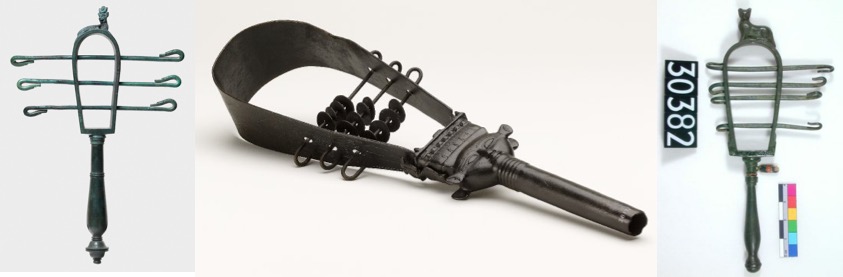
More than providing indications of the quality of its craftsmanship, the little amount of text that survives belies the significance of its content. Concerning Kheredankh herself, we know that she was a sistrum-player during the late Ptolemaic Period, a title indicating a priestess whose distinctive role was to play the sistrum, an instrument producing a rattling sound that was used during various temple rituals. The few lines of surviving text on the Petrie fragment of Kheredankh’s funerary stela provide her date of birth and time of burial, when she died in relatively early adulthood. In a touching fashion typical of such mortuary monuments from ancient Egypt, the inscription is written in the first person, as if Kheredankh herself were addressing the reader through her stela:

‘My father (…) placed <me> in the west (i.e. the necropolis). He performed for [me] all funerary ceremonies (…) I was buried in his family tomb, by the side of his male and female ancestors’.

Beyond these details, we know that Kheredankh belonged to what was probably the most prominent family—right after that of the royals—in Ptolemaic Egypt: the family of the High Priest of Ptah in Memphis, Egypt’s oldest capital and still at the time the holiest city in the whole country. The office of High Priest of Ptah can be traced back to the Old Kingdom, in the third millennium BCE, and Kheredankh’s father, the High Priest Pasherenptah III (who lived from 90–41 BCE), was to be one of the last men to hold this position, which was eventually discontinued by the Romans shortly after their conquest of Egypt in the year 30 BCE.

three sistra
Three sistra. Left: Metropolitan Museum of Art, NYC, Roman (MMA 19.5). Centre: British Museum, Late Period (EA38172). Right: Petrie Museum of Egyptian Archaeology, Graeco-Roman Period

Other monuments provide us with more information about the vicissitudes of Kheredankh’s family—reminding us that objects and the stories they tell do not exist in isolation. From the funerary stela of her mother Taimhotep (or perhaps her stepmother: the lineage is not completely clear) now in the British Museum (EA 147), we know that her father Pasherenptah III was struggling to beget a male child, who would become the heir of the High Priesthood of Ptah. After giving birth to three daughters, Taimhotep and Pasherenptah III eventually turned to the gods, begging for the intercession of Imhotep, the son of the god Ptah (and, originally, an actual historical figure, a high courtier who had lived in the third millennium BCE, and the architect of the Step Pyramid of Djoser). Through a vision in a dream, Imhotep promised the High Priest a male child in exchange for works to be carried out in his sanctuary. Eventually, the god kept his word, and the couple finally celebrated the birth of their son, whom they named Imhotep-Padibastet.

Taimhotep stela
Stela of Taimhotep (c) British Museum, (EA147)

While all this high-born family drama was ongoing, even more radical upheavals were about to reshape the world in which Kheredankh and her parents lived, soon changing Egypt forever. Indeed, one of the reasons to which her stela fragment owes its fame is that it is one of the relatively few Egyptian texts to contain a mention of Caesarion, the ill-fated son of Cleopatra VII and—supposedly—Julius Caesar. This mention occurs in the date given for the day of Kheredankh’s burial, which is said to have taken place in the ninth year of reign of ‘the Queen, the Lady of the Two Lands, Cleopatra, and her son […] Caesarion’, that is, in 43 BCE.

Only the previous year, on the Ides of March of 44 BCE, Julius Caesar had been assassinated in Rome, an event that had triggered a civil war, which quickly expanded from Italy across the Mediterranean. It would only be a matter of a few years before Rome’s new strong men, Mark Antony and Octavian (the future emperor Augustus) would turn against each other. Cleopatra’s private relationship and political alliance with Mark Antony, and Egypt’s consequent alignment against Octavian and his armies in the Roman West, would turn out to be fatal for her and Egypt. Following Octavian’s victory over Mark Antony, events would quickly precipitate, with Cleopatra’s famous suicide in the year 30 BCE, Octavian’s victorious entry into Alexandria, and the murder of the young Caesarion, who had by then been proclaimed king Ptolemy XV Caesarion, the last sovereign of an independent Egypt.

With the Roman conquest, many drastic changes would shake Egypt, at all levels of society. As mentioned above, the office of Pasherenptah III itself, that is, the High Priesthood of Ptah in Memphis, with its tradition dating back over more than two thousand years, would not survive the death of Caesarion by many years.

Technical Details
Provenance: Saqqarah, Egypt
Date: 14 February 43 BCE (reign of Cleopatra and her son Caesarion)
Language: Egyptian of Tradition / Middle Egyptian (hieroglyps)
Collection: Petrie Museum of Egyptian Archaeology, London (UC14357)
Designation: Trismegistos TM113111
Bibliography: Jan Quaegebeur (1971), “Contribution à la prosopographie des prêtres Memphites à l’époque Ptolémaïque,” Ancient Society 3 (1972), pp. 77–109 (no. 2.5, pp. 99–100); Eva A.E. Reymond (1981), From the Records of a Priestly Family from Memphis(Wiesbaden), no. 23; Harry M. Stewart (1983), Egyptian Stelae Reliefs and Paintings from the Petrie Collection: Part Three: The Late Period(Warminster), no. 20, pl. 13.

Thinking about Translations

Jennifer Cromwell

What are we doing when we translate ancient texts and who are we doing it for? These questions have been on my mind for a while, and they lie behind a lot of my pieces for Papyrus Stories. Thinking about translation is not anything new. Texts have been translated into other languages since antiquity, and translation of literature today is an important part of the publishing world.
Two passages from very different sources have recently caught my attention that discuss this very point.

Evagrius of Antioch, Prologue to Life of Antony
In the fourth century, the Greek version of the Life of Antony was translated into Latin. The first translation, by an anonymous writer, was very faithful to the Greek, a later translation was produced by Evagrius of Antioch, who wrote the following in his prologue.

“A literal translation made from one language to another conceals the meaning, as rampant grasses suffocate the crops. As long as the text keeps to the cases and turns of phrases, it is forced to move in an indirect way by way of lengthy circumlocutions, and it finds it hard to give a clear account of something which could be expressed succinctly. I have tried to avoid this in translating, as you requested, the blessed Antony, in such a way that nothing should be lacking from the sense although something may be missing from the words. Some people try to capture the syllables and letters, but you must seek the meaning.”

For him, meaning was more important than a pedantic rendering of just words from one language to the next, so that his target audience (western and Latin-speaking) understood what was happening and didn’t struggle over cumbersome Latin constructions.

854579

N.P. by Banana Yoshimoto
Skipping forward 1,600 years, the novel N.P. by Japanese author Banana Yoshimoto (1990; English translation by Ann Sherif, 1994) is – on the surface at least – about translating, the struggle to translate a novel from English to Japanese. In one scene, the narrator Kazami Kano (girlfriend of the last person to try to translate the novel) discusses the translation process with her mother, also a translator, who’s the first speaker in the following extract.

“I don’t think you’re really cut out for translation, you know that?”

“Why? Because I’m not accurate enough?”

“How can I describe it? You’re weak, not really weak, but too kind. You think that you have to be faithful to the structure of the original sentences.”

That had been bothering me about my own translations lately, and I thought of quitting.

“That sort of thing is inevitable no matter how hard you try to separate yourself from the text. You’re so sensitive, Kazami, that it’s going to wear you out.”

“So there’s no way around it?”

“That’s my opinion. Shoji wasn’t cut out for that kind of work, either.”

“You have a good memory,” I said. Mother nodded—of course she would remember him.

“Once you get too involved with a text, it’s difficult to let go of it or create it in another language. That’s what I think. Of course, if you don’t like the book to begin with, then you have to suffer through it,” she said with a smile. “I know how Shoji felt, though. I’ve been translating for more than ten years, and sometimes I get very weary. Translating exhausts you in a special way.”

Being too close to the text is difficult, as is wanting to be faithful to the original. You’ll lose yourself in it.
And so, what does this mean when we translate ancient texts today? It’s one thing to edit a text for the first time and discuss all the philological difficulties, publishing the edition in a journal or book that will probably have a limited audience. It’s another thing entirely to write translations that mean something to people reading them as texts, who want to know what the writers mean, what they feel.

It may be a small thing, but one phrase in Coptic always sticks with me. Ari-tagapé or ari-pna literally translate into English as ‘do the love’ (Greek ἀγάπη– brotherly love, charity) and ‘do the mercy’. In Coptic, the expression is common in letters, often written before requests, to soften the force of imperatives. Really, this is the equivalent of English ‘please’ (‘please come and visit …’, ‘please send me …’), and that’s how I always chose to translate it. We don’t translate Spanish por favor as ‘by favour’, so why apply such strict literalism to ancient texts? Would ‘do the love’ mean anything to anybody? Please.

Ultimately, do we want to be slavishly faithful to the original text and miss the cultural translation? If we do, who are we writing for – and, more importantly, who are we excluding by obscuring sense with pedantry?

Parental Grief and Child Mortality

Jennifer Cromwell

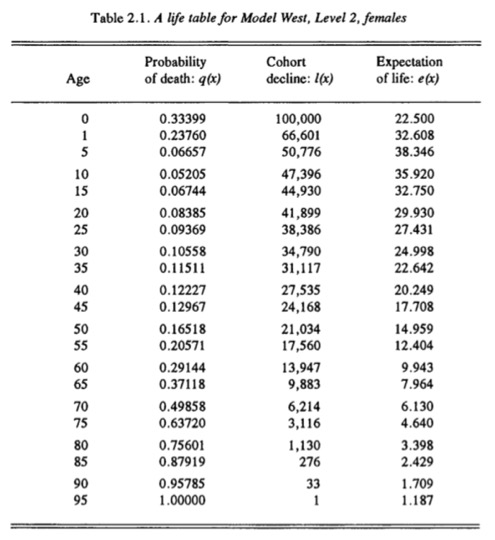
At birth, there was only a 66 per cent chance of celebrating your first birthday: one-third of all new-borns in the ancient world died before reaching that milestone. Once a child reached the age of five, their life-expectancy rose considerably, but the loss of at least one child was something that every parent experienced. While some texts mention the death of children only in passing (for example, this letter from 4th century Kellis), this is not to say that the death of a child did not leave an indelible mark.

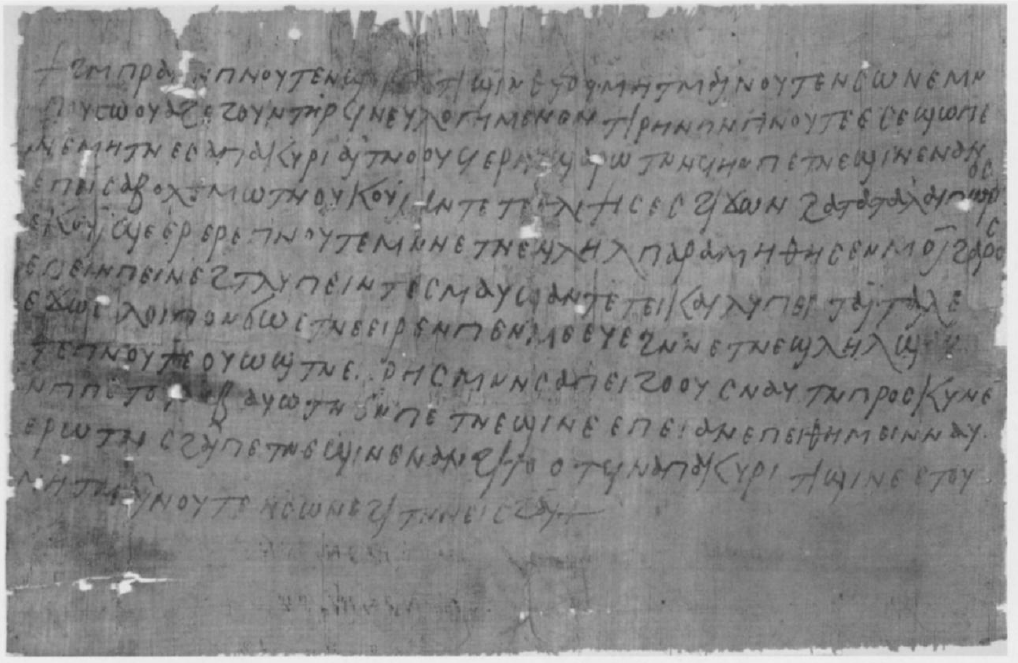
SB Kopt IV 1692
SB Kopt. IV 1692 (image from Schenke 1999)

In a Coptic letter from Hermopolis, a father – unfortunately his name is not included, only the name of the man who delivers his letter – writes to a community of nuns to ask for their prayers.

“I greet your pious sisterhood and your entire blessed community. May the peace of God be with you. Here is Apakyre; I sent him south to you to bring us (back) your greeting, as without you the affliction upon us is not small, concerning the wretched little girl. May God and your prayers comfort me about her, because I could not alleviate her mother’s grief.” [SB Kopt. IV 1692] 

Their young daughter had died and the father, suffering himself, is unable alone to comfort his wife, whose pain is enormous. In their moment of need, they reach out for consolation to the sisters.

Such grief is echoed in a funerary stela written in early January of an unknown year for a girl called Drosis. While her age is not recorded, she was on the cusp of adulthood (for women, the age of sexual maturity, so between 12 and 14), before she was cruelly taken away.

“If a young plant that is protected by reeds comes to the time of bearing fruit, and if it coincides with the flooding season, such that the waters rise […and] drown it. Suddenly, grief will fall upon its owner and he will throw down his reeds, sorrowfully, because the plant has gone in its youth, before it could bear fruit. This is the case with this little girl. When she came to the age of bearing fruit, suddenly she was carried away. She was taken while in her youth, having left around her a [burning?] fire, to be extinguished by her mother and brother, with whom she lived. She went to He to Whom every breath goes, God Almighty. We beg and implore Him, now, for Ηis mercy to reach her, who has been seized prematurely – the blessed Drosis – with great mercy, and to place her in His holy Paradise, so she may find living rest forever. Written 12th Tobe, indication year 1.”

The poetic nature of this stela, with its metaphor comparing Drosis to a plant on the verge of bearing fruit, is exceptional – such inscriptions rarely record such great strength of feeling. The grief of her family, her mother and brother, is a burning fire. She was taken prematurely, but also seemingly unexpectedly, a point that may be reflected in the material aspects of the stela itself. As the image below shows, the stela is damaged in its upper left section, but the inscription itself is complete, indicating that the damage occurred before the text was incised. And even though a central area had been carved out for the epitaph, the writing actually covers the entire available surface. Did Drosis’ unexpected death force her family to buy any available stela from the local stonemason? Or, was a broken slab all that her mother and brother could afford?

Drosis stela (Cramer no6)
Funerary Stela of Drosis, Cairo (from Cramer 1941, pl. 6)
Bagnall-Frier Table 2

Mortality Rates in Roman Egypt

Table from Roger Bagnall and Bruce Frier (2006), The Demography of Roman Egypt (Cambridge). The second column shows the chance of survival before the next age, so:

  • at birth, 33.4% chance of dying before the first birthday;
  • at age 5, there was a 6.6% chance of dying before the age of 10.

The right-hand column shows how many years of life you’d have left: at birth, life expectancy was only 22.5, while if you survive until 5, you may live to be 43!

Technical Details (Papyrus):
Provenance: Hermopolis (el-Ashmunein); Egypt.
Date: 7th century CE(?).
Language: Coptic (Sahidic dialect).
Collection: Benaki Museum, Athens (inv. K2).
Designation: SB Kopt. IV 1692 (according to the Checklist of Editions).
Bibliography: Gesa Schenke (1999), “Die Trauer um ein kleines Mädchen: Eine Bitte um Trost”, in Zeitschrift für Papyrologie und Epigraphik127, pp. 117–122 and pl. 1.

Technical Details (Stela):
Provenance: Unknown.
Date: Unknown.
Language: Coptic (Sahidic dialect).
Collection: Cairo, possibly the Coptic Museum (inv. JdE 59285).
Designation: SB Kopt. I 784 (according to the Checklist of Editions).
Bibliography: Monika Cramer (1941), Die Toteknlage bei den Kopten. Mit Hinweisen auf die Totenklage im Orient überhaupt(Wien–Leipzig), pp. 20–22 + pl. 6; Reginald Engelbach (1932), “A Coptic Memorial Tablet to a Young Girl,” in Studies Presented to F. Ll. Griffith, (London), pp. 149–151.